Artist Blog

Danny Jonokuchi: Collaboration and Mycelium

It has been a pleasure to be a member of the ISJAC community for the past year. After I was honored with the Wayne Shorter Jazz Arranging Prize for my big band chart on “Ping Pong”, I met so many likeminded composers at the symposium, whose work is inspiring in its creativity and who welcomed me in as a member. Receiving a personal note from Coralina Shorter, Wayne’s widow, made the experience deeply meaningful. With this spirit of creativity and connection in mind, I’d like to share a project that is currently in the works.

Back in 2019, in what now feels like the “beforetimes,” I was buried in arranging work but craving a new spark to push me toward more original composition. To get myself moving, I grabbed a notebook and wrote a list of a dozen or so artists I admired and wanted to collaborate with. It wasn’t anything fancy, just a way to check in with myself about whose work I found inspiring and what kinds of musical worlds I wanted to be part of. I’ve always felt that making these kinds of physical lists has real power. They help clarify direction, set intentions, and make creative goals feel more tangible.

At the top of that list was Sirintip, a Thai and Swedish vocalist, producer, and research artist whose interest in the natural world and commitment to sustainable living run through everything she creates. I was a big fan of her album Carbon, which had a core message of sustainability made by example utilizing solar-powered performances, carbon neutral studios, and recycled fashion.

A year later, in 2020, we were connected by a mutual peer and she invited me to orchestrate songs for a big band album she was producing. We bonded immediately over our creative process and attention to musical details. After several weeks of working together, just as the project was finishing up, she called and asked me a simple question: “Do you like mushrooms?” I gave a slightly rambling answer about how growing up in beautiful Southern California made me love nature. Luckily, she wasn’t talking about a psychedelic trip. She meant mycelium, the wide underground network of fungal threads that allow mushrooms to grow.

That one question sparked what would become a multi-year collaboration on an interdisciplinary suite called Mycelium.

A Research Trip Into the Unseen

Our first step was a research trip spanning the Oregon coast where we met with plankton scientists and mycologists with support from the Sitka Center for Art and Ecology. The residency provided housing and a creative base to venture out to visit scientists in their labs, on research ships, in dense forests and even around their dinner tables. We listened to them talk about their fascinating work, the ecosystems they study, and the realities of trying to protect environments that most people never see. Some spoke about canceled science contracts and the ongoing struggle to maintain public support for green initiatives. Even with those challenges, every researcher shared the same underlying motivation: hope.

Hearing their stories reshaped the way we approached the music. The suite suddenly carried a responsibility to communicate something these scientists could not always express through charts or data. The heart behind the science. We wanted listeners to feel the urgency, wonder and fragility of the worlds they spend their lives studying.

We pulled musical ideas from data sonification, growth equations, natural patterns like the Fibonacci sequence, and even the movement and behavior of microscopic organisms. Working in this way gave me the creative spark I had been searching for. Composing became less about craft alone and more about carrying the message of people whose voices often go unheard.

Translating the Invisible Into Sound

To bring this unseen world into musical form, we put together a nine-piece ensemble with a wide range of colors and textures; Sirintip on vocals and effects, myself on trumpet, Ben Wendel on tenor sax, Zach Brock on violin, Andrew Gutauskas on flute and bass clarinet, Jimmy O’Connell on trombone, Kengchakaj on keyboards and synths, Adam Neely on electric and upright bass, and Nolan Byrd on drums. The wide range of registers and timbral combinations gave us the freedom to blend acoustic sounds with electronics. In some sections the woodwinds chatter like forest creatures. In others the brass takes on a metallic weight that suggests machinery and human interference in natural spaces. One movement draws on the eerie behavior of Cordyceps, a fungus that can inhabit and control their hosts. The metaphorical possibilities to our human experience felt endless, and the creativity from each improvising musician shaped the suite in ways we could not have predicted. To help drive the narrative and audience experience we have been collaborating with dancer/choreographer Marie Lloyd Paspe and visual artist Nitcha “Fame” Tothong.

Where the Project Is Now

We have had the joy of performing Mycelium at the Jazz Gallery, Winter Jazz Fest, Montgomery College and the Umeå Jazz Festival in Sweden. The reception has been inspiring, to put it simply. We’ve been overwhelmed by the interest and support in this project that started with us looking at microscopic organisms through a powerful lens. The music and overall performance have been constantly evolving with each performance, and we recorded the suite in October at the Bunker Studio in Brooklyn with John Davis co-producing with Sirintip, and are currently in post-production for the album.

The Joy of Collaboration

Working with Sirintip has been a genuinely symbiotic experience. While our backgrounds overlap in jazz and improvised music, her depth of expertise in production, songwriting and sounds balances my background in orchestration for larger ensembles. We decided early on to co-write everything: melodies, lyrics and orchestrations. It felt more natural than dividing up movements or having one person compose and the other arrange. This type of collaboration was a new experience for me, and one that I recommend composers experiment with in order to get out of their habits and comfort zone.

One example I’d like to share is the opening piece, “Into the Unseen”, from our performance at Montgomery College. It was inspired by microbiologist Anne Thompson, whose words have stayed with us since our first research trip:

“All the secrets of the earth are in a single drop of water.”


Mycelium – Mvmt 1 “Into The Unseen”


About the Author:

Danny Jonokuchi is a multi-talented jazz artist based in New York City and Los Angeles. As a jazz trumpeter, vocalist, composer, arranger, producer, and educator, few artists are as diversely involved in their craft. Whether arranging for artists like Lady Gaga, composing original works for full orchestras, or performing in intimate jazz trios, his distinctive musical voice always shines through. Recognized for his performance on two GRAMMY© Award-winning projects, Jonokuchi has been praised for his “world-class arrangements” (Broadway World) and his work as both a performer and producer. He is also a recipient of several awards including the 2024 ISJAC Wayne Shorter Jazz Arranging Prize, the 2020 ASCAP Foundation Louis Armstrong Award, and he was unanimously named the winner of the 2020 Count Basie Great American Swing Contest. He has released five albums as a leader with his large and small ensembles.

Artist Blog

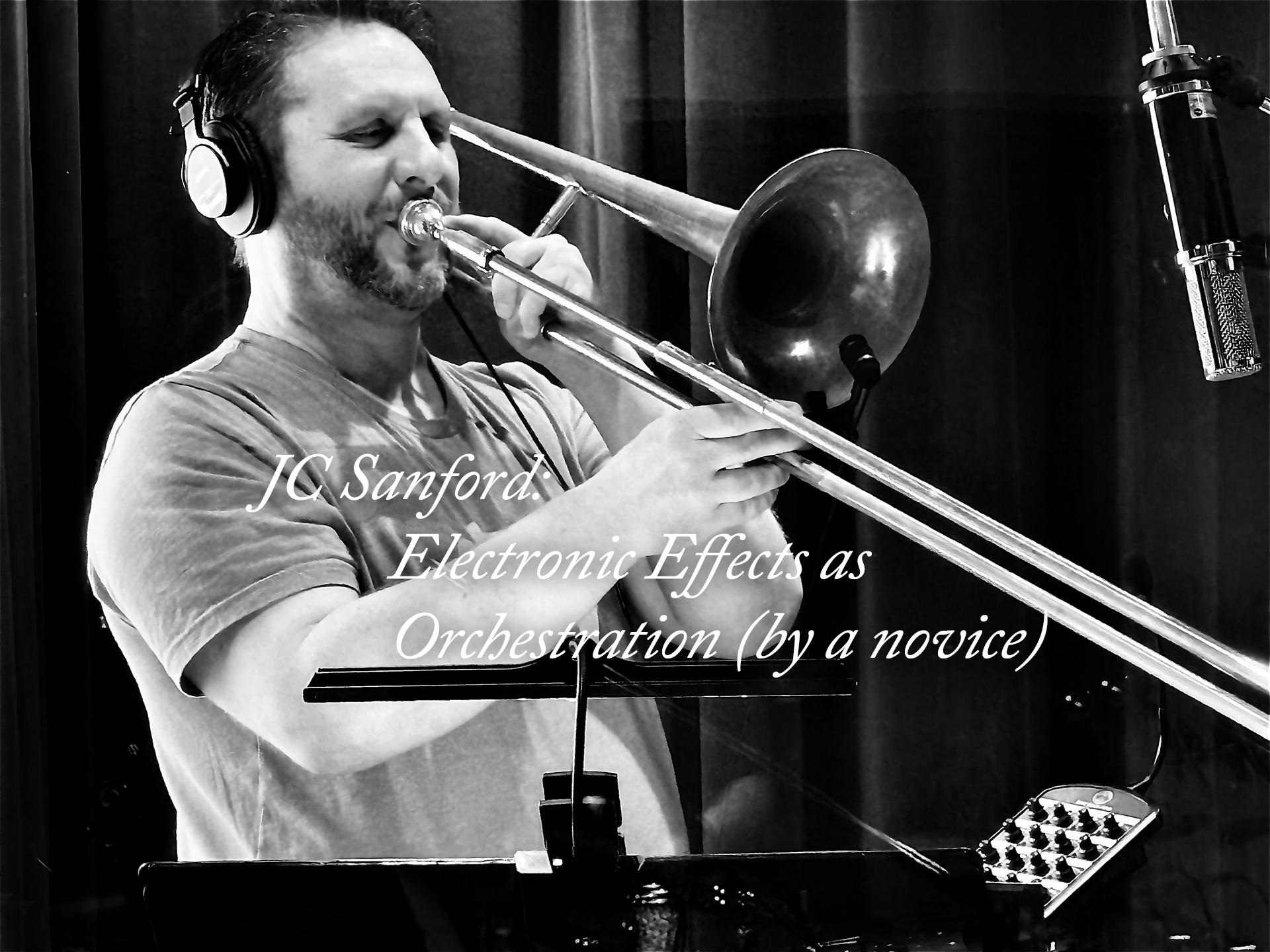
JC Sanford: Electronic Effects as Orchestration (by a novice)

Editor’s note:

At various times throughout my tenure as ISJAC blog curator, and scheduled blogging artist fell through late in the game for any number of reasons, so in that case I would often step in to supply a blog for that month. It’s perhaps poetic that for my penultimate curated blog, I am once more in this position. I promise I did not conspire to do this at a time that coincided with the release of my new album, but here you go.

During the pandemic, I, like most of you, was trying to investigate ways I might move forward as an artist once we would all be able to play music together again. For me, part of this came out of regularly playing informally with some friends in my little town of Northfield, Minnesota. Both of these guys had very different musical training than me, but they had an understanding of the electronic side of things that I had never investigated. So in our collective improvisations, I started to experiment with a delay/loop pedal. Now I’ve heard countless horn players utilizing electronics over the years, none more notable to me than one of my most important improvisational influences, trombonist Hal Crook. But I had long resisted going down the pedal rabbit hole, partially because of expense, but also I thought I had enough to focus on as a trombonist/composer/bandleader/etc., that I just didn’t see it as practical to add another dimension to what I was doing musically. But this new sonic experience and the feedback I started to receive when using this new technique on live gigs awakened an interest I had long avoided.

When I began to explore these electronic possibilities more deeply, I was concerned I was kind of a poser with so many experienced guitarists (and horn players) having a greater understanding of what was available and how it works. It was also important to me not to have my inexperienced use of these pedals feel like a gimmick, but rather an extension of my musical language. So I started off breaking in my initial set of electronics in mostly improvisational settings where I could really experiment with colors and layering. I eventually gained enough control of my equipment to also begin to use it while playing over jazz standards. But I felt like it was time to begin to utilize these tools in a more directed way. Out of that grew my new group EQ (Electric Quartet), which, in addition to myself on trombone and effects, included effects-monster guitarist (Toivo Hannigan) and electric bass specificalist (Erik Fratzke). This put me in the right sonic environment, but writing music for this specific ensemble forced me to think about orchestration in a different way.

I have long had an interest in orchestrational investigations via non-standard ensemble instrumentation, both in small and large group settings. While I was a grad student at New England Conservatory, I started a trio with myself on trombone plus two saxophonists called Triocracy, which had several iterations over the years depending on my residence of the time, but is represented most recently on the album Pyramid Scheme. This group was initially formed largely out of the frustration that my favorite rhythm section players in Boston at the time were rarely available, but it yielded some really interesting compositional and arranging results that wouldn’t have existed if I had been able to employ a more traditional horns-with-rhythm-section band. More recently in 2023, I released an album with pianist Michael Cain and bassist Anthony Cox (no drums) called New Past, another assemblage of instruments that I would think would not be considered the most common.

But probably some of my most notable orchestrational adventures occurred in a large ensemble setting. Like many modern jazz big band composer-arrangers, I took full advantage of both woodwind and brass doubles, especially once I had access to players with a vast number of instruments available to them in NYC. But my affiliation with the composers federation Pulse (with Joseph C. Phillips, Jr., Darcy James Argue, Joshua Shneider, and others) and our projects that featured a variety of mixed chamber ensembles really opened my ears to what I wanted to do with my own ensemble. So I shifted my more “traditional” jazz orchestra to a 15-piece hybrid jazz band/chamber orchestra to fulfill more of my orchestrational desires.

I think this demonstrates how I had really thought about orchestrational options through contrasting/complementary instrumental timbres, but using electronic effects as orchestration was a new way of thinking. I wanted to see how I could use these new colors in a pre-determined context in addition to the improvisational experimentations I had been doing, and how I might combine those effects with some of my own compositional philosophies and techniques.

The first track “ausgleicht” (loosely meaning “balanced” in German) is a good example of how I planned out what my effects could do color-wise, and how that orchestrational concept combined with my compositional one. I have written a number of pieces that contain a clear duality to them in one way or another, like two contrasting sections, characters, moods, etc. (Your Word Alone is a prime example), so I thought I would try and add another dimension of timbral duality to the mix, as well.

It begins with a rocking-out mixed meter ostinato played by the rhythm section, while I use a chorus-effected sustained sound above that, soon adding a perfect 4th above with one of my harmonizer pedals.

Click to view full size score.

After this initial statement, the band tune changes character by metrically modulating to a flowing 12/8. At that point, my sound also shifts character by switching to a more “acoustic” sound, which creates a notable contrast.

Click to view full score.

This alternation of color and groove characters carries on through the track, until a final statement of the melody, where I superimpose the initial 12/8 “head” material over the mixed-meter ostinato. To add to the intensity here, I add not one 4th, but two stacked 4ths above, creating a much thicker texture, really building the intensity in a climactic moment. Again, this is a decision I could not have made without the particular equipment I have, which includes two separate harmonizer pedals.

Click to view full score

Here’s the full track if you’d like to hear it all in context.

I took a different approach when conceiving of my arrangement of Stevie Wonder’s “Love’s in Need of Love Today,” again being inspired by the “forces” available to me. I’ve always loved how many Stevie tunes, particularly this one, would vamp the ending for extended periods of time, almost uncomfortably so. So I wanted to see if I could capture that vibe, even without having my own backup singers. So after a solo opening colored by a delay effect, I used the combination of the diatonic triad function of my harmonizer pedal (it’s great to have my own personal horn section available at the push of a button!) and my loop pedal to try and capture that mood so that I could then improvise over the top of that repeating chorus. I added an additional octave with my second harmonizer to try and emulate Stevie’s soaring improvisational descants while we eventually blend into a more introspective and questioning ending.


Again, here’s the full track:

Bottom line: I still feel like a novice with all this stuff and that I’m just scratching the surface of my understanding of what’s possible. And clearly nothing I’m doing with these effects is novel or innovative in any way. Did I violate some rule by jumping in so uniformed and inexperienced? My belief is no, since I really feel like I’ve approached this new world honestly and authentically (and I know I don’t know what I don’t know). But I do plan to keep heading down this road as I investigate more sonic possibilities. And I intend to follow the advice my great mentor Bob Brookmeyer gave to another of my great mentors Jim McNeely: “Write another one.” So I’ll continue to see where that leads.


https://jcsanford.bandcamp.com/album/denki


About the Author:

JC Sanford has been recognized in the DownBeat Magazine Critic’s Poll over the past ten years, in the trombone, big band and arranger categories. While he originally built a reputation through big band writing, Sanford has forayed into many other areas, including composing for solo piano, wind and brass formations, and various mixed chamber ensembles, and often his original works defy labels such as “jazz” or “classical”. A founding member of the composers’ federation Pulse (with Darcy James Argue and Joseph C. Phillips, Jr.), Sanford was a member of the BMI Jazz Composer’s Workshop led by Jim McNeely and Mike Abene for five years. His works have been performed by John Abercrombie, Lew Soloff, Dave Liebman, Danilo Perez, and a number of universities and high schools across the United States.

His 2014 debut recording with the JC Sanford Orchestra entitled Views From The Inside yielded international acclaim and was awarded a 2014 Aaron Copland Fund Recording Grant alongside organizations and ensembles such as the Seattle Symphony, Nonesuch Records, and American Composers Forum. He is also the leader of several small groups: the JC Sanford Quartet, the Imminent Standards Trio, the chamber jazz trio Triocracy, the New Past Trio with pianist Michael Cain and bassist Anthony Cox, and EQ (Electric Quartet).

Sanford is in high demand as a conductor of new original music. He conducts the Grammy-nominated John Hollenbeck Large Ensemble, the Alan Ferber Nonet with Strings, the Frank Carlberg Large Ensemble, and the Alice Coltrane Orchestra, featuring Ravi Coltrane and Jack DeJohnette. He recently was guest conductor for the North German Radio Big Band (NDR), and Quinsin Nachoff’s new “Patterns in Nature” multimedia project. He was also the curator for the “Size Matters” large ensemble series in Brooklyn for four and a half years.

Since returning to Minnesota with his family in 2016, Sanford has performed as a trombonist in the Twin Cities area with JT Bates, Chris Bates, Davu Seru, Anthony Cox, Babatunde Lea, Zacc Harris, Dave Hagedorn, and Laura Caviani. In 2017, he co-founded the Twin Cities Jazz Composers’ Workshop alongside his wife, Asuka Kakitani. Sanford received a 2018 McKnight Composer Fellowship, a 2019 MN State Arts Board Artist Initiative Grant to record his quartet, 2021 and 2022 Creative Support Grants to record his Imminent Standards Trio, and another in 2023 to record his NEW PAST Trio with Michael Cain and Anthony Cox, and another to record his electric quartet (EQ) in 2025 featuring drummer Satoshi Takeishi. He is currently teaching jazz, Western music theory, and composition courses at Gustavus Adolphus College.

JC Sanford is a fiscal year 2025 recipient of a Creative Support for Individuals grant from the Minnesota State Arts Board. This activity is made possible by the voters of Minnesota through a grant from the Minnesota State Arts Board, thanks to a legislative appropriation from the arts and cultural heritage fund.

Header photo by Asuka Kakitani; Bio photo by Bryan Murray.