You must be a member to view this content.
Jason Palmer reflects on his path to developing his craft as a jazz composer, how it interfaces with improvisation, and some practicalities of performing original music.
Like most avid music listeners, music moves me in deeply visceral ways. Listening to music for me is just as physical an experience as it is intellectual, if not more so. The vibrations of Coltrane’s saxophone, the deep grooves of a Brazilian samba band, the emotional expressiveness of a perfectly delivered lyric, the tension, release and drama of a perfectly developed Maria Schneider arrangement, or the resonance of an expertly crafted Gil Evans orchestration, are just a few examples of how very real and measurable aspects of music making can emotionally and physically alter the music listener. Of course, most serious music listeners and musicians are aware of this kind of visceral musical power, however, it has been my experience that many people avoid making the kind of analytical observations mentioned above, perhaps in fear of ruining the musical “magic”.
As I delve deeper and deeper into the world of music creation which includes composition, improvisation, arranging, orchestration, post-production, and performing, I have found it enormously helpful to try and identify specific traits of the music that has profoundly moved me in an attempt to understand how that musical power operates. Why does Jimmy Cobb’s ride pattern FEEL so good and how does it differ from the ordinary ride pattern of aspiring jazz students? Why does Duke Ellington’s music elicit so much excitement and maintain the focus of the listener? Why does the voice of Milton Nascimento almost bring me to tears? I don’t pretend to have all the answers but I have found this process of musical interrogation to be incredibly inspiring and fruitful in my creative process, and l hope to inspire others to perhaps dig a little deeper and listen more carefully and thoughtfully to the music they love.
To that end, I’ve compiled a short list of songs or albums that have moved me in deep and meaningful ways over the past two years, highlighting some of the traits that I found to be creatively inspiring. The result can be heard on our new full-length album, “The Hope I Hold”, featuring the indie jazz ensemble, Catharsis, just released on Greenleaf Music last week.
Querteto Novo
Every single musician around the world should know this album by heart. It is, in my opinion (and many other Brazilians’) one of the most important genre defining albums of 20th century popular music. On a short list that would include Louis Armstrong’s “Hot Fives and Hot Sevens”, Miles Davis “Kind of Blue”, The Beatles’ “White Album”, Joni Mitchell’s “Blue”, Jimi Hendrix’s “Electric Ladyland”, etc… The music is drawn from the rich folkloric tradition of Brazil, and in particular the African and indigenous influenced music of Northern Brazil, and combines it with jazz in the hands of some of the greatest Brazilian musicians of that time. Two of those musicians, Hermeto Pascoal and Airto Moreira, would go on to make huge contributions to both Brazilian and American music. The album is widely regarded to have helped spawn the genre of Musica Popular Brasileira, or MPB, which has completely changed my life after falling in love with the genre in recent years.
Charles Mingus’ “Reincarnation of a Love Bird”
I might be preaching to the choir with this choice but, of all the great Mingus compositions out there to learn from, this composition is, in my mind, in its own special category. Talk about songwriting genius! Every detail of this extended composition (the tune itself is over 60 measures long!) is so uniquely thoughtful that just when you think you’ve figured out where the song is headed it makes an unexpected turn, constantly challenging the listener to follow along and in return provides such a rewarding listen. From a technical standpoint, this composition sets the gold standard for perfect thematic development on every level – melodic, harmonic and rhythmic. The arrangement changes tempos, meters, etc… in typical Mingus fashion but still feels so natural. The original recording features one of the more inspiring introductions I know of. The tune epitomizes the way in which Mingus pushes me to avoid the road most travelled as a composer and to always search for the best possible songwriting decision at each and every turn. Finally, the song is a great example of what the best jazz should be and almost always is – challenging to play yet so rewarding when done so at the highest level. I wish more current jazz music followed these maxims.
Antonio Loureiro’s album Livre
My good friend and colleague, John Ellis, introduced me to Antonio’s music while touring with Catharsis earlier this year. (side note: I’m not sure there is any better place to discover music than while touring with your favorite musicians!!). Some of you might know Antonio from the work he does playing drums in Kurt Rosenwinkel’s Caimi Brazilian project. However, Antonio is also an unbelievable keyboardist, beautiful vocalist, and absolute genius songwriter and producer. I have not listened to a recording more than I’ve listened to Livre in a very long time. He calls his music Brazilian pop, but to me it sounds like all the things great modern jazz can be in 2019 – sophisticated yet rewarding songs played by virtuosic musicians striving to make the most beautiful music possible. The opening track, “Meu Filho Nasceu!”, a song Antonio wrote dedicated to the birth of his child, gives me goose bumps every time I listen (even after months of daily listening!). The harmony is so fresh yet deeply rooted in the songwriting traditions of jazz and Brazilian music a la Milton Nascimento, Toninho Horta, Hermeto Pascoal, etc… and the arrangement and production of the track is genius-level good.
Milton Nascimento and Lo Borges’ album Clube da Esquina
This is the album that, along with The Beatles and Duke Ellington, completely changed the trajectory of my musical life more than any other. Technically this was a collaborative project between a number of soon-to-be major forces in the 1970’s Brazilian music scene including Lo Borges, Beto Guedes, and Toninho Horta, but the album is, for all practical purposes, a Milton Nascimento record featuring some of his most magical compositions, unbelievably virtuosic singing and guitar playing, glorious arrangements some of which include a full orchestra, and deeply poetic and insightful lyrics. I can’t imagine the minds that were blown when it came out in 1972 because, almost 50 years later, my mind and body was altered forever when I first heard it, and upon the next one thousand lessons I continue to hear new and compelling details.
JJ Johnson’s “Euro Suite #1”
JJ is, of course, known universally as the most important jazz trombonist in history, and I would whole-heartedly agree. However, what many people don’t know, or are just peripherally aware of, is that JJ was a master composer and arranger. In fact, JJ spent much of the late 60’s and 70’s living in LA composing for Hollywood and television shows including regular contributions to The Mod Squad and The Six Million Dollar Man. JJ’s composing reminds me exactly of his improvising (as it should!) – perfectly crafted to tell a compelling musical story, full of drama, yet utterly refined so as to not include any unnecessary excess or gimmickry. My favorite composition BY FAR, and something I was deeply inspired by while writing the music for our upcoming Catharsis album, “The Hope I Hold”, is his 6-minute magnum opus, “Euro Suite #1”. Actually, I recently adapted the piece for trombone choir to be performed at this year’s International Trombone Festival in Muncie, Indiana in honor of what would have been JJ’s 100th birthday. I’m told JJ”s widow will be in attendance which is SUPER exciting. This facet of JJ’s career is what has inspired me to develop my craft as a composer and arranger, in addition to instrumental performance technique, and something I return to on a regular basis.
Edu Lobo’s “Uma Vez Um Caso” from his album, Limite das Aguas
The Brazilian singer/songwriter, Edu Lobo, released the tune “Uma Vez Um Caso” in 1976, over 40 years ago, but the composition sounds categorically modern and fresh. Besides being an incredible composition (it reminds of me of Brazilian Mozart in that every detail of the recording is in its perfect place) the music also inspired me to do more singing in my own musical projects. I love the rapport he has with his female vocalist, the equally amazing Joyce, which is something that Camila Meza and I strive to do on our tune, “Campinas”.
Sami Joik Norwegian folk song tradition
– as sung by the Norwegian indie singer/songwriter, Marja Mortennson and her trio with Daniel Herskedal and Jakop Janssonn
I heard Marja and her incredible trio, all based in Norway, perform at the Katowice JazzArt Festival in Poland. I was totally oblivious to the Sami Joik folk singing tradition of northern Norway and was utterly captivated by both the tradition and its interpretation in the hands of Marja, Daniel and Jakop. The tradition, like so many folk music traditions, uses music to tell the story of the Sami people and their culture and history. However, what makes this vocal tradition unique is that it is a word-less music, relying on the expressiveness of the human voice and the power of MUSIC (music does not include lyrics in my definition) to capture the essence of important individuals, family members, etc… of the Sami people. Marja pointed out in their set that while music with words are limited to the specific verbal language used and the serious expressive limitations of that language, the Joik tradition can capture the essence and unique qualities of its subject by relying on the power of MUSIC and SOUND bypassing the limitations of verbal language.
ADDENDUM:
As you might have noticed, many of the artists on this list are part of an incredibly rich Brazilian musical tradition from the late 1960’s and 1970’s called Musica Popular Brasileira, or MPB. Below is a playlist featuring my favorite songs from the MPB genre that I discovered while falling down the rabbit hole that is Brazilian music. These songs, albums and artists have completely transformed my musical world over the past two years.

Photo by Amanda Gentile
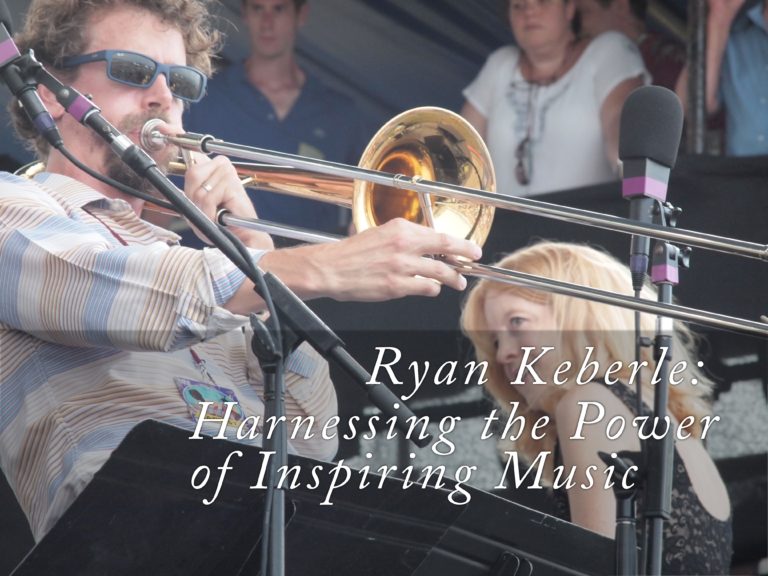
Hailed in the Downbeat International Critics Poll as #1 Rising Star trombonist, a player “of vision and composure” according to The New York Times, Ryan Keberle has developed a one-of-a-kind voice both on his instrument and as a composer, earning distinction among jazz’s most adventurous new voices. Keberle’s music integrates his wide-ranging experiences into a highly personal vernacular — immersed in jazz tradition, drawing on world music, rock and other influences, seeking fresh and original pathways. His flagship ensemble, Catharsis, has released five albums, three on Dave Douglas’s Greenleaf Music record label, to worldwide critical acclaim.
In 2017 Catharis turned its attention to political turmoil in the U.S. with the protest album Find the Common, Shine a Light, praised by The Nation as “unpretentiously intelligent and profoundly moving.”
Keberle has also worked in endlessly varied settings with musicians ranging from superstars to up-and-coming innovators, in jazz, indie rock, R&B and classical music. As a featured soloist with the Maria Schneider Orchestra, he collaborated with David Bowie on his 2015 single “Sue (Or in a Season of Crime).” He has performed extensively with the acclaimed songwriter Sufjan Stevens, with Brazilian superstar Ivan Lins, and with the Saturday Night Live house band. He has accompanied soul hit-makers Alicia Keys and Justin Timberlake as well as jazz legends Rufus Reid and Wynton Marsalis.
You must be a member to view this content.
I recently revisited a magazine article I did on arranging over 30 years ago to see how germane it is to today’s world of scoring. Surprisingly, except for the fact that musical styles and industry practices have changed drastically (in the commercial advertising world we got paid to do demos and we recorded with live musicians), the basic tenants of presenting the fundamentals of arranging haven’t changed. Here’s an abridged and slightly updated version of that article.
BASIC TOOLS FOR BETTER ARRANGING
“As a young arranger, I was always searching for some work that actually described the process involved in making orchestral arrangements.“- Glenn Miller, 1943
Well, Glenn, we’re still looking for that one text that gives us the secrets and lays it all out for us. Unfortunately, that book will never exist, because arranging is an art that evolves hand-in-hand with music composition and technology; it is changing constantly. And, since it is an art, one can’t effectively break it down into hard rules and regulations. We can, however, list and explore the various musical techniques that one might use to get a working knowledge of the field. It doesn’t matter if you use a pencil and score paper or a mouse and a notation program, the principles and techniques still apply. “Okay, La Barbera, quit talking and show us some hip voicings.” Sorry Glenn, no voicings yet. So often, the novice assumes that the secrets of arranging lie in the chord voicings used by the various greats of the art. Nothing could be further from the truth. We have to learn what arranging is before we get to any of that. Here’s my definition of arranging:
Arranging, in music, is the art of giving an existing melody musical variety for a listening audience.
The composer gives us the melody and we, as arrangers, strive to give it variety. Henry Mancini has said, “The song is the thing, and the arranger’s function is to make it memorable, regardless of one’s personal feelings.” And variety, musical variety – is what makes the song memorable. This musical variety comes from our knowledge of the tools of arranging and how to use them. An arranger is very much like a magician. After presenting a melody to an audience we try musical sleight-of-hand to keep their attention, because if the audience can predict what’s going to happen next, we lose their attention and therefore are not as successful as arrangers. We’ll list some of those tools in a little while, but first I want to explain the last part of my definition – the audience.
As arrangers (or composers or performers for that matter) we are always dealing with an audience, whether real or imaginary. If we wrote or played music just for ourselves, it would not truly be a creative art. To be successful in the musical arts, one must always acknowledge the existence of a listener and create accordingly. It’s somewhat like the old riddle of “if a tree falls on your Pro Tools Rig in the woods and there is no one around to hear it fall, does it make a sound?“ Suffice it to say that with even one set of ears around, the whole event has an impact. It becomes memorable. I believe that the success of our great arrangers is partially due to their conscious or subconscious acknowledgement of a listening audience. So, if you think about it, the arranger’s job is to take a melody/song and play it for an audience for a certain length of time without boring them. If we played the same melody over and over with the same instruments for six minutes, with the same chord changes, they’d be searching for the rotten egg emoji. We have to give it variety and make it memorable so as to keep the audience’s attention. It’s just that simple. How we keep their attention shows our talent as arrangers. If we wanted to break down my definition into rules or commandments of arranging, we’d arrive at something like the following.
Rule 1: Thou Shalt Not Bore.
Strive to give the song or melody as much variety as necessary to capture and please an audience, while at the same time keeping the integrity of the composer’s musical idea. This is such a fine line – balancing one’s arranging techniques against the intent of the composer while maintaining a stamp of individuality – that it can take a lifetime to learn to do it consistently.
Rule 2: Know Thy Place.
We must always remember that, as arrangers, we’re subservient to the melody and must write accordingly. Unlike composers, we arrangers are not allowed the luxury of personal likes and dislikes when it comes to the melody or the musical style we have to work in. Disdain for a certain style or song shows through in your musical arrangement. (The hardest job I ever had was when Count Basie asked me to arrange Rubenstein’s “Melody In F” for his band. I didn’t care for the song as a Basie-style tune, and I stared at blank score pages for weeks.) We have to divorce ourselves from our musical prejudices, listen to all kinds of music, and be prepared to cover any style with sincerity. Remember what Hank Mancini said – “regardless of one’s personal feelings.”
Rule 3: Know Thy Boss.
Remember that we are ultimately working for someone else. When we take the job of arranger, we are not working for ourselves but for an audience with a composer or producer in between. We must strive to please both but fight like hell for the audience when confronted with a choice. I tell students that if I can get five percent of John La Barbera (a creative uniqueness or stamp of identity) in a chart, I’m more than pleased. The hardest pill to swallow is when you bring your finished masterpiece to a bandleader or producer and he/she immediately cuts out the hippest interlude you’ve ever written. All of us, no matter how famous we become, must be prepared to give up our most prized musical child at the whim of the client. The best advice I ever received from any arranging book was from Mancini’s Sounds And Scores [Cherry Lane]. I underlined the last paragraph on page 1 in my copy: ” … Finally, don’t fall in love with every note you write … Be prepared to eliminate anything that tends to clutter up your score, painful as it may be to do so.” Even if you are the composer /producer and it’s your record label featuring you as the artist, the audience is still the boss. Keep that in mind and you’ll find arranging decisions much easier to make. Now then, if you’re still with me, we’ll move on.
Rule 4: Know Thy Styles.
We must be familiar with the idiom in which we intend to place the melody. In simpler terms, if you have never listened to current pop styles like R&B, or Country Blues groove, etc., then you can’t successfully arrange a melody in those styles. Or, if you’ve never heard second line, you’ll be spinning your wheels when it comes time to cover that style. So, it’s obvious that if you aren’t familiar with a style of music, you can’t competently arrange in it. That seems pretty obvious, but I’ve seen students try to arrange a big band jazz chart who have never heard of Basie or listened to Stan, Woody or Duke. So, before we can become arrangers, we have to know our musical styles and learn what instruments, rhythms, and harmonies are basic to each idiom.
Now, let’s get down to the nuts and bolts of arranging by listing some of our tools and putting them in an arranging road case. These are what I call the five basic variations used in arranging, and we’ll get our roadie to pull them out one at a time and illustrate how each of them works. The devices in each category are just a starting point. I’m sure you’ll have your own ideas so add those as necessary.
RHYTHMIC VARIATION
1. Change the rhythm of the melody. Of course, no brainer.
2. Change the rhythmic feel; double time, half time etc.
3. Gradually speed up or slow down the tempo.
4 .Refrain from using one rhythm for any length of time.
5. Displace the melody relative to the bar line by a uniform value.
6. Change the meter 4/4 to 3/4. (My arrangement of “So What” is a good illustration)
Slightly varying the rhythm gives new life to the melody however, this is effective ONLY after you’ve stated the original.
The audience needs a reference before it recognizes a variation. I believe this is true for all of the variations we incorporate.
It’s been a common practice for years to go to double time for the blowing on a ballad and then back to the original tempo to take it out. Gradually speeding up and slowing down is a great device (Brad Mehldau and other groups have used this very effectively) but it takes some rehearsing.
Changing the meter is a great way to add variety. My arrangement of “So What” is a good illustration.
Then imply 4/4 and eventually get there.
The next tool in our road case is
HARMONIC VARIATION
1. Substitute chord changes (reharmonization).
2. Change melodic modes (major to minor).
3. Use counterpoint to imply new harmonies.
4. Modulate to new keys, either subtly or drastically.
Every melody comes with its own harmony or set of chord changes, whether given or implied. If we change the harmony after our audience has heard and absorbed the original chord changes, we automatically create variety. So, the use of substitute chord changes, or reharmonization, is one device in the harmonic category. Another secret that seasoned writers share is that a new device introduced into the chart has effect, but the more devices or variations you add to a chart at the same time, the less impact each will have (i.e. modulating and using a substitute change for the new target key down beat…softens the impact). Keep this in mind when you are tempted to empty the whole road case of tools into the same section of a melody. As with all devices in arranging, we must remember that we are working for the song. Anything we add has to support the melody and not overpower it. I find that harmonic variation is the one tool that’s most overused by arrangers and is an area where we can get into the most trouble. Hip changes, used for the sake of being hip, rarely fit comfortably into a well-balanced chart.
Now that we have two arranging tools at our disposal. Let’s go on to another. I call the next device:
PERFORMANCE VARIATION
1. Vary the articulations of the melody.
2. Vary the dynamics of a phrase or section.
3 .Use ornaments, such as trills, turns, and grace notes.
4. Use pitch-bend or modulation.
5. Take advantage of the basic instrument mutes (plungers, straight mutes, hats, etc.) and combinations thereof (plunger wa-wa over straight mute, bucket over straight, cup in bucket, etc.).
6. Use effects that are unique to individual instruments, such as half valves, squeaks, flutter tongue, sub tone, etc.
Performance variations encompass quite a few items that we don’t always think of when doing an arrangement and, to me, is one of the most important tools we can use. I believe it’s what’s above & below the notes that make music and the uniqueness of an arrangement.
These are the performance techniques are the one uses when playing music – articulations (long, short, etc.), ornaments (turns, trills, shakes, flips, pitch-bend, vibrato, etc.), and dynamics (crescendo, decrescendo, subito p, sforzando, etc.). Using any of these performance devices in your arrangement is a sign of a seasoned writer. Just as an orchestra conductor studies all of the nuances of string bowing techniques, we must be familiar with all of the unique sounds and variances of each instrument in the band.
Mixtures of muted and open instruments is a wonderful way to add variety to an already stated melody…it adds color and the repetition of the melody is acceptable to an audience. The hat or derby is probably one of the most versatile mutes for brass but it has fallen out of favor these days. Muted brass in buckets produce wonderful colors. Look how a bone deep in the hat coupled with alto and trumpet creates a life like French horn sound at the end of the shout chorus.
Also, like Basie, using cresendi, subito p, and back and forth adds so much variety to the passage.
Here’s a link to the entire chart in case you want to check it out.
https://www.youtube.com/watch?v=rZIA_zYlF_0
“What about chord voicings , aren’t you ever going to get to chord voicings like clarinet lead over two altos and two tenors?”
Sorry, Glenn, not yet. But that brings up an interesting point. People tend to interchange orchestration and voicing. They use the term voicing when they really mean orchestration and vice-versa. It’s very important to understand the difference.
When beginning students come to me with questions about arranging, the first thing they usually say is something like, “I’ve been working on this chart and I want to use this sax voicing but I’m not sure if it will sound.” Or, “Will this half step between the cellos and violas work?” This aspect of arranging, the voicing and orchestrating of chords , is just another tool in the art, but it always seems to attract the most attention. I guess it’s like a slick paint job on a Porsche – the most important parts are under the hood, but the paint job gets the attention, So, let’s clear this up right now. Voicing is the putting together of chords in a certain way, with the notes stacked in a certain order. Orchestration is simply what instruments are assigned to play the notes you included in the voicing.
VOICING
1. Close.
2. Open.
3. Cluster.
4. Unisons & Octaves.
Let’s talk about voicings. We all should know the difference between a closed voicing and an open voicing, a cluster and an octave unison. Voicing techniques, especially in jazz, are usually the individuality stamp of the arranger. I would voice and orchestrate a certain passage differently from my colleagues. If we’ve listened enough to any idiom we can probably pick out the individual arrangers by their style and voicing techniques. Traditionally, a composer/arranger would give a sketch of his or her work to an orchestrator, who, in turn, would use standard rules for assigning the different musical lines and chords to conventional bodies of instruments. In today’s music, there are so many new instruments, recording techniques, and consolidations of music styles that there are fewer and fewer standard rules of orchestration. So what was once a separate trade has now become an additional, necessary skill of the arranger.
To recap, the voicing is the type of chord structure (unison, close, open, octave, unison, cluster, etc.) and the orchestration is the body of instruments assigned to play the voicing. Orchestration and voicing allow us to create unique sounds or musical colors by combining different instruments. If we think of voicing and orchestration as two separate entities, it will be much easier to understand our job as arrangers.
On top of the endless possibilities and permutations of traditional acoustic instruments, we now have to contend with the modern instruments (world instruments, synths, samples, etc.). These new instruments are a challenge in themselves, and the combining of acoustic and electronic instruments gives us further combinations with which to achieve unique musical colors. We can truly spend a lifetime experimenting with voicing and orchestration, but it shouldn’t take the beginning arranger that long to find those combinations that fit and seem comfortable with his or her writing techniques. These combinations go toward making up an arranger’s style. For example, Nelson Riddle’s harmonic variation use of Lydian motifs identifies his work just as Gil Evans’ and Duke Ellington’s unique orchestration of their voicings identify their work.
Simply changing a line from unison to octaves gives it an entirely new character and an audience will accept the same backgrounds and chord changes. Here’s an example using my arrangement of “Esperanza.”
Here’s a link to full video of the chart in case you want to check it out.
https://www.youtube.com/watch?v=UHN0FEgQRRY
There is one more device – melodic variation.
“Hey, that’s the composer’s job!”
Yes Glenn, sort of. Melodic variation, this last piece of essential equipment, is composition. The composer rarely gives us intros or endings. The arranger is usually expected to furnish those. We arrangers are also required to compose counterlines, interludes, and background melodies as well, in order to give existing material variety. Here are some thoughts worth pondering:
“Arranging, after all, is a euphemism,” according to Alex Wilder, “For it includes composition as well as orchestration. The introductions, countermelodies, transitions, and reharmonizing are all more than just orchestration. But by using the word arrangement, they get two skills for the price of one.”
“The true art of orchestration,” Walter Piston declared ,”is inseparable from the creative act of composing music.”
And from Nelson Riddle: “An arranger occupies, in music, that shifting, almost indefinable ground between an orchestrator and composer.”
MELODIC VARIATION
1. Creating and using countermelodies against melody.
2. Variation of melody or fragment of melody used for interludes between sections.
3. Introductions and endings based on newly created material.
It’s undeniable that arrangers must wear many hats in today’s music industry and must function sometimes as composers and orchestrators. That’s why arranging is not a hack trade but an art that takes years to perfect. So if you get discouraged because it doesn’t come to you right away, or, if after years of arranging, you still seem to get stuck, don’t worry; join the club.

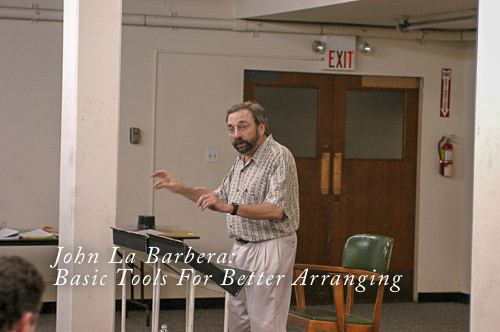
John P. La Barbera is a Grammy® nominated composer/arranger whose writing spans many styles and genres. His works have been recorded and performed by Buddy Rich, Woody Herman, Count Basie, Dizzy Gillespie, Mel Torme, Chaka Khan, Harry James, Bill Watrous, and Phil Woods just to name a few. Though his major output has been in jazz, he has had works performed and recorded for symphony orchestra, string chamber orchestra, brass quintet, and other diverse ensembles. Most recently, Mr. La Barbera was chosen from among dozens of applicants to participate in the Jazz Composers Orchestra Institute at UCLA. As a result, John was one of sixteen composers commissioned by the JCOI to compose new works that meld jazz and symphonic music. “Morro da Babilonia” was the resulting work and was presented by the American Composers Orchestra in New York City at Columbia University’s Miller Hall. His “Drover Trilogy” for string orchestra and corno da caccia was recorded by the late Dr. Michael Tunnell and has recently been released on Centaur Records. John’s Grammy® nominated big band CD “On The Wild Side“ along with “Fantazm“ and his latest “Caravan” on the Jazz Compass® label, have been met with tremendous artistic and commercial success and are on the way to becoming a jazz big band standards. As co-producer and arranger for The Glenn Miller Orchestra Christmas recordings (In The Christmas Mood I & II) John has received Gold & Platinum Records and his arrangement of “Jingle Bells” from those recordings can be heard in the Academy Award winning film “La La Land.” Mr. La Barbera is a Professor Emeritus of Music at the University of Louisville’s School of Music and an international clinician/lecturer whose topics range from composing/arranging to intellectual property and copyright. Among his numerous organizational affiliations are Jazz Education Network, Phi Mu Alpha Sinfonia, NARAS, American Composers Forum, Chamber Music America, and a writer/publisher member of ASCAP since 1971.
John’s Sunday morning big band jazz radio show, “Best Coast Jazz” on WFPK has been a mainstay on public radio for over twenty years and is streamed worldwide. He is a two-time recipient of The National Endowment for The Arts award for Jazz Composition and has served as a panelist for the NEA in the music category. His career has recently been profiled in “Bebop, Swing and Bella Musica: Jazz and the Italian American Experience” and in dozens of publications and encyclopedias. John’s published works are considered standards in the field of jazz education.
Most of us spend our time studying the art of composition and arranging with the ultimate goal of writing for professional bands, either our own groups, top level university groups, military jazz ensembles and the like. Writing for groups likes these allows us to write challenging music, replete with woodwind doubles, all kinds of mutes, odd meters, no seriously limiting range constraints or technical considerations and the possibility of highly complex changes to improvise over. While these pieces can be published and sold off of our own websites or possibly through existing publishers, if they are willing to take on pro level material, there is also a world out there of elementary, junior high and high school jazz bands who also desperately need to be exposed to good literature. There are certainly many age-appropriate well-written pieces out there already, but I’m writing this in the hopes of encouraging more professional composers, especially younger ones, to think about taking on the challenge of writing unique and compelling music for developing players that may provide them inspiration to continue on in this music.
I have been fortunate to get opportunities to write for younger groups and can attest to the fact that it is extremely difficult to do well. I can write a bad arrangement of a video game tune with the best of them but to expose students to jazz standards or interesting original compositions that they will enjoy playing and that are written in an appropriate manner for them is a whole ‘nother ball game. When I speak at education conferences on the subject of the selection of good primary or secondary school jazz ensemble material I cite these following considerations:
While many of these categories also apply to professional level writing, the consequences of not adhering to these limitations for younger players will render the chart unplayable, not merely unsatisfying or disappointing.
So the trick then becomes to maintain as high a level of harmonic and rhythmic sophistication possible while still keeping it playable. I firmly believe that you can still add alterations to your voicings or have an interesting progression; you just have to create individual lines for the players that are technically manageable, range-appropriate and that voice lead well.
One of the composers that I most admire for his ability to write interesting and fun music that never sounds “dumbed down” is the late, great Fred Sturm. I have used two of his pieces in presentations to show how the goals mentioned above can be achieved:“Song of The Rainforest” and “Another Step Towards The Blues”.
I’m including the front page of the Rainforest score here as it includes background on the derivation of the piece as well as important information to help beginning students start improvising on the piece, with relevant scales and rhythmic ideas. The use of pentatonic scales here is brilliant as it is appropriate for the genre and gives the beginning improvisers less notes to contend with:
I am also including a score page that shows the instrumental writing as well as a concert reduction of the section – the parts are simple to play but when put together sound beautiful. Figures repeat so that the students can lock into the basic rhythmic patterns but he doesn’t shy away from having an occasional second between voices in order to have interesting voicings, especially when it provides some good tension and release.
He also has included auxiliary percussion parts which allows directors to involve more students.
This piece is playable by an advanced elementary group or middle school band but could be played by a developing high school group without sounding inappropriate, which is a mark of a really well-crafted composition and arrangement.
Looking at a slightly more difficult piece, and taking a page from “Car Talk’s” Shameless Commerce Division, I’ll include one of my own pieces here, “Point, Counterpoint” (commissioned by the Minnesota Band Director’s Association) and published by Doug Beach Music:
My goal was to write a swinging chart that had good lines for each section that were often contrapuntal in nature, in an effort to engage the students’ ears in a slightly different way than the vertical orchestrations that typically get used for younger players. The sax line is established over the swing ride pattern (the implied progression is a minor blues but no bass to start) and then repeats itself with a few trumpets added as the trombone counterpoint comes in. In the third chorus the top trumpets come in playing a paraphrase of the sax melody with the saxes and trombones answering in the spaces. The rhythm section is in at this point and I wrote out all the bass lines taking care to have half notes mixed in for younger hands that tire more easily and chord symbols above so that the pianists, bassists and guitarists understand how what they are playing reflects the progression and so that at some point when they are confronted with just chord symbols and slashes they may be able to recall some of the types of chords and voicings they played before.
There is a short ensemble shout that acts as a send-off to the solos and scales are included on the parts in addition to written out solos that the publisher asked to have. To show an example of 8 bars where the individual parts are very playable but the complete sound involves quartal harmony, altered dominant chords and poly chords I have included a score page from part of the ensemble choruses about ¾ of the way through the chart as well as a concert reduction. Each section sounds good unto itself (a lesson I learned from my teacher and mentor Rayburn Wright, among many others!) and the whole ensemble sounds pretty hip (if I do say so myself) once the players have mastered the individual notes.
While pieces for younger bands generally need to be shorter than the magnus opi we generally write when given the license to do so (think 4 or 5 minutes max for junior high, maybe 6 for high school) that is part of the challenge. I frequently find that I have to edit myself, chopping out that 2nd or 3rd chorus of shout, for example, or that extended intro with all the cool extra bars in the phrases, but that the piece is always stronger in so doing. (Note to self – perhaps I should be doing that more in my other writing as well…). I think we are all guilty of being self-indulgent with our composing and arranging from time to time and writing for younger groups is a great cure for that!
You never know how a piece you write may light a fire under a budding jazz player OR budding jazz composer. Holding ourselves to the highest standards possible when writing for younger groups can help their ears develop, provide them with a better understanding of jazz harmony, improve their improvisation skills and hopefully even inspire them to start writing themselves.
I encourage everyone to take a crack at this if you haven’t already – reach out to a local school and ask if you can write something for them. This can even develop into a commissioning situation, which, as we all know, is all to the good! I am certainly grateful to the Illinois Music Educators, Minnesota Band Directors and the various schools that have asked me for charts and have learned more every time I have taken one on.
Sensible Ranges:

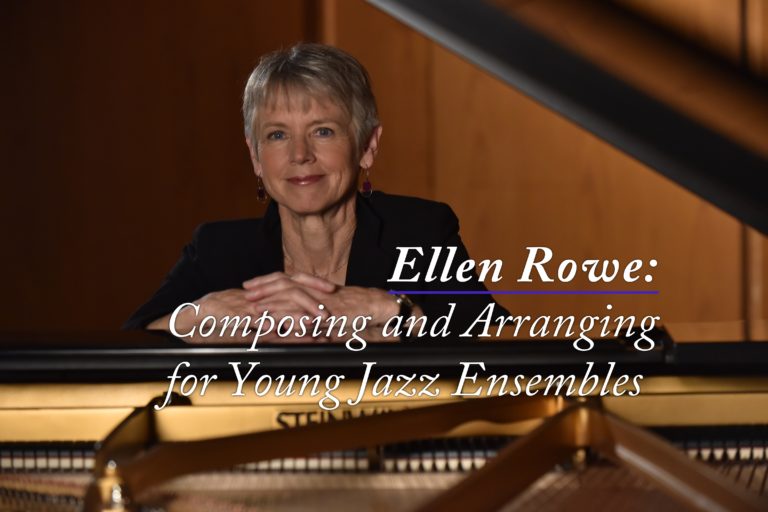
Ellen Rowe, jazz pianist and composer, is currently Arthur F. Thurnau Professor of Jazz and Contemporary Improvisation at the University of Michigan. She is a graduate of the Eastman School of Music, where she studied with Rayburn Wright and Bill Dobbins. Prior to her appointment in Michigan, she served as Director of Jazz Studies at the University of Connecticut.
Ms. Rowe has performed at jazz clubs and on concert series throughout the U.S., as well as touring in Germany, Holland, Switzerland, Ireland, Poland, South Africa and Australia. CDs out under her own name include “Sylvan Way”, “Wishing Well”, “Denali Pass” and “Courage Music.” Her latest project, “Momentum – Portraits of Women In Motion”, featuring Ingrid Jensen, Tia Fuller, Marion Hayden and Allison Miller will be released in the winter of 2018. Also active as a clinician, she has given workshops and master classes at the Melbourne Conservatory, Hochshule fur Musik in Cologne, Grieg Academy in Bergen and the Royal Academy of Music in London, in addition to many appearances as a guest artist at festivals and Universities around the country.
When not leading her own trio, quartet or quintet, she is in demand as a sideman, having performed with a wide variety of jazz artists including Kenny Wheeler, Tim Ries, Tom Harrell, John Clayton, Ingrid Jensen and Steve Turre. She was also a guest on two installments of Marian McPartland’s “Piano Jazz” on National Public Radio.
Ms. Rowe’s compositions and arrangements have been performed and recorded by jazz ensembles and orchestras around the world, including the Village Vanguard Orchestra, BBC Jazz Orchestra, U.S. Navy Commodores, Berlin and NDR Radio Jazz Orchestras, London Symphony, DIVA and the Perth Jazz Orchestra. Many of these works can be heard on recordings including “Leave It To DIVA”, “The Perth Jazz Orchestra”, “Bingo” (The Bird of Paradise Orchestra) and “I Believe In You” (DIVA). She has recently been a composer-in-residence at the Eastman School of Music and the University of Wisconsin at Madison. A recipient of jazz ensemble commissions from the Minnesota Band Directors Association, Belleville (MI) High School, Illinois Music Educators and Lawrence University’s Fred Sturm Jazz Festival, her big band compositions are currently published by Sierra Music Publications, Doug Beach Music and Kendor Music.
Having been selected to conduct the NAfME All-Eastern and All-Northwest Jazz Ensembles as well as All-State jazz ensembles throughout the country, she has also been an invited clinician at the National Association for Music Education Eastern Division Convention, International Society for Jazz Composition and Arranging Symposium and Jazz Education Network conferences. She is on the Board of the International Society of Jazz Arrangers and Composers and also serves as the Coordinator for the JEN Sisters In Jazz Collegiate Combo Competition. Her quintet has performed at the San Jose Jazz Festival, Jazz Education Network Conference, Michigan Jazz Festival, Detroit International Jazz Festival and in jazz clubs around the country. Other activities include serving as an adjudicator and mentor for the JEN Young Composers Showcase, adjudicating the 2019 Kimmel Center Jazz Residencies and Lincoln Center Ertegun Hall of Fame. She also serves on the faculty of the NJPAC All-Female Jazz Residency in Newark, NJ. In 2017 she was named a UCROSS Composer Fellow and awarded a residency at the Leighton Artist Colony at the Banff Centre for the Arts.
You must be a member to view this content.
I grew up in a house full of love of melody. My mother was an accomplished pianist, performing everything from Chopin to cowboy tunes, and I was pushed through piano lessons that were full of the works of classical composing masters. My sister Ingrid was always interpreting melodies on the trumpet, and my oldest sister Janet was consistently keeping us in check of the current Top 40 hits on the radio, all full of melody. These are all scenes that added to my character development as a musician. Once I switched to saxophone I started playing in the school big band, where I aspired to play like Phil Woods and Cannonball Adderley as a soloist. They really knew how to project their gorgeous sounds through phrases full of melody.
Through my university studies, I was pushed to be the best player possible, and was given the tools to improvise by understanding concepts of jazz harmony. The lights went on once I really applied myself to voice leading between each vertical harmonic movement. It was so exciting to hear rich harmony connect through close relationships in jazz, and a bonus seeing it move on the piano. My ears opened up, shooting me into the world of composition. If I were to sum up my life as a musician, I am constantly intertwining the act of composition and improvisation, with composition being improvisation slowed down, and improvisation being composition sped up at lightning speed. Masters of improvisation always humble and inspire me for this reason.
All jazz composers that I have really researched have developed their own process. I hope I can share a bit of mine here. I am only scratching the surface on elements that I try to apply in my process of creating a new story.
Some starting notes about character development in my approach to composition:
I have included an excerpt of Red Cedar, from my recording Treelines. This is an example of my melody in full character development, with 2-part counterpoint at letter B (melody and bass line), and Three-part counterpoint at letter C (melody, supporting melody line, and bass line).
Here are my top three composition book desert island picks that I love to go to because of their content that contains insight into the process of the jazz composer:
(Excerpt: 1:18-2:23)
Score: Click here to see the score
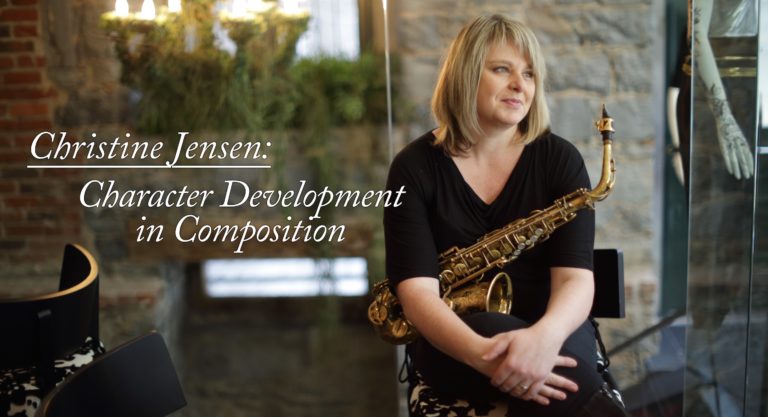
Montreal-based saxophonist, composer and conductor Christine Jensen has been described as an original voice on the international jazz scene, while being regarded as one of Canada’s most compelling composers. She is a recent winner of the Downbeat Critic’s Poll for Rising Star Big Band, Arranger, and Soprano Saxophonist, as well as being a recipient of the Montreal International Jazz Festival’s 2017 Oscar Peterson Prize. She currently leads her own jazz orchestra as well as other diverse ensemble projects featuring her saxophone playing. “Jensen writes in three dimensions, with a quiet kind of authority that makes the many elements cohere. Wayne Shorter, Maria Schneider and Kenny Wheeler come to mind.” –Downbeat.
Jensen has won two Canadian Juno Awards for her recordings with her jazz orchestra, including Habitat (2014) and Treelines (2011). Four of her albums have been nominated for jazz album of the year with Quebec’s ADISQ awards. Habitat received five stars in Downbeat, along with being included at the top of several international critic’s polls, including Jazz Album of the Year in 2014. She was also profiled on NPR’s All Things Considered for her work with Habitat. She has topped 2014 critic’s polls for Album of the Year with CBC, Downbeat, NPR, Ottawa Citizen, and JazzTimes. A two-time recipient of the Hagood Hardy Prize for jazz from SOCAN, she has also received two Quebec Opus Awards for her big band recordings and concerts. Her recent collaborations as conductor and composer with Orchestre National Jazz Montreal have included conducting Terence Blanchard, Oliver Jones, the music of Carla Bley, as well as recording her suite Under the Influence, which won the 2017 Prix Opus for jazz recording of the year.
As a leader, Jensen has released three small ensemble recordings between 2000 and 2006. Along with her sister, trumpeter Ingrid Jensen, she has co-led Nordic Connect, where they released two recordings, as well as touring Canada, US, and Scandinavia numerous times. Over the past two years, they have toured Canada, US and Europe extensively with Infinitude, featuring NY guitarist Ben Monder.
Jensen’s music has taken her all over the world, where she has received numerous commissions and conducting opportunities with jazz orchestras in Canada, the US and Europe. Recent residencies include Frost School of Music, The New School, Dartmouth College and MacEwan University. She works extensively with her sister Ingrid, and her partner saxophonist Joel Miller on projects of varying sizes. Collaborators have included Phil Dwyer, Ben Monder, Gary Smuylan, Geoffrey Keezer, Lenny Pickett, Gary Versace, George Colligan, and Donny McCaslin. She has studied with Kenny Werner, Jim McNeely, Dick Oatts, Remi Bolduc and John Hollenbeck.
Jensen has released three recordings for jazz orchestra on Justin Time Records:
Jensen’s published works for jazz orchestra are available at Whitewater Music Publications: https://whitewatermusic.ca/
You must be a member to view this content.
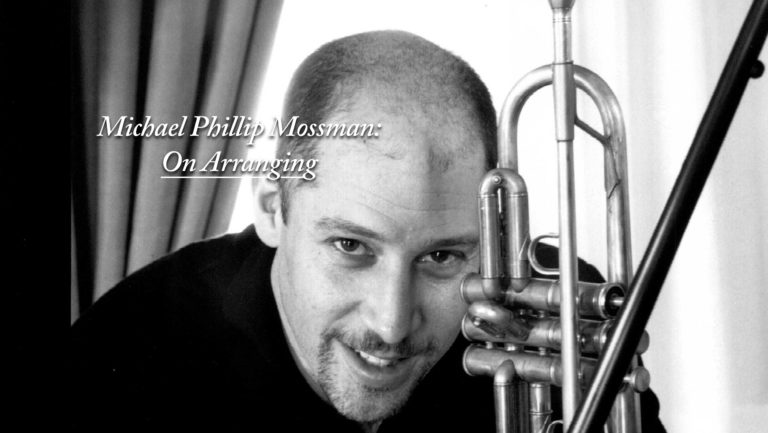
Michael Phillip Mossman reflects on his work as an arranger, how those opportunities shaped him, and a few pieces of directly applicable tips and ideas.
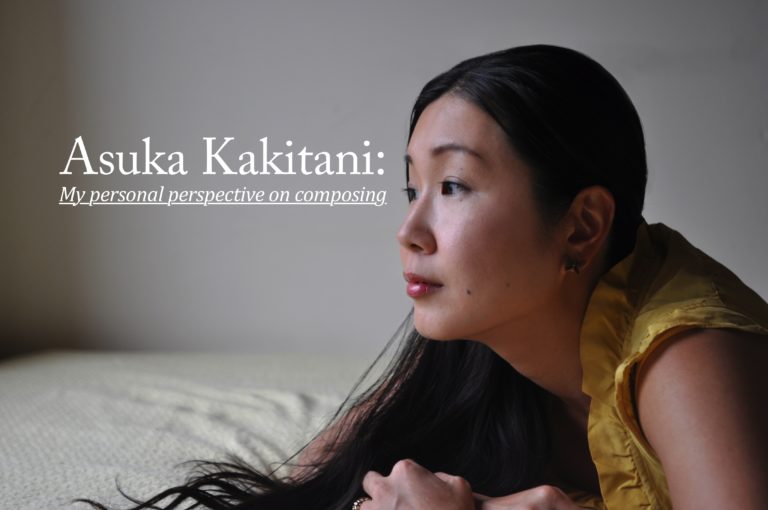
Although I don’t talk much about the process of composing with my fellow composer friends or anybody, I enjoy reading about other composers’ processes when I get a chance, so I will share mine here hoping someone would enjoy reading it. This is not technical but more of my personal perspective.
I started studying jazz composition at Berklee College of Music when I was twenty-six years old. I would imagine many people would start much earlier studying something like that, but I actually wasn’t really interested in composing before I attended Berklee. Soon after I started classes there, I had to compose for some school projects and I quickly fell in love with the freedom of composing. At that time, I was trying to play piano like Bud Powell, and it was struggle for me being constrained by my own idea of how I should sound. On the other hand, composing, it was a discovery of a new playground. I loved to tell my stories through my composition, which I even didn’t know I would enjoy so much. I just felt so free.
Telling stories is an important part of composing for me. Sometimes composing is my tool to tell a story. I almost always have a story in my head before I start writing. It doesn’t have to be a dramatic one; it could be an ordinary day of summer in the garden. Nature is usually a great inspiration for me. I think composing is like taking my camera and going outside to look under a leaf or inside flowers with a macro lens. There are lives and dramas that we cannot see with our naked eye. There are so many details, which are delicate, colorful, and vibrant. That is how I want my music to be, too.
One of my teachers at Berklee, Ted Pease once told me that melody is the most important thing. That stayed with me for a long time, and most of the time, my piece starts taking shape and firming its character with some melodies. I sing (terribly) in the street, on the subway, in the shower, waiting in line, in the woods, or in front of piano to find the magical melodies somewhere in the air. Sometimes I would succeed to catch them and write them down on manuscript paper, but I fail a lot of the time, too. Singing works best for me so far because then I can be free from my hand habits on the piano, I do not play any other instruments, and I do not want to write something that I cannot sing. When I luckily find a succession of notes I’m happy with, I quickly and carefully write them down on paper without key signature or time signature to not have any constraints to shape a melody I found. I would sing and play it on the piano many times until it feels right, and then I figure out the best time signature for the melody. Often times I won’t have enough rehearsal time with a band, so it is crucial to have the clearest and easiest way possible to read. I stopped using key signatures at some point, so I even don’t bother to think about it.
It takes a lot of time. Every time I almost cannot believe when I complete a piece.
Since I had my daughter in 2014, it has been even harder to find time to sit and work. Although parenting is a wonderful and incomparable experience, it is a 24-hour commitment. I suffer from lack of time and sleep and being unfocused. Finding five minutes to sit in front of the piano here and there, staying up late or getting up early, or staying up late AND getting up early depends on her sleeping schedule – scavenging for time to write and stay focused has been a real challenge for me.
Sometimes I cannot write anything for a few weeks. And one day I think I hear something, and write it down, and the next day I think it does not sound as good as I thought yesterday, and after two weeks, I would come back to that melody and feel it is pretty nice. Three days later, I would say, “This is awful!” I would be stressed out, feel miserable for a few days. Then a “good day” comes and I am able to catch a few magical notes in the air. That makes me so happy until I become miserable again, which would be the next day. A “good day” does not come so often. But despite my agony, “bad days” are necessary to endure in order to have a “good day” from time to time. After feeling gloomy from not being able to write any notes for many days, I suddenly find myself lost in the music that I am writing. It starts to grow its own personality and follows me around all the time, and I feel as if I am with someone who is very close to me. I feel a connection with the piece, and we are attached to each other until it changes its mind and starts acting as a stranger again.
Although I love the freedom of composing, and composing makes me feel that I am free to create what I want to, it is very easy to settle in with an idea or phrase that I feel should work. Once I get trapped in the “this is going to be a masterpiece” syndrome, I start circling, and I notice that I stop trying to hear those magical melodies in the air anymore. There are many obstacles to overcome: feeling the need to utilize certain “cool” techniques, not being able to let go of an idea that does not work in context, and the pressure to finish a piece by a deadline. It is a perpetual struggle to escape from all the things that tie me down, and to keep pushing myself to step out from my comfort zone. For me, composing is an endless journey for finding something real. In order to keep pressing on, I would continually tell myself that music does not need to be impressive, but should be completely honest. It might not end up being so great of a piece of music after all, but the experience of writing absolutely honest music is the most precious thing to me. And more times than not, but utilizing this process, the end result is something I’m truly satisfied with, and sometimes even love.

Asuka Kakitani is a composer, arranger, and conductor. She is the founder of the Asuka Kakitani Jazz Orchestra (AKJO). Their 2013 debut album ”Bloom” was selected as one of the best albums on the NPR Music Jazz Critics Poll, All About Jazz, Lucid Culture, and DownBeat Magazine. Her awards include the BMI Charlie Parker Jazz Composition Prize, the Manny Albam Commission, and artist grants from the American Music Center, Brooklyn Arts Fund, and the Jerome Fund for New Music from the American Composers Forum.
Pianist and Composer Florian Ross outlines a well-balanced metaphor about reconnecting with our roots.