Artist Blog

Terri Lyne Carrington: In Conversation with Kris Davis and Devon Gates on jazz, gender, and New Standards (Nov 2022)

When I was asked to contribute to the ISJAC blog, I immediately thought about the lack of representation of women’s works in the canon and how the same names keep reappearing when there is representation. Though I’ve seen a heightened effort in this area over the last few years, I believe we still have to remain vigilant about making change in this area – and focus on radical inclusion – until we don’t have to anymore.

I came up with the slogan “Jazz Without Patriarchy” before founding the Berklee Institute of Jazz and Gender Justice (JGJ). So much of our work is under the umbrella of The Jazz Without Patriarchy Project, and the first initiative of the project was to form a collection of compositions written by women to be an addition to the wonderful tunes that are already considered standards, of which we’ve played for so long. To that end, I am pleased to say that the book, New Standards: 101 Lead Sheets by Women Composers (Berklee Press/Hal Leonard), came out in September 2022. I must admit I’ve been a little bit surprised by the extent of excitement around it, and did not fully realize the need for this collection, nor the need for this “space” that allows so many women composers to be acknowledged together. I’ve received many heartfelt emails and text messages from women in the book (and those not in the book), that seem incredibly happy and genuinely thankful that the book exists.

I’ve begun to ponder once again why jazz has been so slow to address gender justice. We wouldn’t read books only by male authors, and we wouldn’t watch plays or movies with only male actors, so why would we play music by only – or mostly – male composers? Music is supposed to not only contribute to bettering the human experience, but somehow to also reflect the lives and experiences of people during the time it was played or composed. If we were looking back 100 years from now through a time capsule, what would we think about who played and composed jazz? This problem has existed for far too long. It is blatantly obvious and rather exhausting for those who live the experience and for those who work toward its correction. Also, it’s starting to become a rather boring topic, as I’m sure most of us would rather be discovering, playing or composing new music. Luckily, it’s also something that is being addressed head-on during these very exciting times. I’m sure many of the members of ISJAC are educators that are concerned about the next generation. And I remain convinced that if we love the music and care about its future, then we have to insist upon more equitable gender representation, so the music can reach its greatest potential. Seems simple to me.

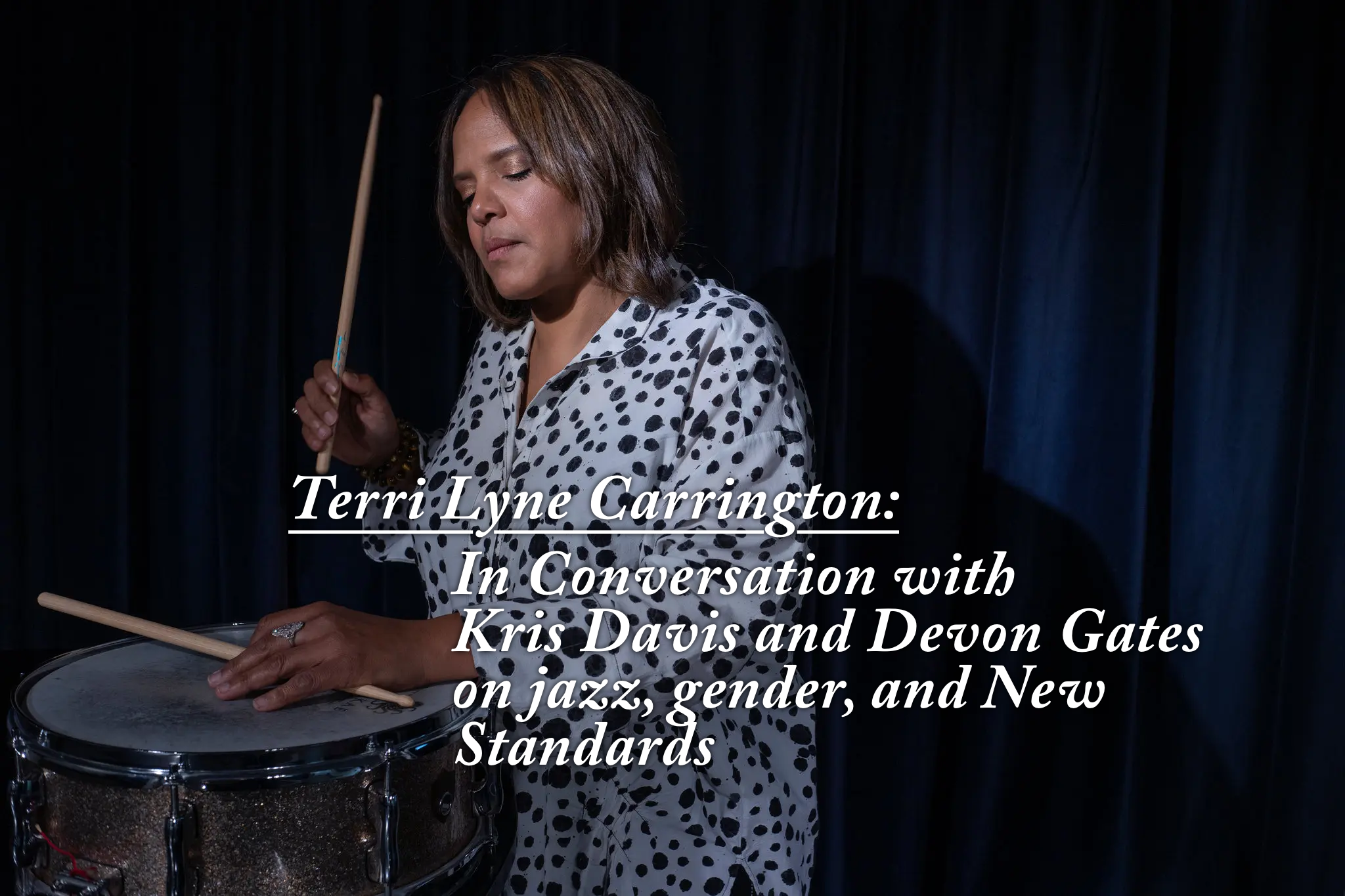
I sat down with my colleague and friend, pianist/composer Kris Davis, who is the Associate Director of Creative Development for JGJ, and with one of our students, bassist/composer, Devon Gates, to chat about jazz, gender and New Standards. Both have compositions in the book.


Terri Lyne Carrington: What do you think jazz will gain by having more equitable representation with composers and arrangers? As you know, from middle school through college and the professional world, compositions and arrangements presented to students and young artists have been mostly by male composers, so what do you think will change if or when that is different?

Kris Davis: Society is more dynamic when we hear the ideas of all people, and art is a mirror of society.  If people are left out based on gender, race or disability in any field, we as a community suffer because pieces of that mirror are missing or blurred. We often don’t even know that we are missing out on, like opportunities to learn from one another and to experience empathy and connection.  Representation has been quite narrow in the field of jazz since the beginning.  The Standards book amplifies voices that have been left out or silenced, and I think the next generation of musicians will gain new perspectives and ideas in music by studying this book.

Devon Gates: I definitely agree. As a student, my conception of what was possible in jazz was almost entirely shaped by the men I saw and heard around me, until I got to the Institute. Being able to play repertoire by non-male composers broadened my ideas of how a playing situation can feel, and also how differently things can sound as a result. When we uplift more voices, when we feel truly heard and seen by who we are playing with, when we don’t feel like a token or minority in a playing situation, the music reflects that comfort, and the vulnerability we are then allowed to share. It opens up to newer possibilities, and we in turn inspire each other to create new innovations, and transform each other as musicians, and as people.

TLC: I’m so close to the lead sheet book and of course hoping it helps in carving space for women composers to be acknowledged, but as composers represented in the book, I am wondering what you think the impact can be.

KD: Since the Me Too movement and Black Lives Matter, many institutions have been addressing diversity, equity and inclusion at every level, from hiring practices and mentorship, to the curriculum and repertoire they are teaching.  Institutions were floundering to find repertoire by women, and I believe this book will become a critical resource in the coming years, not only for repertoire, but to introduce names of women composers that have been left out, or who are still contributing to the jazz canon.

DG: I agree. It definitely leaves less excuses for institutions or educators to leave out women in their curriculum or teaching practices. It also sets a precedent for many more similar publications to further broaden the repertoire, and hopefully creates more visibility in general for the issue of non-male composer representation, in addition to non-male player representation.

Outside of institutions, students like me can also bring these tunes to each other, use them to jam, compose our own new works, and introduce each other to this growing repertoire, so that the culture can shift on a more grassroots level, as the tunes we call to play with each other hopefully become more reflective of the jazz community without patriarchy that we are aiming to cultivate.

TLC: In education, how do you think we (artists/educators) can better affect the next generation of composers and improvisers?

KD: By exposing them to the history and tradition of the music, while encouraging them to explore and express their authentic selves and the current culture in the art they create.

TLC: Yes, I agree, that balance of knowing the past in order to expand the present and future is so important.

Do you feel your voice is heard by your male colleagues and do you feel free and confident to express yourself authentically, openly, honestly with colleagues, press, etc.?

KD: To some extent.  I’m grateful to be part of a community at Berklee that talks openly and honestly about the way each of us move through the world, discovering experiences that bind us and experiences we can learn from.

DG: Yes—being at Berklee is definitely a far more open environment, although of course, like any space, there are still very real remnants of patriarchy that we are still working towards eliminating. The more listening, the better…

TLC: Yes, the needle is moving, but it is not utopic by any far stretch of the imagination. We are doing better in some ways, but there is, of course, still improvement to be had. I always say I can’t wait until the day this work is not needed anymore!
Kris, do you feel there are still gatekeepers in the music? And where do you feel you experience a glass ceiling, if at all? For me, I think it is in the production, music directing realm of things.

KD: Childcare is a major hurdle for families with young children, especially artists with young children who don’t get paid for the time they work or for networking in the community.   A woman is often faced with the hard choice to decide between her career or having a family in America.  I can name at least ten  incredible women artists who had to step away at a critical moment in their careers to be mothers.  Until our society supports families with young children, women will continue to be a minority in many fields of work, including the arts.

DG: That is definitely something that as a younger person, my friends and I think about when it comes to having a future in this field. I think it has been really influential on us to be able to watch our professors at the Institute like you (Kris), and Terri, and Linda May Han Oh and others really impressively do this seemingly impossible balancing act – before seeing this, it wasn’t even something I had considered much at all, so I really appreciate that it’s been a visible part of me and my peers’ experience.

I also want to emphasize that the Institute is still the first and only space of its kind among most conservatories, and that although I am so proud of the strides that we are making, it is clear in my conversations with peers from other schools or in other cities that this cultural shift is just not present yet. So something I’ve been thinking about a lot is how to create more pockets of community in other, non-Berklee, non-New England, non-institutional spaces that bring us forward. And of course, there is always the tension of jazz being institutionalized and the uneven racial disparity that emerges from that in higher education and other spaces…

TLC: Yes, and we are counting on you to do so! This is all collective work and I think sometimes men don’t realize that it is just as much their responsibility as ours to make strides in these areas. I love how Robin D.G. Kelly speaks on why men should be feminists – and how it liberates them in doing so. We are seeing more of that now with this generation – men rejecting performative masculinity.

And one last thing. How are you feeling about the future for arrangers and composers that identify as female or non-binary? Do you see the it changing for the better – and what is your tangible experience with that?

KD: I am extremely hopeful and optimistic! There are such incredible young musicians on the rise, forging their own paths as cutting-edge artists! Young people are coming up at a time when the culture is hyper aware of inequality, and I see an awareness and commitment to equity and justice in students I meet from all over the world.

DG: Yes! I really feel so inspired by the incredible art, community, and activism that I see from my mentors, and my peers, at Berklee and beyond. I’m so excited to see what continues to emerge from programs like M3, student groups like Oberlin’s Crimson Collective, and just from jazz musicians anywhere coming together and making space for community in whatever creative and caring ways that looks like.

TLC: And that’s what it’s really all about – caring!

Thank you both for taking the time to chat with me about this for our ISJAC community.


About the Moderator:

Celebrating 40 years in music, three-time GRAMMY® award-winning drummer, producer, educator and activist, Terri Lyne Carrington started her professional career in Massachusetts at 10 years old when she became the youngest person to receive a union card in Boston. She was featured as a “kid wonder” in many publications and on local and national TV shows. After studying under a full scholarship at Berklee College of Music, Carrington worked as an in-demand musician in New York City, and later moved to Los Angeles, where she gained recognition on late night TV as the house drummer for both the Arsenio Hall Show and Quincy Jones’ VIBE TV show, hosted by Sinbad.

In 1989, Ms. Carrington released a GRAMMY®-nominated debut CD on Verve Forecast, Real Life Story, and toured extensively with Wayne Shorter and Herbie Hancock, among others. In 2011 she released the GRAMMY®Award-winning album, The Mosaic Project, featuring a cast of all-star women instrumentalists and vocalists, and in 2013 she released, Money Jungle: Provocative in Blue, which also earned a GRAMMY®Award, establishing her as the first woman ever to win in the Best Jazz Instrumental Album category.

To date Ms. Carrington has performed on over 100 recordings and has been a role model and advocate for young women and men internationally through her teaching and touring careers. She has worked extensively with luminary artists such as Al Jarreau, Stan Getz, Woody Shaw, Clark Terry, Cassandra Wilson, Dianne Reeves, James Moody, Yellowjackets and Esperanza Spalding, and many more. Ms. Carrington’s 2015 release, The Mosaic Project: LOVE and SOUL, featured performances of iconic vocalists Chaka Khan, Natalie Cole, and Nancy Wilson.

In 2003, Ms. Carrington received an honorary doctorate from Berklee College of Music and was appointed professor at the college in 2005, where she currently serves as the Founder and Artistic Director of the Berklee Institute of Jazz and Gender Justice, which recruits, teaches, mentors, and advocates for musicians seeking to study jazz with gender equity as a guiding principle, and asks the important question, “what would jazz sound like in a culture without patriarchy?” She also serves as Artistic Director for Berklee’s Summer Jazz Workshop, co-curator for BAMS Fest, and co-Artistic Director of The Carr Center, Detroit, MI.

In 2019 Ms. Carrington was granted The Doris Duke Artist Award, a prestigious acknowledgment in recognition of her past and ongoing contributions to jazz music. Her current band project, Terri Lyne Carrington and Social Science (a collaboration with Aaron Parks and Matthew Stevens), released their debut album, Waiting Game, in November, 2019 on Motema Music. Galvanized by seismic changes in the ever-evolving social and political landscape, Waiting Game expresses an unflinching, inclusive, and compassionate view of humanity’s breaks and bonds through an eclectic program melding jazz, R&B, indie rock, contemporary improvisation, and hip-hop.

Both Waiting Game and the Berklee Institute of Jazz and Gender Justice point to Carrington’s drive to combine her musical passion with her profound regard for humanity. Waiting Game is not the first time that Carrington has addressed her concerns for society, though it is the most direct and impactful. The subjects addressed on Waiting Game run the gamut of social concerns: mass incarceration, police brutality, homophobia, the genocide of indigenous Americans, political imprisonment, and gender equity.

“In previous projects I’ve hinted at my concerns for the society and the community that I live in,” Carrington says. “But everything has been pointing in this direction. At some point you have to figure out your purpose in life. There are a lot of drummers deemed ‘great.’ For me, that’s not as important as the legacy you leave behind.”

About the Interviewees

Photo © Mardok 2021

Kris Davis is a critically acclaimed pianist and composer described by The New York Times as a beacon for “deciding where to hear jazz on a given night.”  Since 2003, Davis has released 23 recordings as a leader or co-leader. She has collaborated with Terri Lyne Carrington, John Zorn, Craig Taborn, Ingrid Laubrock, Tyshawn Sorey, Tom Rainey, Eric Revis, Johnathan Blake, Stephan Crump and Eric McPherson, among others. In 2019, her album “Diatom Ribbons” was named jazz album of the year by both the New York Times and the NPR Music Jazz Critics Poll. She was also named a 2021 Doris Duke Artist alongside Wayne Shorter and Danilo Perez, Pianist of the Year by DownBeat magazine in 2022 and 2020, and 2021 Pianist and Composer of the Year by the Jazz Journalists Association.  In 2016, Davis launched Pyroclastic Records to support artists whose expression expands beyond the commercial sphere. She subsequently formed a nonprofit organization to support the label’s work. Davis is the Associate Program Director of Creative Development at the Berklee Institute of Jazz and Gender Justice.  Kris Davis is a Steinway Artist.


Devon Gates is a bassist, vocalist, and composer from Atlanta, GA now in her third year of a dual degree program between Harvard University and Berklee College of Music, where she studies social anthropology and jazz, respectively. She has worked as a research assistant with Berklee’s Jazz and Gender Justice Institute on the book, New Standards: 101 Lead Sheets By Women Composers (which also includes her composition, “Don’t Wait”) and for the accompanying installation at the Carr Center

Artist Blog

Terri Lyne Carrington: In Conversation with Kris Davis and Devon Gates on jazz, gender, and New Standards.

When I was asked to contribute to the ISJAC blog, I immediately thought about the lack of representation of women’s works in the canon and how the same names keep reappearing when there is representation. Though I’ve seen a heightened effort in this area over the last few years, I believe we still have to remain vigilant about making change in this area – and focus on radical inclusion – until we don’t have to anymore.

I came up with the slogan “Jazz Without Patriarchy” before founding the Berklee Institute of Jazz and Gender Justice (JGJ). So much of our work is under the umbrella of The Jazz Without Patriarchy Project, and the first initiative of the project was to form a collection of compositions written by women to be an addition to the wonderful tunes that are already considered standards, of which we’ve played for so long. To that end, I am pleased to say that the book, New Standards: 101 Lead Sheets by Women Composers (Berklee Press/Hal Leonard), came out in September 2022. I must admit I’ve been a little bit surprised by the extent of excitement around it, and did not fully realize the need for this collection, nor the need for this “space” that allows so many women composers to be acknowledged together. I’ve received many heartfelt emails and text messages from women in the book (and those not in the book), that seem incredibly happy and genuinely thankful that the book exists.

I’ve begun to ponder once again why jazz has been so slow to address gender justice. We wouldn’t read books only by male authors, and we wouldn’t watch plays or movies with only male actors, so why would we play music by only – or mostly – male composers? Music is supposed to not only contribute to bettering the human experience, but somehow to also reflect the lives and experiences of people during the time it was played or composed. If we were looking back 100 years from now through a time capsule, what would we think about who played and composed jazz? This problem has existed for far too long. It is blatantly obvious and rather exhausting for those who live the experience and for those who work toward its correction. Also, it’s starting to become a rather boring topic, as I’m sure most of us would rather be discovering, playing or composing new music. Luckily, it’s also something that is being addressed head-on during these very exciting times. I’m sure many of the members of ISJAC are educators that are concerned about the next generation. And I remain convinced that if we love the music and care about its future, then we have to insist upon more equitable gender representation, so the music can reach its greatest potential. Seems simple to me.

I sat down with my colleague and friend, pianist/composer Kris Davis, who is the Associate Director of Creative Development for JGJ, and with one of our students, bassist/composer, Devon Gates, to chat about jazz, gender and New Standards. Both have compositions in the book.


Terri Lyne Carrington: What do you think jazz will gain by having more equitable representation with composers and arrangers? As you know, from middle school through college and the professional world, compositions and arrangements presented to students and young artists have been mostly by male composers, so what do you think will change if or when that is different?

Kris Davis: Society is more dynamic when we hear the ideas of all people, and art is a mirror of society.  If people are left out based on gender, race or disability in any field, we as a community suffer because pieces of that mirror are missing or blurred. We often don’t even know that we are missing out on, like opportunities to learn from one another and to experience empathy and connection.  Representation has been quite narrow in the field of jazz since the beginning.  The Standards book amplifies voices that have been left out or silenced, and I think the next generation of musicians will gain new perspectives and ideas in music by studying this book.

Devon Gates: I definitely agree. As a student, my conception of what was possible in jazz was almost entirely shaped by the men I saw and heard around me, until I got to the Institute. Being able to play repertoire by non-male composers broadened my ideas of how a playing situation can feel, and also how differently things can sound as a result. When we uplift more voices, when we feel truly heard and seen by who we are playing with, when we don’t feel like a token or minority in a playing situation, the music reflects that comfort, and the vulnerability we are then allowed to share. It opens up to newer possibilities, and we in turn inspire each other to create new innovations, and transform each other as musicians, and as people.

TLC: I’m so close to the lead sheet book and of course hoping it helps in carving space for women composers to be acknowledged, but as composers represented in the book, I am wondering what you think the impact can be.

KD: Since the Me Too movement and Black Lives Matter, many institutions have been addressing diversity, equity and inclusion at every level, from hiring practices and mentorship, to the curriculum and repertoire they are teaching.  Institutions were floundering to find repertoire by women, and I believe this book will become a critical resource in the coming years, not only for repertoire, but to introduce names of women composers that have been left out, or who are still contributing to the jazz canon.

DG: I agree. It definitely leaves less excuses for institutions or educators to leave out women in their curriculum or teaching practices. It also sets a precedent for many more similar publications to further broaden the repertoire, and hopefully creates more visibility in general for the issue of non-male composer representation, in addition to non-male player representation.

Outside of institutions, students like me can also bring these tunes to each other, use them to jam, compose our own new works, and introduce each other to this growing repertoire, so that the culture can shift on a more grassroots level, as the tunes we call to play with each other hopefully become more reflective of the jazz community without patriarchy that we are aiming to cultivate.

TLC: In education, how do you think we (artists/educators) can better affect the next generation of composers and improvisers?

KD: By exposing them to the history and tradition of the music, while encouraging them to explore and express their authentic selves and the current culture in the art they create.

TLC: Yes, I agree, that balance of knowing the past in order to expand the present and future is so important.

Do you feel your voice is heard by your male colleagues and do you feel free and confident to express yourself authentically, openly, honestly with colleagues, press, etc.?

KD: To some extent.  I’m grateful to be part of a community at Berklee that talks openly and honestly about the way each of us move through the world, discovering experiences that bind us and experiences we can learn from.

DG: Yes—being at Berklee is definitely a far more open environment, although of course, like any space, there are still very real remnants of patriarchy that we are still working towards eliminating. The more listening, the better…

TLC: Yes, the needle is moving, but it is not utopic by any far stretch of the imagination. We are doing better in some ways, but there is, of course, still improvement to be had. I always say I can’t wait until the day this work is not needed anymore!
Kris, do you feel there are still gatekeepers in the music? And where do you feel you experience a glass ceiling, if at all? For me, I think it is in the production, music directing realm of things.

KD: Childcare is a major hurdle for families with young children, especially artists with young children who don’t get paid for the time they work or for networking in the community.   A woman is often faced with the hard choice to decide between her career or having a family in America.  I can name at least ten  incredible women artists who had to step away at a critical moment in their careers to be mothers.  Until our society supports families with young children, women will continue to be a minority in many fields of work, including the arts.

DG: That is definitely something that as a younger person, my friends and I think about when it comes to having a future in this field. I think it has been really influential on us to be able to watch our professors at the Institute like you (Kris), and Terri, and Linda May Han Oh and others really impressively do this seemingly impossible balancing act – before seeing this, it wasn’t even something I had considered much at all, so I really appreciate that it’s been a visible part of me and my peers’ experience.

I also want to emphasize that the Institute is still the first and only space of its kind among most conservatories, and that although I am so proud of the strides that we are making, it is clear in my conversations with peers from other schools or in other cities that this cultural shift is just not present yet. So something I’ve been thinking about a lot is how to create more pockets of community in other, non-Berklee, non-New England, non-institutional spaces that bring us forward. And of course, there is always the tension of jazz being institutionalized and the uneven racial disparity that emerges from that in higher education and other spaces…

TLC: Yes, and we are counting on you to do so! This is all collective work and I think sometimes men don’t realize that it is just as much their responsibility as ours to make strides in these areas. I love how Robin D.G. Kelly speaks on why men should be feminists – and how it liberates them in doing so. We are seeing more of that now with this generation – men rejecting performative masculinity.

And one last thing. How are you feeling about the future for arrangers and composers that identify as female or non-binary? Do you see the it changing for the better – and what is your tangible experience with that?

KD: I am extremely hopeful and optimistic! There are such incredible young musicians on the rise, forging their own paths as cutting-edge artists! Young people are coming up at a time when the culture is hyper aware of inequality, and I see an awareness and commitment to equity and justice in students I meet from all over the world.

DG: Yes! I really feel so inspired by the incredible art, community, and activism that I see from my mentors, and my peers, at Berklee and beyond. I’m so excited to see what continues to emerge from programs like M3, student groups like Oberlin’s Crimson Collective, and just from jazz musicians anywhere coming together and making space for community in whatever creative and caring ways that looks like.

TLC: And that’s what it’s really all about – caring!

Thank you both for taking the time to chat with me about this for our ISJAC community.


About the Moderator:

Celebrating 40 years in music, three-time GRAMMY® award-winning drummer, producer, educator and activist, Terri Lyne Carrington started her professional career in Massachusetts at 10 years old when she became the youngest person to receive a union card in Boston. She was featured as a “kid wonder” in many publications and on local and national TV shows. After studying under a full scholarship at Berklee College of Music, Carrington worked as an in-demand musician in New York City, and later moved to Los Angeles, where she gained recognition on late night TV as the house drummer for both the Arsenio Hall Show and Quincy Jones’ VIBE TV show, hosted by Sinbad.

In 1989, Ms. Carrington released a GRAMMY®-nominated debut CD on Verve Forecast, Real Life Story, and toured extensively with Wayne Shorter and Herbie Hancock, among others. In 2011 she released the GRAMMY®Award-winning album, The Mosaic Project, featuring a cast of all-star women instrumentalists and vocalists, and in 2013 she released, Money Jungle: Provocative in Blue, which also earned a GRAMMY®Award, establishing her as the first woman ever to win in the Best Jazz Instrumental Album category.

To date Ms. Carrington has performed on over 100 recordings and has been a role model and advocate for young women and men internationally through her teaching and touring careers. She has worked extensively with luminary artists such as Al Jarreau, Stan Getz, Woody Shaw, Clark Terry, Cassandra Wilson, Dianne Reeves, James Moody, Yellowjackets and Esperanza Spalding, and many more. Ms. Carrington’s 2015 release, The Mosaic Project: LOVE and SOUL, featured performances of iconic vocalists Chaka Khan, Natalie Cole, and Nancy Wilson.

In 2003, Ms. Carrington received an honorary doctorate from Berklee College of Music and was appointed professor at the college in 2005, where she currently serves as the Founder and Artistic Director of the Berklee Institute of Jazz and Gender Justice, which recruits, teaches, mentors, and advocates for musicians seeking to study jazz with gender equity as a guiding principle, and asks the important question, “what would jazz sound like in a culture without patriarchy?” She also serves as Artistic Director for Berklee’s Summer Jazz Workshop, co-curator for BAMS Fest, and co-Artistic Director of The Carr Center, Detroit, MI.

In 2019 Ms. Carrington was granted The Doris Duke Artist Award, a prestigious acknowledgment in recognition of her past and ongoing contributions to jazz music. Her current band project, Terri Lyne Carrington and Social Science (a collaboration with Aaron Parks and Matthew Stevens), released their debut album, Waiting Game, in November, 2019 on Motema Music. Galvanized by seismic changes in the ever-evolving social and political landscape, Waiting Game expresses an unflinching, inclusive, and compassionate view of humanity’s breaks and bonds through an eclectic program melding jazz, R&B, indie rock, contemporary improvisation, and hip-hop.

Both Waiting Game and the Berklee Institute of Jazz and Gender Justice point to Carrington’s drive to combine her musical passion with her profound regard for humanity. Waiting Game is not the first time that Carrington has addressed her concerns for society, though it is the most direct and impactful. The subjects addressed on Waiting Game run the gamut of social concerns: mass incarceration, police brutality, homophobia, the genocide of indigenous Americans, political imprisonment, and gender equity.

“In previous projects I’ve hinted at my concerns for the society and the community that I live in,” Carrington says. “But everything has been pointing in this direction. At some point you have to figure out your purpose in life. There are a lot of drummers deemed ‘great.’ For me, that’s not as important as the legacy you leave behind.”

About the Interviewees

Photo © Mardok 2021

Kris Davis is a critically acclaimed pianist and composer described by The New York Times as a beacon for “deciding where to hear jazz on a given night.”  Since 2003, Davis has released 23 recordings as a leader or co-leader. She has collaborated with Terri Lyne Carrington, John Zorn, Craig Taborn, Ingrid Laubrock, Tyshawn Sorey, Tom Rainey, Eric Revis, Johnathan Blake, Stephan Crump and Eric McPherson, among others. In 2019, her album “Diatom Ribbons” was named jazz album of the year by both the New York Times and the NPR Music Jazz Critics Poll. She was also named a 2021 Doris Duke Artist alongside Wayne Shorter and Danilo Perez, Pianist of the Year by DownBeat magazine in 2022 and 2020, and 2021 Pianist and Composer of the Year by the Jazz Journalists Association.  In 2016, Davis launched Pyroclastic Records to support artists whose expression expands beyond the commercial sphere. She subsequently formed a nonprofit organization to support the label’s work. Davis is the Associate Program Director of Creative Development at the Berklee Institute of Jazz and Gender Justice.  Kris Davis is a Steinway Artist.


Devon Gates is a bassist, vocalist, and composer from Atlanta, GA now in her third year of a dual degree program between Harvard University and Berklee College of Music, where she studies social anthropology and jazz, respectively. She has worked as a research assistant with Berklee’s Jazz and Gender Justice Institute on the book, New Standards: 101 Lead Sheets By Women Composers (which also includes her composition, “Don’t Wait”) and for the accompanying installation at the Carr Center

Artist Blog

An Interview with John Clayton

NOTE: Interview conducted by Paul Read on Jan 10, 2018 at 2:30 PST.

ISJAC: Hey, John. Thanks for doing this.

JC: Happy to do it

ISJAC: Where are you at the moment, Los Angeles?

JC: Yes, I am in Los Angeles. I actually was born and raised here and finished school at Indiana University… hit the road for four years and then moved to Holland to be with my, then, girlfriend, now my wife, and played in a symphony orchestra for five years.1The Amsterdam Philharmonic.

ISJAC: You were with the Basie band before you went to Amsterdam?

JC: Yes. After I finished school I went on the road with Monty Alexander and Jeff Hamilton for two years. And I missed out on my dream to play with Duke Ellington – he died while I was still in college – and one of my other dreams was to play with Count Basie. I was studying with Ray Brown and I knew that Ray knew Count Basie very well. So I asked him if he could look into helping me get in touch with him. He said, “Sure” and the next day I was talking to Count Basie [laughter]. He called me and said, “Young man, I hear you would like to play in my orchestra.” and I said, “Yes, sir, Mr. Basie”. And he said, “Well, I’ll have my manager call you.” and it just so happened that his bass player was leaving in two weeks, so I let Monty Alexander know I had this opportunity and he gave me his blessing. I went with Count Basie and that’s where I really got bit by the writing bug. I’d never studied composition or arranging but I fell in love with that music being able to hear it every night there in real time. I knew how to transpose for instruments and I had some fantasies. So, I asked Mr. Basie if I could write some music, and he said, “sure”. I wrote something that was embarrassingly bad.  [Laughter] I was frustrated, certainly, but I wasn’t put off and I wasn’t discouraged. That’s the best way to put it.  So on one of my breaks I took the recording that Basie had done years before with Neal Hefti of a song called “Splanky.”2Recorded on The Atomic Mr. Basie. (YouTube video posted by Warner Bros.) “Which is “the 6th most critically acclaimed album of 1958, the 25th most acclaimed of the 1950s, and the 837th most acclaimed of all time, based on an aggregation of hundreds of critics’ lists from around the world”. Wikipedia.

ISJAC: Right.

JC: “Splanky” has an amazing shout chorus,3See the Appendix at the end of the article for an score excerpt showing the ‘triple lead’ approach. and I got goose bumps every time we played it, so I wrote a sketch of everything that was happening in that arrangement. The intro, I wrote it in words…you know: piano – Ab pedal in the left hand, drums plays with sticks, bass playing the pedal. Roman numeral two: melody played in unison by the brass with mutes (and I didn’t know which so I wrote cups, buckets, question mark). Sort of walked through it in words like that, and then I went back and I transcribed as many of the notes that I could hear. From that, I noticed that when we got to the shout chorus I could hear on the recording that the lead trumpet note happened to be the same note that the lead trombone player was playing and the same note that the lead alto was playing so I had discovered this ‘triple lead’ concept of writing…

ISJAC: Yeah, I hear that from time to time in your writing…

JC: Yeah, and the thing that it provides is a lot of clarity for the melody.  So I learned that whenever I want that kind of clarity I could use ‘triple lead’ or even ‘double lead’.  Anyway, that was the beginning.

ISJAC: How much music did you write while you were with Basie? Were you producing an arrangement or composition once a week, once a month?

JC: It went from once a month or every three weeks or so…it was never once a week.

ISJAC: Yeah, that’s a lot!! [Laughter]

JC: I also acknowledged that I did not have the chops to write that fast. And, by the way, they paid me for the arrangements.

ISJAC: That’s great of course.

JC: It was kind of shocking that I wrote my first endeavour and I got paid for it. So that was great.  And they not only paid for the chart, they paid for the copying too.

ISJAC: What a tremendous learning experience. To be inside a band like that, to be playing with the band, and hearing all those colours, and the orchestration. Everything is right there for you. As opposed to learning about those things from a purely theoretical standpoint.

JC: I absolutely agree.

ISJAC: Whenever I played saxophone in a big band, I would particularly notice what the trumpets and trombones were doing…. I mean I couldn’t avoid it…they were sitting right behind me [laughs].  But it is a truly amazing story that you started writing while you were in the Basie band!

JC: And, of course, the guys were very helpful. They had excellent writers in the band: Bobby Plater, Eric Dixon, and Dennis Wilson. Dennis was my homey because he was my age. He was a schooled writer because he studied at Berklee, and he would show me things about writing technically. And the other guys in the band would say things to me off the cuff that turned out to be invaluable – things that I think too many writers don’t know or don’t do. For instance, they’d see me working on a score, and that I was frustrated because we just played it and I’d be making some edits and corrections and they’d say, “Hey, what are you doing?” and I’d say, “Oh, this didn’t sound very good and I just want to change this or that”, and they’d say, “Well don’t change that! Just write another one! And the stuff you didn’t like in this one, don’t put it in the new one.”

ISJAC: Great advice.

JC: And that was so spontaneous on their part, but so deep for me and I followed their advice. With their encouragement, I kept writing and writing and writing. Another time, earlier on, one of the writers in the band was looking at a score of mine and he asked, “You write a ‘C’ score?” I replied [hesitating] “Yeah”, and asked me, “Well why?” and I said, “I don’t know” and then he said, “Don’t do that! Write a transposed score.” So I said, “OK” and that was that.

ISJAC: And is that what you do now?

JC: Yes. I write my sketches in C but then I always write transposed scores. Honestly, I’m at the point now where I have an assistant, so I usually write detailed sketches and use shorthand that she understands and can decipher. I’m in a lot of situations now where I have to write very quickly and so having an assistant is very helpful.

Incidentally, when I write a score, I don’t use notation software. I have Sibelius because I thought I should have it but I really don’t use it. I had Finale before that because I thought I might use it, but I have so many shortcuts that the software slows me down. It’s just the way I write.

ISJAC: I totally get that. It’s so much easier to write something on paper rather than have to look on page 135 of the manual to find out how to put something or other on the score for the first time.

JC: Yeah, and also, let’s say I’m writing a more extended piece. I sit at my piano and to my left is my desk and to the left of my desk, are two music stands. Now, I may need to refer to page 12, or 23 and 35 and, if I have to scroll on a computer, and have a couple of screens open, it really slows me down. But I do understand the importance of that technology and all my charts are computer-generated now and it is great to have those files. I do recognize the value of it. Its just that writing-wise, it’s just not the way I work.

ISJAC: And your assistant puts it into the software? Is that what happens?

JC: Yes. She copies them into the software. I’m not the kind of person who writes one line and says, “Here, make this sound like Thad Jones.” [Laughter].  I mean all the notes on the score are my notes.

ISJAC: You mentioned Thad Jones. He was in the Basie band long before you, right?

JC: Yes, long before.

ISJAC: Was he an influence on your writing?

JC: Huge. Yeah, Duke Ellington, Thad Jones, Quincy Jones, Billy Byers, Oliver Nelson and Henry Mancini.  I got to work with him [Mancini] in my early days, so I really got to hear his treatment of orchestra and big band and big band with strings and all that. And – I’m sure I’m leaving somebody out – those are some of the people that really had an influence.

ISJAC: That’s a pretty heavy list. I read a story recently about Thad writing on the band bus. I think the story was in that book that came out last year, “50 Years at the Village Vanguard.”4“50 Years at the Village Vanguard (Thad Jones and Mel Lewis at the Village Vanguard) ” by Dave Lisik and Eric Allen available at www.skydeckmusic.com. Do you know that book?

JC: Yes, I know about that. I don’t have that yet.

ISJAC: I haven’t read all of it yet, it’s pretty comprehensive, but at one point one of the members of the band noted that Thad would be writing a score while riding the band bus and that he was able to shut out everything. Just completely absorbed in what he was doing. Apparently the music was for whatever event they were heading to – a recording session or whatever it was. It takes such great concentration to be able to do that with so much going on around you.  Really amazing.

JC: I think that’s something you learn to do, I mean, if you desire to do it, you figure it out. In fact, I got my chops together doing the exact same thing on the Basie bus. I would sit in the back of the bus and write my scores and then, when we got to the concert hall, or wherever we were going, I’d go to the piano to check things. You know, you do write a little differently when you write away from the piano. It’s not that you write more safely, it’s just that you write things that are a little more familiar to you. And so, yeah, I still write that way. At one point, I had a lesson with Johnny Mandel and he encouraged me to write that way because I played him one of the songs I had composed, and he said, “Mmm, did you write that at the piano?” And I thought about it for a moment, and I said, “Yes I did”, and he said, “Yup, sounds like it. You know people don’t sing chord changes, they sing melodies.” And so, whenever possible I try to write away from the piano. That was a major lesson for me. So to this day I write away from the piano and use the piano it to check what I’ve written.

ISJAC: Do you find yourself singing while you write?

JC: Yes. You know, the musicians have to have a chance to breathe when they play or sing what I’m writing.

ISJAC: I’m curious about something that I think every writer faces as they evolve, and that is developing good judgement or taste. You know, how much you decide to put here or put there. Or when there is enough of a particular idea and its time to move on. I guess I’m referring to the intuitive side of things. Finding rhythmic ideas that feel good, sound good and swing. Do you have any thoughts that would be helpful to students or up and coming composer/arrangers that you might want to share?

JC: I’m big on models. I find training wheels are a really good thing because we’ve all got ideas. We’ve all got fantasies. But if you are in the beginning stages of it, there’s a lot that you don’t know. And if you write from rules, it sounds like you are writing from rules.  To free yourself from that you need to put your feet in the shoes of the masters – the people you are interested in and that have influenced you. When you put your feet in their shoes, you go well beyond the analytical level.  You develop a feel for what they are doing. You develop a feel for the phrases and textures and for the apex of the phrase or the piece – and, of course, that’s really what you want. You don’t merely want to write from an analytical, left brain, point of view. You want to naturally flow the way that the music you enjoy listening to does.

I haven’t had that many composition/arranging students but sometimes I believe sincerely that they kind of don’t want to do what I say. And that’s fine…that’s cool…but if someone was studying with me, I’d would have them work on a three-tiered project. The first part would be to find a piece that they like, that’s close to their level. Don’t focus on a ‘level 25’ piece right now. Focus on something with an  ‘11’ or ‘12’ level of complexity. They are going to have to work hard to get it right,  but because it is close to their level it will be an attainable goal. So, for someone who is just starting out writing, I’m not going to send them to a later Thad chart or later Brookmeyer work. I’m going to send them instead to explore a piece they love. It might be Neal Hefti or early Quincy Jones or something like that where the textures are more at their level.

They would start by describing the piece in some detail using words – including describing the moods. Is it an exciting piece? Is it a romantic piece? What does the mood of this music say to you? Because that’s what we are ultimately doing as writers: we’re expressing ourselves and taking those moods that we want to express and attaching sounds to them.  And they would have to describe the structure of the piece. For example, they would describe the intro, where the melody is, who is playing it, what the textures are…just in words. And then they would have to go back and, as best they can, transcribe the notes of the entire piece. There are some options here if the task is too difficult.  It could be that they don’t transcribe the bass line, or only transcribe a sample of the piano voicings, or not transcribe exactly what the drummer is doing with all of his or her limbs. Then the work is not as daunting as it might seem at first.

So that’s the first tier or part of the project, and then the second tier would be that they would have to write their own piece based on what they just analyzed and transcribed.  Of course they can change things, but they should respect the model they’ve just analyzed. So, instead of an 8 bar intro, they might write a 12 bar intro instead for the new piece. They should note things that were particularly noticeable in the piece they transcribed. For example, they might hear that the trumpets were in a certain register and so, in their piece they would write the trumpets in a similar register. It could be that the composer stuck to tensions like 13s and 9s and maybe just occasional alterations to a certain harmonic structure. Well, they should do the same thing. In other words, if you are going to write something in the style of Mozart, you probably shouldn’t use Ravel-like harmony.

And then, the third part of the project would be to write something that has nothing to do with the first two.  You know, whatever you’re feeling – wherever your fantasies take you. So you don’t feel like you’re becoming a carbon copy of that other music.

And then I would have them go through that whole process three or four times. Then they would have a good 12 pieces that they have have really put their heart and soul into. Some of this is analysis based, and some of it is putting your feet in the shoes of another composer and imitating certain aspects of their writing.  And then finally they do whatever they want to do.

Along with that advice I would address three things that I define as gaps in the skills composers or arrangers that I see today. Number one would be transposing. Become comfortable with writing transposed scores. I can’t tell you how many times, having been instructed by writers in the Basie band to do this has saved my bacon.  I’ve been in so many recording situations or rehearsals when I’m standing in front of an orchestra and a hand goes up, the red light is on, and someone says, “John, can you tell me what my note is in the first bar of letter C?” I look and I see that they are playing French horn, and then I have to do an immediate vertical analysis of the score and figure out what that person’s note has to be changed to. Well, someone else could say that they never write a transposed score and still would be able to answer the French horn player’s question, but then, you don’t know what kind of situations you are going to be in and you may have to conduct someone else’s score and that score might be transposed.

Also, I think that the tendency nowadays in education is to allow students to prepare just enough to get through the gig; just enough to get through the recital; just enough to make it through the lesson; just enough to get through the concert and then move on to the next thing. And that’s kind of the nature of what happens in a lot of schools. But if you look at all the things that you feel good about having done, they reflect, I think, over-learning. You’ve done it so many times you don’t have to think about it. It feels really comfortable. But I think that it is too easy in some instances to be satisfied with doing an adequate job –accepting that that was your best effort and then moving on.

Luckily in my life I’ve had enough people who wouldn’t let me do that. You know, Ray Brown told me, (I can’t tell you how many times – maybe hundreds) – he would say to me, “Here’s what you got to do.” And then he would tell me whatever that was and I’d do it! I trusted him. And if I questioned his advice, I’d kind of put those questions aside for the time being. Often, it would take me a certain amount of time – sometimes years – to look back and say, “Oh, that’s why he had me do that!”

ISJAC: Ha! [Both laugh]

JC:  So Ray Brown, and like I said, the guys in the Basie band would give me that kind of advice. Even Basie. At one time, I was really writing a lot and the band was playing more and more of my stuff, and I said to him, “Chief,”  – we used to call him Chief, “ – would you ever consider allowing me to write an album for the band? It would be an honour for me and I would love to do it.” And he kind of looked at the ceiling and looked around and you know, like he wasn’t quite hearing me. So I sort of slithered out of the room and never brought it up again. Well, years later – because I know he heard me – I’d already left the band and I was living in Holland and I found some cassette tapes of some rehearsals and some things I’d done with band, and I’m listening to them and the light bulb went on. And I thought, oh my god, I wasn’t ready. He knew that I wasn’t ready and he allowed me to discover, at some point in life, that I wasn’t ready. He didn’t say ‘no’ to me and he didn’t say ‘yes’ either. He left it alone and that is one example of those lessons that Basie allowed me to learn.

ISJAC: What a wonderful lesson.  I wanted to mention that I had occasion to play some of your charts many years ago while playing piano in a big band, I think in Vancouver, and there were several guest artists – one of them being Diana Krall. I expected her to play piano for her part of the concert and I started to get up and she said, “No, you play,” so I was in the, what I think was the unusual position of playing piano behind her.  I think some of the charts might have been on the From this Moment On recording that you arranged for her. I can’t remember exactly. But one of the things I noticed while I was playing your music was the economy, that’s the word that comes to mind…there wasn’t a note out of place, and there wasn’t too much of anything. It was just right. Everything was clear and beautiful. And I haven’t forgotten that experience. It was a great lesson for me about writing music to accompany a singer, or any other writing for that matter.

JC: Wow, thank you!

ISJAC: It’s so easy to overwrite (I do it all the time!).

JC: Yes, it truly is. [Laughs]. You’re absolutely right and we learn that by…overwriting! There are no shortcuts, you know. Again, I’ve been so lucky that I’ve been around people that have encouraged me and been patient with me as I developed my writing skills. They saw how eager I was and how much I wanted to do it. Nobody said, “You’re going to have to figure this out on your own.” Or, “I don’t have time for you.” It was never that. And that helped me understand the familial relationship that we musicians have with each other, with this community that we are a part of. But the ‘economy’ thing… the older I get, the simpler I want to write. And the reason I want to write simpler is because I am striving for clarity. Even if I’m writing a piece that has a lot of information in it, and has a lot going on, I want there to be a lot of clarity in the textures and the complexities I’m involving myself in.

Here’s an example: I might have a two-fisted chord with 10 or 11 notes in it…oh I guess there would have to be 10, wouldn’t it? [Laughs] Or I guess it could have 11, but anyway, what I’ll do is play a crunchy, thick, dark chord, and I’ll just start lifting fingers and play the chord again with those fingers lifted and if I still get the effect that I’m going for, then I’ll lift another finger and I’ll think, can I eliminate that? And sometimes I think, no, I need that one, and I’ll put my finger back down.

When you write for a vocalist – and Bill Holman said this – it’s almost like taking candy from a baby. A lot of ‘givens’ are already in place. You already know the length of the piece, you already know the key, and you already know the tempo. You already know the time signature. You already know the melody. You know, there are so many givens and you remember the basic rules: enhance the mood and probably before that, don’t step on the singer. Then continue to do what you can to draw the ear toward the vocalist. So with all those parameters known, it makes it pretty easy to work with them and adapt them to your taste. Versus, if someone says,  “I’d like you to write a composition for me – write whatever you want”. Now I have to come up with virtually everything. And even though we love doing that, it’s definitely going to take more time and thought and effort than doing an arrangement for a vocalist.

ISJAC: You encourage those who you are around because that is what others did for you. And with respect to that, I have a question related to your son, Gerald.  I love his playing and everything he does.

JC: Thanks.

ISJAC: I have a daughter and when she was young I decided not to teach her. It was a difficult decision, but I thought it best to separate the dad part from the teacher part. As I was thinking about interviewing you, I thought I’d ask how you approached that with him as he was growing up. Did you teach him, or just encourage him, or…?

JC: Yeah, I think that it was more of the latter. My wife and I supported and encouraged, but we never pushed. And his older sisters, they are a year older than he is, and they both were taken to concerts and there was always music around. Actually, I didn’t have a stereo in the house but they heard a lot of music and knew what was going on. Once that I saw that Gerald was interested in going the music route, I just did my best, like most parents, to supply him with things that hopefully would help him move forward. So it was not only taking him to concerts, but also showing him a melody or showing him a chord that he was trying to figure out or, maybe just chiming in, but then stepping back and leaving him alone. I just didn’t want him to feel pressured. But then, often I’d be in the kitchen cooking dinner and Gerald would be in the other room practicing and he’d be playing a tune that I knew and I’d call out, “No, that’s an A-flat!” [Laughter]. So there’d be moments like that, but for the most part I was, as you say, more encouraging.

ISJAC: Thank you for sharing that. I suppose it was a bit of a departure, but I thought I’d ask you about that.

JC: How old is your daughter?

ISJAC: She turned 41 on New Year’s Eve.  She was into music and played piano and flute, but ultimately she became a graphic designer and art director, which, interestingly enough, is what her grandmother did.

JC: Yeah it’s funny. My daughter hasn’t followed in my wife’s footsteps but is aligned more to her way of thinking…and it’s a combination for sure, but I feel a lot more of my wife’s influence in my daughter in direction than I do in Gerald in a lot of ways. We’re a close-knit family.

ISJAC: I’ve always been fascinated by the great musician families. You mentioned the La Barberas: Pat, John and Joe, and the Jones family, Thad, Hank and Elvin, the Heath brothers, and…the Clayton family too.

JC: You never know!

ISJAC: Before I let you go, are there any current projects, performances or recordings you might like to mention?

JC: Before I do that, I’d like to say I thoroughly enjoyed our chat! Thanks for all of the time you’re putting into this.

I guess you could mention to be on the lookout for a few projects this year. There is possibly/probably a duo release with the wonderful (deceased) pianist, Mulgrew Miller. I’m also discussing releasing or rerecording the Monterey Jazz Festival commission I did, “STORIES OF A GROOVE, Conception, Evolution, Celebration.” It’s one of the largest works I’ve done and I’d like to release it in some fashion. That’s all being discussed. So, everything is percolating! Fingers crossed that it all comes together.

ISJAC: Thanks. What a joy to talk to you!

JC: Likewise.

ISJAC: And, thanks for the lesson! I learned a lot.

JC: Yeah, well I was just passing along what was passed along to me.

ISJAC: Thanks, John.


APPENDIX A

Shout chorus from “Splanky” composed for the Count Basie Band and is recorded on “The Atomic Mr. Basie”. Demonstrates ‘triple lead’ orchestration. Lead trumpet, alto saxophone and trombone are doubled at the octave.


About John Clayton:

John Clayton is a natural born multitasker. The multiple roles in which he excels — composer, arranger, conductor, producer, educator, and yes, extraordinary bassist — garner him a number of challenging assignments and commissions. With a Grammy on his shelf and eight additional nominations, artists such as Diana Krall, Paul McCartney, Regina Carter, Dee Dee Bridgewater, Gladys Knight, Queen Latifah, and Charles Aznavour vie for a spot on his crowded calendar.

He began his bass career in elementary school playing in strings class, junior orchestra, high school jazz band, orchestra, and soul/R&B groups. In 1969, at the age of 16, he enrolled in bassist Ray Brown’s jazz class at UCLA, beginning a close relationship that lasted more than three decades. After graduating from Indiana University’s School of Music with a degree in bass performance in 1975, he toured with the Monty Alexander Trio (1975-77), the Count Basie Orchestra (1977-79), and settled in as principal bassist with the Amsterdam Philharmonic Orchestra in Amsterdam, Netherlands (1980-85). He was also a bass instructor at The Royal Conservatory, The Hague, Holland from 1980-83.

In 1985 he returned to California, co-founded the Clayton-Hamilton Jazz Orchestra in 1986, rekindled the The Clayton Brothers quintet, and taught part-time bass at Cal State Long Beach, UCLA and USC. In 1988 he joined the faculty of the University of Southern California Thornton School of Music, where he taught until 2009. Now, in addition to individual clinics, workshops, and private students as schedule permits, John also directs the educational components associated with the Lionel Hampton Jazz Festival, Centrum Festival, and Vail Jazz Party.

Career highlights include arranging the ‘Star Spangled Banner” for Whitney Houston’s performance at Super Bowl 1990 (the recording went platinum), playing bass on Paul McCartney’s CD “Kisses On The Bottom,” arranging and playing bass with Yo-Yo Ma and Friends on “Songs of Joy and Peace,” and arranging playing and conducting the 2009 CD “Charles Aznavour With the Clayton-Hamilton Jazz Orchestra,” and numerous recordings with Diana Krall, the Clayton Brothers, the Clayton-Hamilton Jazz, Orchestra, Milt Jackson, Monty Alexander and many others.

Website: http://www.johnclaytonjazz.com


Footnotes

Footnotes
1 The Amsterdam Philharmonic.
2 Recorded on The Atomic Mr. Basie. (YouTube video posted by Warner Bros.) “Which is “the 6th most critically acclaimed album of 1958, the 25th most acclaimed of the 1950s, and the 837th most acclaimed of all time, based on an aggregation of hundreds of critics’ lists from around the world”. Wikipedia.
3 See the Appendix at the end of the article for an score excerpt showing the ‘triple lead’ approach.
4 “50 Years at the Village Vanguard (Thad Jones and Mel Lewis at the Village Vanguard) ” by Dave Lisik and Eric Allen available at www.skydeckmusic.com.
Composer Interviews

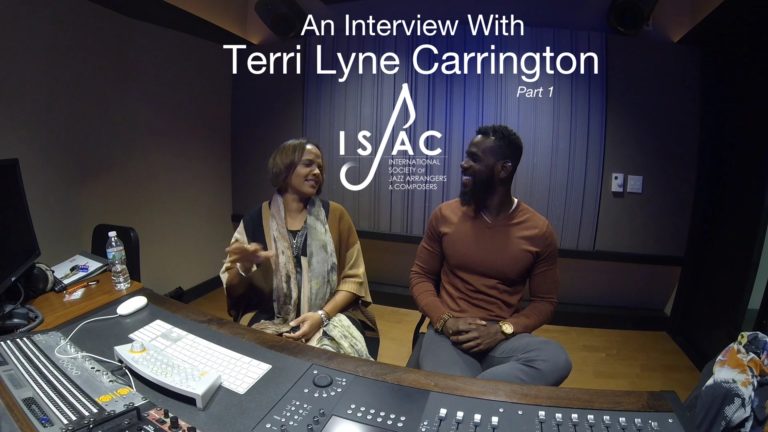
An Interview With: Terri Lyne Carrington (Part 1)

An Interview with:
Terri Lyne Carrington (Part 1)


An Interview with drummer and composer Terri Lyne Carrington
Presented by the International Society of Jazz Arrangers and Composers
Want to help ISJAC create more content like this? Visit: isjac.org/support

Terri Lyne Carrington
terrilynecarrington.com

In this part, Terri Lyne Carrington talks about her career, her method of arranging, cross-genre explorations, and creativity with ISJAC’s Omar Thomas.

Composer Interviews

An Interview With: Darcy James Argue

An Interview with:
Darcy James Argue


An Interview with composer Darcy James Argue
Presented by the International Society of Jazz Arrangers and Composers
Want to help ISJAC create more content like this? Visit: isjac.org/support

Darcy James Argue
secretsocietymusic.org

Darcy James Argue talks about his background, his voice, writing for multimedia, his latest project, “Real Enemies,” and more in this video interview with ISJAC’s Omar Thomas.