Frank Carlberg: Some Harmonic Strategies In (Jazz) Composition
In my studies in writing and playing I’ve noticed that the stimulus for pieces or explorations come from a wide variety of places. One way I’ve thought of the sources for new music is to put them in three loosely defined categories:
- music or musical ideas inspired by or derived from existing music (“model” composition, drawing from a specific parameter of a piece one admires etc);
- non-musical inspirations both structural (Brion Gysin’s permutation poems, the charms of restrictions in the writings of Anthony Etherin and Christian Bök, number sequences [pi, phone numbers, counting etc] and reflective/non-structural [visual arts, poetry, social issues, political events, nature,“non-musical” arts in general etc]);
- music or ideas created out of a musical concept, not necessarily an existing piece (12-tone systems, Peter Schat’s Tone Clock, The Lydian Chromatic Concept, permutations, instrument technical topics etc).
This is certainly not the only way I would or could divide my inspirations or sources but it will serve the purposes of this short essay. The categories also often have natural overlap. In any case the categories are not important per se, just a way to organize thoughts and look for ideas. Below I will focus on a very limited area related the third category. We will focus on exploring harmonic possibilities within very narrowly set parameters. I am also mostly avoiding examples of existing pieces as that can often lead us to interpret a concept as something that generates a certain result. I am very interested in open ended ideas that do not dictate style and surface elements but rather leave those facets up to the individual writer to arrive at. The short examples below should be understood with that in mind and are only there as a way of illuminating a certain idea or process, not as a finished piece of music.
Chord symbols can be very practical and serve as kind of a shorthand for harmony, but I wanted to explore fairly simple harmonic units that are a bit more precisely defined. “Thinking” in terms of chord symbols when composing can expose some limitations. This led me to investigate a limited set of “traditional” triads, trichords and tetrachords.
One way of viewing harmony is to observe its two dimensions; color (vertical) and movement (horizontal). In the topics below I attempt to first discuss the vertical and then address the horizontal. I should also mention that although this article focuses on harmony, I have utilized many of these ideas in a linear/melodic/horizontal way.
“Traditional” Triads
Start with major and/or minor triads only in a three-voice structure. Set up some voiceleading parameters such as:
-two common tones between adjacent triads; one voice move up or down in minor or major seconds.
AND/OR
-one common tone between adjacent triads; two voices move up or down in minor or major seconds.
AND/OR
-all three notes move up or down by minor or major seconds.
When there is an aesthetic “need”, allow for augmented and diminished triads and “suspended triads”(not really a triad, I know) also. Experiment with your own parameters.
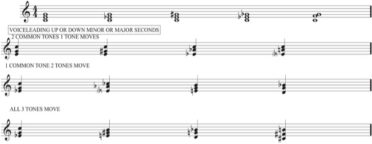
Here is an example that initially focuses on minor triads. I use an open position for these as it brings out the individual voices more distinctly (accidentals in all examples apply only to note that follows it). Incidentally I used something similar on my piece Los Trabajos Y Las Noches which is on an upcoming album of the same name with the great Argentine singer Roxana Amed (Sony Latin).

https://soundcloud.com/user-397727903/los-trabajos-y-las-noches?in=user-397727903/sets/roxana-amedfrank-carlberg-los-trabajos-y-las-noches
Trichords
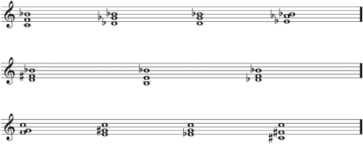
In order to further explore three-note units/cells I’ll also include non-triadic formations. Here are a handful of trichords, both triadic and non-triadic:

This is by no means a complete list of possible trichords but certainly enough to create some interesting movement. I didn’t set strict parameters regarding the voiceleading to guide my choices but find it useful to limit the number of trichord types I’ll use in one progression.
Here are some examples (the trichords with their inversions):
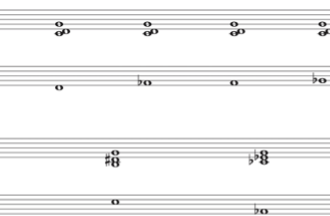
Add a fourth voice as a bass part. You can compose a bass part freely or use a pre-existing set of pitches.
In this example I’m using the tone row from Alban Berg’s violin concerto, in part because it emphasizes movement in thirds and avoids the cycle of fifths movement. Again, I’m limiting the trichord types that I choose.
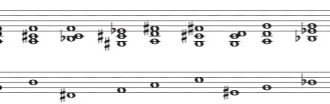
Since these verticalities are not functional in the traditional sense a sequence like this can yield many different perspectives by exploring various harmonic phrase lengths; as for instance in dividing these 12 chords in phrases of 3(chords)-3-3-3; or 2-3-4-3; or 3-2-1-4-2 etc. Or looping the 12 chord sequence, which gives even more options such as 3-2-3-2-3-2-3-4 etc.
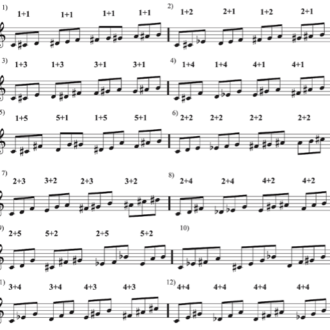
Peter Schat’s TONE CLOCK (peterschat.nl/clockwise.html) has also directed me in interesting directions. The Tone Clock concept has 12-tone rows that are each divided into 4 trichords. Each trichord for any row has the same intervallic makeup to any other trichord in the same row. This leads to certain symmetries in each row. I will not delve deeper into the Tone Clock possibilities but will just present the tone rows here and a couple of simple applications.
Here are the basic Tone Clock rows (the numbers above indicate the intervals in each trichords in number of halfsteps):
Here are the trichords (non-transposed) from row 9 and then with a freely composed bass voice added:
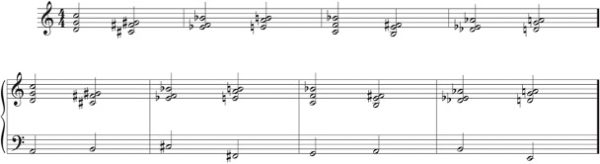
Here are the trichords from row 11 combined with themselves (in simple separation) creating 6-note vertical structures with one transposition included. Notice how the harmonic effect changes when the same two trichords are used in reversed vertical order.

Here are the trichords from row 11 mixed vertically in a short progression:

Tetrachords
When working with tetrachords start with 4-note structures such as these (these are by no means all the possibilities (there are 29 unique tetrachords) but there are more than enough options here):

As with the trichords, I might prefer to limit the number of tetrachords that I use in order to create a certain intervallic/language coherence. However, you can experiment with this in any way you’d like, of course.
One can also consider which “traditional” chord type each tetrachord can express. Here are a few examples of that.
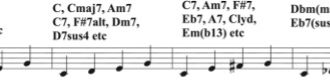
If the harmonic language and color of these tetrachords feel new to us, we might find it helpful to use an existing piece/progression as kind of a guide to “lean” on. This can help us to create direction and movement in our tetrachordal explorations (rumor has it that Scriabin would sometimes take a Bach piece and then create a harmonic abstraction of it… there is no scholarly consensus that he indeed extensively worked this way, but he certainly used a lot of tetrachords in his writing).
Here is an example of using the first half of Stella By Starlight as the harmonic guide in creating some tetrachordal movement.
The basic progression in chord symbols:
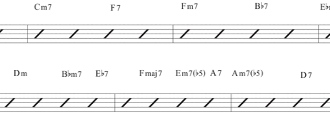
After omitting many of the ii chords in the ii-V’s and applying tetrachords to the remaining chords the result can look like this:

The chord symbols here are for reference and clarity only, not to necessarily be used. This is not Stella anymore. I would not consider it a “reharmonization” of Stella either, but rather materials for a new piece, with its own needs, wants and its own sound world.
Much of the material presented here I use in free flowing explorations. In my actual writing I tend to work fairly intuitively but I believe that everything we do in a study or analytical mode eventually has an impact on our reflexes, intuition and creative impulses.
None of these examples should be understood as methods but rather as concepts with open ended interpretations.
Georges Braque noted that limitation determines style, engenders new form, and gives impulse to creation. The materials above cover only a very limited area in terms of harmonic explorations. However, I hope that from these examples it is clear that even this narrow focus can generate a vast range of possibilities. These possibilities are not steering us in a set stylistic direction but are allowing us to operate in a space that is wholly reflecting our artistic personality.
Some Examples in Practice
Video from Ran Blake/Frank Carlberg album Gray Moon:
Track from recent trio album Reflections 1952:
https://www.youtube.com/watch?v=5pDG4nq1GSU
Track from Frank Carlberg Quintet album The American Dream (with poetry by Robert Creeley):
EPK for Frank Carlberg Large Ensemble album Monk Dreams, Hallucinations and Nightmares:
For more music by Frank Carlberg visit: https://frankcarlberg.bandcamp.com
About the Author:
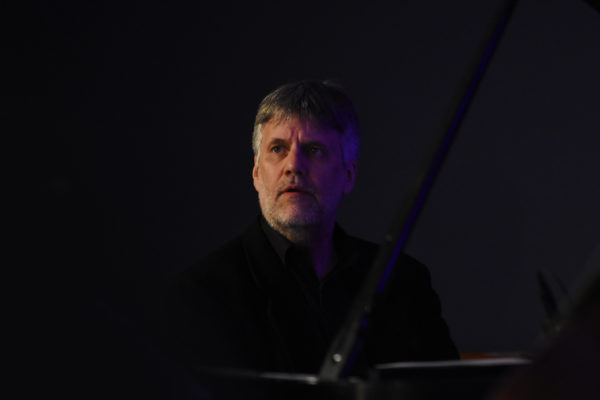 Originally a native of Helsinki, Finland, pianist/composer Frank Carlberg has carved himself quite a niche in the New York jazz community. As a leader, his groups include the Frank Carlberg’s Word Circus (performing settings of a wide variety of texts by Finnish, American, Russian, Argentine and Indian poets), the Tivoli Trio (a classic jazz piano trio playing an eclectic mix of Carlberg’s compositions drawn from cinematic and circus inspirations) and the Frank Carlberg Large Ensemble (performing original compositions as well as arrangements and re-compositions of standards and folk materials).
In addition to his own bands, the pianist has been involved in many crossover projects throughout the years. Some of his most notable collaborations have included performances and recordings with the likes of saxophonist Steve Lacy, trombonist Bob Brookmeyer and trumpeter Kenny Wheeler. He has been commissioned to write music for big bands, small ensembles, symphony orchestras as well as modern dance companies. He has composed nearly 200 settings to a wide range of texts and poetry. In addition to his playing and composing activities Carlberg also serves on the faculty at New England Conservatory. Carlberg has released over 20 albums as a leader. He was a founding member of the Douglass Street Music Collective and runs Red Piano Records, an independent record label with a current catalogue of over 50 releases. He runs 20 Questions, an interview blog.