Artist Blog

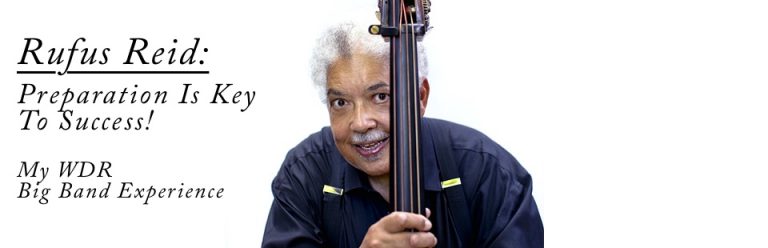
Rufus Reid: Preparation Is Key To Success! My WDR Big Band Experience (May 2020)

There were many lessons learned from the time I was asked to schedule a timeline to perform with the infamous WDR Big Band in Koln, Germany, with my music. For those who do not know, WDR, Westdeutscher Rundfunk is a German public-broadcasting Institution with the main office in Köln, Germany. NDR Big Band is based in the North in Hamburg, Germany. The HR Big Band is in Frankfurt, Germany. Each of these bands are made up of exceptionally talented jazz musicians, many who are from other countries, including the United States, as well as from Germany. These professional European bands have been around a very long time. I am deeply honored to have been invited this past March to perform my music with the WDR. My dear friend, Dennis Mackrel, was my conductor who made this memorable visit a most successful one on many levels.

(Watch Link: https://www.facebook.com/watch/?ref=external&v=576875436374551)

To become a good composer is somewhat similar to becoming a good player. One should have, at least, one significant role model for inspiration. One also has to be persistent, diligent, and consistent with conviction to be taken seriously, so they can be called again and again to play with other good musicians. Composers also want to hear their music played more than once, as well. You can be recommended that first time, but the second time is totally based on that initial performance. When are you ready? Watch, listen, study, and ask questions by seeking out those individuals who inspire you! When it’s time for your music to be performed on the stage, it must sound like it belongs there. How do you know? When people you respect give you an unsolicited thumbs up! Believe me, it will empower and carry you a long way! Begin being truly honest with yourself! Bottom line, the music you compose must resonate with others. The best compliment would be, “I’d love to hear that again!” Ultimately, it’s all on you.

In my many years as a professional improvising bassist, I have had the good fortune to perform and record with some of the greatest players who were and are incredible composers, as well. I have always been intrigued and baffled how they were able to conceive this incredible music. I began a quest to find out what this composition thing was all about.

When I joined the BMI Composers Workshop in 1999, I was thrust into an environment that was completely foreign to me. Intellectually, I understood we would be writing for a big band. I had written a few big band arrangements, but this workshop was about coming up with fresh ideas. Arranging requires its own set of unique skill sets to take a known composition and give it a new look and/or sound. I was asked to write what I wanted to write. I was NOT prepared to write what “I” wanted to write. I had no idea what that was! In that moment I felt completely at a loss to respond in any way. I had never been asked that question before, ever! The music I knew basically was already prescribed for a particular musical setting, i.e. music for film, television, a musical, a wedding, or a myriad of situations. So, the inner search was initiated to find out what actually pleased and satisfied me without being judgmental! HA! Fat chance of that not happening! At the time, the BMI Workshop had three exceptional coaches, Manny Albam, Jim McNeely, and Michael Abene, to help guide all of the individual participants closer to being yourself. In the five years as a participant, I was never told “No, that’s not good!” I was simply asked, “Is that really how you want it to sound?” That sent a huge message for me to return to the drawing board and keep searching! Another was, “That’s pretty good, but try orchestrating this with very different instruments!” We all have our comfort zones and I was asked to stretch and leave mine. I still have to NOT get too comfortable with what I come up with too soon in the process. And that is it! I have grown to love the entire process of composing! The constant search is very mysterious, extremely daunting, and exhilarating when you discover “it!” One of my oldest friends, the late Muhal Richard Abrams, said to never stop listening to all kinds of music. You might be surprised at what you actually like. Eddie Harris taught me not be afraid of any music. So, these past twenty years, I have conscientiously tried to do exactly do as they suggest.

Now, with all that said, one has to learn how to orchestrate so that idea sounds solid, while also “sounds!” It is clearly heard no matter of the density surrounding this idea. Finding the “sweet spots” of all instruments. Manny Albam used to call them the “money notes” because he was always on the clock and it had to sound good all of the time or people were unhappy! Whether you are on the clock, everything written must have a “sound.” The idea sounds. That voicing really sounds! The orchestration truly sounds. Everything is clear with articulations, dynamics, measure numbers, page numbers, chord symbols, and whatever else makes a great sounding chart, etc. etc. etc!

The WDR Big Band experience gave me a real taste of what the BMI workshop prepared me for! That in itself was extremely gratifying. I remember so well being told that you are in a good place when you finish a commission or any project. Now, have the confidence to put the score and parts in a package. Mail the package and do not expect to hear anything, except it was received, the first reading went well, and the music was liked by all! THAT, my fellow readers, is not easy to accomplish, but I am getting closer, I think!

The music I have written and performed with the WDR Big Band will give the listener a glimpse of what has happened in these past years. I was sent guidelines as how to prepare my music to send via PDF. All of the scores and parts had to be prepared by computer software. That made sense since we all use Finale or Sibelius software, but they did not want to see the “jazz font” at all. I had four charts with the jazz font. I know, supposedly, you can designate the change and push a button and that’s it. It isn’t quite that simple. The articulations changed. Then I said to myself, since I’m in this, let me see if I can tweak some parts and the domino effect came in. Oh my, did I mention I had a couple different versions of this chart in the computer and I tweaked and sent the wrong one? Fortunately, I caught most of the proofing issues before sending out nine pieces of music for this project. We rehearsed four days and all of the players were so on it about everything! Specific articulations had to be discussed and finalized before moving on. What one might think is a universal language for “jazz” articulation, is not that simple, particularly to those who do not know you or your music! When you are aware your music is new to everyone, the clearer everything must be at the outset! I had to adjust some measures in a saxophone tutti in one piece and correct some trombone voicings in another. This doesn’t sound like much, but folks, I was mortified! The score and parts matched, which is supposed to be a good thing, but they were wrong! I do not know how any of that could have happened! The computer messed up my parts, I am sure of it! DUH! I am truly happy that out of all the music I sent, this was minor, but it should not have happened at all at this level. If I had truly taken the time to proof and/or have someone else proof, the music would have been sufficient, as it should be.

One of the issues at hand for me at this juncture in my life, is, I am attempting to compose other music outside and away from the jazz mentality or sensibilities. This has required me to become more articulate with literally everything on the music page. When you write for your band or players who are familiar with you, the music should still be clear enough to have a smooth initial rendering. Theoretically, I am well aware of the importance of proofing, but somehow it still eludes me. That’s when it hurts when you get busted for it!

The moral to this story, is no matter how savvy you are with the computer software, one should have another set of eyes and ears to help proof your music. I wish to be asked to return to perform and write for the WDR Big Band again in the future. Hence, preparation is the key to success. “Gots to be more careful!”


About the Author:

Photo by John Abbott

For the last 50 years, Rufus Reid has been a consistent, formidable, and influential presence in the jazz world as a bassist and educator. His performances and recordings with Eddie Harris, Nancy Wilson, Dexter Gordon, Andrew Hill, The Thad Jones-Mel Lewis Orchestra and Quartet, Kenny Barron, Stan Getz, J. J. Johnson, Lee Konitz, Jack DeJohnette, to name but a few, has cemented his stature as one of the great living deans of the jazz bass. His receipt of the 2006 Raymond Sackler Commission resulted in his five-movement suite for large jazz ensemble, Quiet Pride-The Elizabeth Catlett Project. In November 2015, this album received two Grammy nominations, for Best Large Jazz Ensemble and Best Instrumental Composition. Rufus Reid is a 2008 Guggenheim Fellow in the field of composition, which resulted in the three-movement symphonic work, Mass Transit. In April 2016 he was named Harvard University’s Jazz Master in Residence, participating in public conversations and also performing in concert with his original compositions. In April 2017, Lake Tyrrell In Innisfree, Rufus’ third symphonic work was debuted in Raleigh, NC by the Raleigh Civic Symphony. May 2017, Rufus Reid was awarded the America Composers Forum Commission to composed, Remembrance, for Pittsburgh New Music Ensemble to be premiered in July 6-7, 2018. In December 2017, Newvelle Records, an all vinyl recording company, will release the Rufus Reid Trio, “Terrestial Dance,” featuring the Sirius Quartet. February, 2020, Newvelle Records release his second vinyl duo recording, “Always In The Moment,” with stellar pianist, Sullivan Fortner. A distinguished educator as well, for 20 years Rufus was Director of the Jazz Studies Program at William Paterson University and was instrumental in building the program’s international reputation as one of the leading jazz schools in the world. He has recorded more than 400 albums and a dozen albums as a leader and authored a seminal text and DVD for bass methodology, The Evolving Bassist. Rufus’ continues to evolve as a composer and “The Evolving Bassist.”

Artist Blog

Rufus Reid: Preparation Is Key To Success! My WDR Big Band Experience

There were many lessons learned from the time I was asked to schedule a timeline to perform with the infamous WDR Big Band in Koln, Germany, with my music. For those who do not know, WDR, Westdeutscher Rundfunk is a German public-broadcasting Institution with the main office in Köln, Germany. NDR Big Band is based in the North in Hamburg, Germany. The HR Big Band is in Frankfurt, Germany. Each of these bands are made up of exceptionally talented jazz musicians, many who are from other countries, including the United States, as well as from Germany. These professional European bands have been around a very long time. I am deeply honored to have been invited this past March to perform my music with the WDR. My dear friend, Dennis Mackrel, was my conductor who made this memorable visit a most successful one on many levels.

(Watch Link: https://www.facebook.com/watch/?ref=external&v=576875436374551)

To become a good composer is somewhat similar to becoming a good player. One should have, at least, one significant role model for inspiration. One also has to be persistent, diligent, and consistent with conviction to be taken seriously, so they can be called again and again to play with other good musicians. Composers also want to hear their music played more than once, as well. You can be recommended that first time, but the second time is totally based on that initial performance. When are you ready? Watch, listen, study, and ask questions by seeking out those individuals who inspire you! When it’s time for your music to be performed on the stage, it must sound like it belongs there. How do you know? When people you respect give you an unsolicited thumbs up! Believe me, it will empower and carry you a long way! Begin being truly honest with yourself! Bottom line, the music you compose must resonate with others. The best compliment would be, “I’d love to hear that again!” Ultimately, it’s all on you.

In my many years as a professional improvising bassist, I have had the good fortune to perform and record with some of the greatest players who were and are incredible composers, as well. I have always been intrigued and baffled how they were able to conceive this incredible music. I began a quest to find out what this composition thing was all about.

When I joined the BMI Composers Workshop in 1999, I was thrust into an environment that was completely foreign to me. Intellectually, I understood we would be writing for a big band. I had written a few big band arrangements, but this workshop was about coming up with fresh ideas. Arranging requires its own set of unique skill sets to take a known composition and give it a new look and/or sound. I was asked to write what I wanted to write. I was NOT prepared to write what “I” wanted to write. I had no idea what that was! In that moment I felt completely at a loss to respond in any way. I had never been asked that question before, ever! The music I knew basically was already prescribed for a particular musical setting, i.e. music for film, television, a musical, a wedding, or a myriad of situations. So, the inner search was initiated to find out what actually pleased and satisfied me without being judgmental! HA! Fat chance of that not happening! At the time, the BMI Workshop had three exceptional coaches, Manny Albam, Jim McNeely, and Michael Abene, to help guide all of the individual participants closer to being yourself. In the five years as a participant, I was never told “No, that’s not good!” I was simply asked, “Is that really how you want it to sound?” That sent a huge message for me to return to the drawing board and keep searching! Another was, “That’s pretty good, but try orchestrating this with very different instruments!” We all have our comfort zones and I was asked to stretch and leave mine. I still have to NOT get too comfortable with what I come up with too soon in the process. And that is it! I have grown to love the entire process of composing! The constant search is very mysterious, extremely daunting, and exhilarating when you discover “it!” One of my oldest friends, the late Muhal Richard Abrams, said to never stop listening to all kinds of music. You might be surprised at what you actually like. Eddie Harris taught me not be afraid of any music. So, these past twenty years, I have conscientiously tried to do exactly do as they suggest.

Now, with all that said, one has to learn how to orchestrate so that idea sounds solid, while also “sounds!” It is clearly heard no matter of the density surrounding this idea. Finding the “sweet spots” of all instruments. Manny Albam used to call them the “money notes” because he was always on the clock and it had to sound good all of the time or people were unhappy! Whether you are on the clock, everything written must have a “sound.” The idea sounds. That voicing really sounds! The orchestration truly sounds. Everything is clear with articulations, dynamics, measure numbers, page numbers, chord symbols, and whatever else makes a great sounding chart, etc. etc. etc!

The WDR Big Band experience gave me a real taste of what the BMI workshop prepared me for! That in itself was extremely gratifying. I remember so well being told that you are in a good place when you finish a commission or any project. Now, have the confidence to put the score and parts in a package. Mail the package and do not expect to hear anything, except it was received, the first reading went well, and the music was liked by all! THAT, my fellow readers, is not easy to accomplish, but I am getting closer, I think!

The music I have written and performed with the WDR Big Band will give the listener a glimpse of what has happened in these past years. I was sent guidelines as how to prepare my music to send via PDF. All of the scores and parts had to be prepared by computer software. That made sense since we all use Finale or Sibelius software, but they did not want to see the “jazz font” at all. I had four charts with the jazz font. I know, supposedly, you can designate the change and push a button and that’s it. It isn’t quite that simple. The articulations changed. Then I said to myself, since I’m in this, let me see if I can tweak some parts and the domino effect came in. Oh my, did I mention I had a couple different versions of this chart in the computer and I tweaked and sent the wrong one? Fortunately, I caught most of the proofing issues before sending out nine pieces of music for this project. We rehearsed four days and all of the players were so on it about everything! Specific articulations had to be discussed and finalized before moving on. What one might think is a universal language for “jazz” articulation, is not that simple, particularly to those who do not know you or your music! When you are aware your music is new to everyone, the clearer everything must be at the outset! I had to adjust some measures in a saxophone tutti in one piece and correct some trombone voicings in another. This doesn’t sound like much, but folks, I was mortified! The score and parts matched, which is supposed to be a good thing, but they were wrong! I do not know how any of that could have happened! The computer messed up my parts, I am sure of it! DUH! I am truly happy that out of all the music I sent, this was minor, but it should not have happened at all at this level. If I had truly taken the time to proof and/or have someone else proof, the music would have been sufficient, as it should be.

One of the issues at hand for me at this juncture in my life, is, I am attempting to compose other music outside and away from the jazz mentality or sensibilities. This has required me to become more articulate with literally everything on the music page. When you write for your band or players who are familiar with you, the music should still be clear enough to have a smooth initial rendering. Theoretically, I am well aware of the importance of proofing, but somehow it still eludes me. That’s when it hurts when you get busted for it!

The moral to this story, is no matter how savvy you are with the computer software, one should have another set of eyes and ears to help proof your music. I wish to be asked to return to perform and write for the WDR Big Band again in the future. Hence, preparation is the key to success. “Gots to be more careful!”


About the Author:

Photo by John Abbott

For the last 50 years, Rufus Reid has been a consistent, formidable, and influential presence in the jazz world as a bassist and educator. His performances and recordings with Eddie Harris, Nancy Wilson, Dexter Gordon, Andrew Hill, The Thad Jones-Mel Lewis Orchestra and Quartet, Kenny Barron, Stan Getz, J. J. Johnson, Lee Konitz, Jack DeJohnette, to name but a few, has cemented his stature as one of the great living deans of the jazz bass. His receipt of the 2006 Raymond Sackler Commission resulted in his five-movement suite for large jazz ensemble, Quiet Pride-The Elizabeth Catlett Project. In November 2015, this album received two Grammy nominations, for Best Large Jazz Ensemble and Best Instrumental Composition. Rufus Reid is a 2008 Guggenheim Fellow in the field of composition, which resulted in the three-movement symphonic work, Mass Transit. In April 2016 he was named Harvard University’s Jazz Master in Residence, participating in public conversations and also performing in concert with his original compositions. In April 2017, Lake Tyrrell In Innisfree, Rufus’ third symphonic work was debuted in Raleigh, NC by the Raleigh Civic Symphony. May 2017, Rufus Reid was awarded the America Composers Forum Commission to composed, Remembrance, for Pittsburgh New Music Ensemble to be premiered in July 6-7, 2018. In December 2017, Newvelle Records, an all vinyl recording company, will release the Rufus Reid Trio, “Terrestial Dance,” featuring the Sirius Quartet. February, 2020, Newvelle Records release his second vinyl duo recording, “Always In The Moment,” with stellar pianist, Sullivan Fortner. A distinguished educator as well, for 20 years Rufus was Director of the Jazz Studies Program at William Paterson University and was instrumental in building the program’s international reputation as one of the leading jazz schools in the world. He has recorded more than 400 albums and a dozen albums as a leader and authored a seminal text and DVD for bass methodology, The Evolving Bassist. Rufus’ continues to evolve as a composer and “The Evolving Bassist.”

Artist Blog

John La Barbera: Basic Tools For Better Arranging

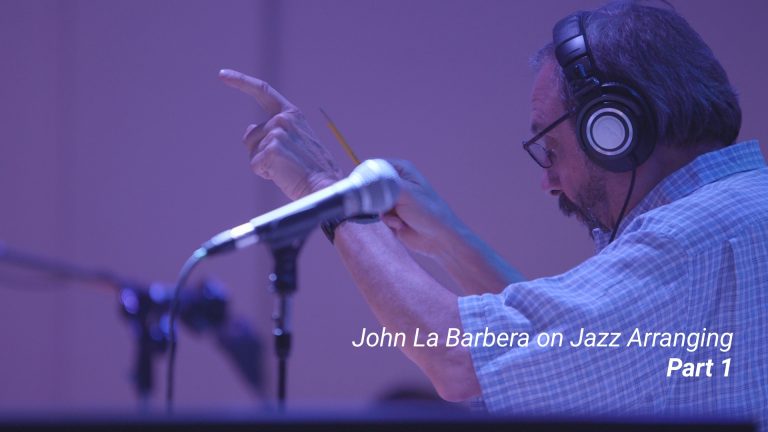
I recently revisited a magazine article I did on arranging over 30 years ago to see how germane it is to today’s world of scoring.   Surprisingly, except for the fact that musical styles and industry practices have changed drastically (in the commercial advertising world we got paid to do demos and we recorded with live musicians), the basic tenants of presenting the fundamentals of arranging haven’t changed.   Here’s an abridged and slightly updated version of that article.

BASIC TOOLS FOR BETTER ARRANGING

As a young arranger, I was always searching for some work that actually described the process involved in making orchestral arrangements.“- Glenn Miller, 1943

Well, Glenn, we’re still looking for that one text that gives us the secrets and lays it all out for us.  Unfortunately, that book will never exist, because arranging is an art that evolves hand-in-hand with music composition and technology; it is changing constantly.  And, since it is an art, one can’t effectively break it down into hard rules and regulations.  We can, however, list and explore the various musical techniques that one might use to get a working knowledge of the field.  It doesn’t matter if you use a pencil and score paper or a mouse and a notation program, the principles and techniques still apply.  Okay, La Barbera, quit talking and show us some hip voicings.  Sorry Glenn, no voicings yet.  So often, the novice assumes that the secrets of arranging lie in the chord voicings used by the various greats of the art.   Nothing could be further from the truth.   We have to learn what arranging is before we get to any of that.   Here’s my definition of arranging:

Arranging, in music, is the art of giving an existing melody musical variety for a listening audience.

The composer gives us the melody and we, as arrangers, strive to give it variety.   Henry Mancini has said, “The song is the thing, and the arranger’s function is to make it memorable, regardless of one’s personal feelings.”  And variety, musical variety – is what makes the song memorable.   This musical variety comes from our knowledge of the tools of arranging and how to use them.   An arranger is very much like a magician.  After presenting a melody to an audience we try musical sleight-of-hand to keep their attention, because if the audience can predict what’s going to happen next, we lose their attention and therefore are not as successful as arrangers.  We’ll list some of those tools in a little while, but first I want to explain the last part of my definition – the audience.

As arrangers (or composers or performers for that matter) we are always dealing with an audience, whether real or imaginary.   If we wrote or played music just for ourselves, it would not truly be a creative art.   To be successful in the musical arts, one must always acknowledge the existence of a listener and create accordingly.  It’s somewhat like the old riddle of “if a tree falls on your Pro Tools Rig in the woods and there is no one around to hear it fall, does it make a sound?  Suffice it to say that with even one set of ears around, the whole event has an impact.  It becomes memorable.  I believe that the success of our great arrangers is partially due to their conscious or subconscious acknowledgement of a listening audience.  So, if you think about it, the arranger’s job is to take a melody/song and play it for an audience for a certain length of time without boring them.  If we played the same melody over and over with the same instruments for six minutes, with the same chord changes, they’d be searching for the rotten egg emoji.  We have to give it variety and make it memorable so as to keep the audience’s attention.  It’s just that simple.  How we keep their attention shows our talent as arrangers.  If we wanted to break down my definition into rules or commandments of arranging, we’d arrive at something like the following.

Rule 1: Thou Shalt Not Bore

Strive to give the song or melody as much variety as necessary to capture and please an audience, while at the same time keeping the integrity of the composer’s musical idea.  This is such a fine line – balancing one’s arranging techniques against the intent of the composer while maintaining a stamp of individuality – that it can take a lifetime to learn to do it consistently.

Rule 2: Know Thy Place

We must always remember that, as arrangers, we’re subservient to the melody and must write accordingly.  Unlike composers, we arrangers are not allowed the luxury of personal likes and dislikes when it comes to the melody or the musical style we have to work in.  Disdain for a certain style or song shows through in your musical arrangement.  (The hardest job I ever had was when Count Basie asked me to arrange Rubenstein’s “Melody In F”  for his band.  I didn’t care for the song as a Basie-style tune, and I stared at blank score pages for weeks.) We have to divorce ourselves from our musical prejudices, listen to all kinds of music, and be prepared to cover any style with sincerity.  Remember what Hank Mancini said – “regardless of one’s personal feelings.”

Rule 3: Know Thy Boss

Remember that we are ultimately working for someone else.  When we take the job of arranger, we are not working for ourselves but for an audience with a composer or producer in between.  We must strive to please both but fight like hell for the audience when confronted with a choice.  I tell students that if I can get five percent of John La Barbera (a creative uniqueness or stamp of identity) in a chart, I’m more than pleased.  The hardest pill to swallow is when you bring your finished masterpiece to a bandleader or producer and he/she immediately cuts out the hippest interlude you’ve ever written.  All of us, no matter how famous we become, must be prepared to give up our most prized musical child at the whim of the client.  The best advice I ever received from any arranging book was from Mancini’s Sounds And Scores [Cherry Lane].  I underlined the last paragraph on page 1 in my copy:  ” …  Finally, don’t fall in love with every note you write … Be prepared to eliminate anything that tends to clutter up your score, painful as it may be to do so.”  Even if you are the composer /producer and it’s your record label featuring you as the artist, the audience is still the boss.  Keep that in mind and you’ll find arranging decisions much easier to make.  Now then, if you’re still with me, we’ll move on.

Rule 4: Know Thy Styles

We must be familiar with the idiom in which we intend to place the melody.  In simpler terms, if you have never listened to current pop styles like R&B, or Country Blues groove, etc., then you can’t successfully arrange a melody in those styles.  Or, if you’ve never heard second line, you’ll be spinning your wheels when it comes time to cover that style.  So, it’s obvious that if you aren’t familiar with a style of music, you can’t competently arrange in it.  That seems pretty obvious, but I’ve seen students try to arrange a big band jazz chart who have never heard of Basie or listened to Stan, Woody or Duke.  So, before we can become arrangers, we have to know our musical styles and learn what instruments, rhythms, and harmonies are basic to each idiom. 

Now, let’s get down to the nuts and bolts of arranging by listing some of our tools and putting them in an arranging road case.  These are what I call the five basic variations used in arranging, and we’ll get our roadie to pull them out one at a time and illustrate how each of them works.  The devices in each category are just a starting point.  I’m sure you’ll have your own ideas so add those as necessary.

RHYTHMIC VARIATION

1.  Change the rhythm of the melody.  Of course, no brainer.

2.  Change the rhythmic feel; double time, half time etc.

3.  Gradually speed up or slow down the tempo.

4 .Refrain from using one rhythm for any length of time. 

5.  Displace the melody relative to the bar line by a uniform value.

6.  Change the meter 4/4 to 3/4.  (My arrangement of “So What”  is a good illustration)

Slightly varying the rhythm gives new life to the melody however, this is effective ONLY after you’ve stated the original.

The audience needs a reference before it recognizes a variation.  I believe this is true for all of the variations we incorporate.   

It’s been a common practice for years to go to double time for the blowing on a ballad and then back to the original tempo to take it out.  Gradually speeding up and slowing down is a great device (Brad Mehldau and other groups have used this very effectively) but it takes some rehearsing.   

Changing the meter is a great way to add variety.  My arrangement of “So What”  is a good illustration.

Then imply 4/4  and eventually get there.

The next tool in our road case is

HARMONIC VARIATION

1.  Substitute chord changes (reharmonization).

2.  Change melodic modes (major to minor).

3.  Use counterpoint to imply new harmonies.

4.  Modulate to new keys, either subtly or drastically.

Every melody comes with its own harmony or set of chord changes, whether given or implied.  If we change the harmony after our audience has heard and absorbed the original chord changes, we automatically create variety.  So, the use of substitute chord changes, or reharmonization, is one device in the harmonic category.   Another secret that seasoned writers share is that a new device introduced into the chart has effect, but the more devices or variations you add to a chart at the same time, the less impact each will have (i.e.  modulating and using a substitute change for the new target key down beat…softens the impact).  Keep this in mind when you are  tempted to empty the whole road case of tools into the same section of a melody.  As with all devices in arranging, we must remember that we are working for the song.  Anything we add has to support the melody and not overpower it.  I find that harmonic variation is the one tool that’s most overused by arrangers and is an area where we can get into the most trouble.  Hip changes, used for the sake of being hip, rarely fit comfortably into a well-balanced chart.

Now that we have two arranging tools at our disposal.  Let’s go on to another.  I call the next device:

PERFORMANCE VARIATION

1.  Vary the articulations of the melody. 

2.  Vary the dynamics of a phrase or section. 

3 .Use ornaments, such as trills, turns, and grace notes. 

4.  Use pitch-bend or modulation.

5.  Take advantage of the basic instrument mutes (plungers, straight mutes, hats, etc.) and combinations thereof (plunger wa-wa over straight mute, bucket over straight, cup in bucket, etc.).

6.  Use effects that are unique to individual instruments, such as half valves, squeaks, flutter tongue, sub tone, etc. 

Performance variations encompass quite a few items that we don’t always think of when doing an arrangement and, to me, is one of the most important tools we can use.  I believe it’s what’s above & below the notes that make music and the uniqueness of an arrangement. 

These are the performance techniques are the one uses when playing music – articulations (long, short, etc.), ornaments (turns, trills, shakes, flips, pitch-bend, vibrato, etc.), and dynamics (crescendo, decrescendo, subito p, sforzando, etc.).  Using any of these performance devices in your arrangement is a sign of a seasoned writer.   Just as an orchestra conductor studies all of the nuances of string bowing techniques, we must be familiar with all of the unique sounds and variances of each instrument in the band.

Mixtures of muted and open instruments is a wonderful way to add variety to an already stated melody…it adds color and the repetition of the melody is acceptable to an audience.   The hat or derby is probably one of the most versatile mutes for brass but it has fallen out of favor these days.  Muted brass in buckets produce wonderful colors.  Look how a bone deep in the hat coupled with alto and trumpet creates a life like French horn sound at the end of the shout chorus.

Also, like Basie, using cresendi, subito p, and back and forth adds so much variety to the passage.

Here’s a link to the entire chart in case you want to check it out.

https://www.youtube.com/watch?v=rZIA_zYlF_0

“What about chord voicings , aren’t you ever going to get to chord voicings like clarinet lead over two altos and two tenors?”

Sorry, Glenn, not yet.  But that brings up an interesting point.  People tend to interchange orchestration and voicing.  They use the term voicing when they really mean orchestration and vice-versa.  It’s very important to understand the difference.

When beginning students come to me with questions about arranging, the first thing they usually say is something like, “I’ve been working on this chart and I want to use this sax voicing but I’m not sure if it will sound.”  Or, “Will this half step between the cellos and violas work?”  This aspect of arranging, the voicing and orchestrating of chords , is just another tool in the art, but it always seems to attract the most attention.  I guess it’s like a slick paint job on a Porsche – the most important parts are under the hood, but the paint job gets the attention, So, let’s clear this up right now.  Voicing is the putting together of chords in a certain way, with the notes stacked in a certain order.  Orchestration is simply what instruments are assigned to play the notes you included in the voicing.

VOICING

1.  Close.

2.  Open.

3.  Cluster.

4.  Unisons & Octaves.

Let’s talk about voicings.  We all should know the difference between a closed voicing and an open voicing, a cluster and an octave unison.  Voicing techniques, especially in jazz, are usually the individuality stamp of the arranger.  I would voice and orchestrate a certain passage differently from my colleagues.  If we’ve listened enough to any idiom we can probably pick out the individual arrangers by their style and voicing techniques.  Traditionally, a composer/arranger would give a sketch of his or her work to an orchestrator, who, in turn, would use standard rules for assigning the different musical lines and chords to conventional bodies of instruments.  In today’s music, there are so many new instruments, recording techniques, and consolidations of music styles that there are fewer and fewer standard rules of orchestration.  So what was once a separate trade has now become an additional, necessary skill of the arranger. 

To recap, the voicing is the type of chord structure (unison, close, open, octave, unison, cluster, etc.) and the orchestration is the body of instruments assigned to play the voicing.  Orchestration and voicing allow us to create unique sounds or musical colors by combining different instruments.  If we think of voicing and orchestration as two separate entities, it will be much easier to understand our job as arrangers.

On top of the endless possibilities and permutations of traditional acoustic instruments, we now have to contend with the modern instruments (world instruments, synths, samples, etc.).  These new instruments are a challenge in themselves, and the combining of acoustic and electronic instruments gives us further combinations with which to achieve unique musical colors.  We can truly spend a lifetime experimenting with voicing and orchestration, but it shouldn’t take the beginning arranger that long to find those combinations that fit and seem comfortable with his or her writing techniques.  These combinations go toward making up an arranger’s style.  For example, Nelson Riddle’s harmonic variation use of Lydian motifs identifies his work just as Gil Evans’ and Duke Ellington’s unique orchestration of their voicings identify their work.

Simply changing a line from unison to octaves gives it an entirely new character and an audience will accept the same backgrounds and chord changes.  Here’s an example using my arrangement of “Esperanza.”

Here’s a link to full video of the chart in case you want to check it out.

https://www.youtube.com/watch?v=UHN0FEgQRRY

There is one more device – melodic variation.

“Hey, that’s the composer’s job!”

Yes Glenn, sort of.  Melodic variation, this last piece of essential equipment, is composition.  The composer rarely gives us intros or endings.  The arranger is usually expected to furnish those.  We arrangers are also required to compose counterlines, interludes, and background melodies as well, in order to give existing material variety.  Here are some thoughts worth pondering:

Arranging, after all, is a euphemism,” according to Alex Wilder, “For it includes composition as well as orchestration. The introductions, countermelodies, transitions, and reharmonizing are all more than just orchestration.  But by using the word arrangement, they get two skills for the price of one.” 

“The true art of orchestration,” Walter Piston declared ,”is inseparable from the creative act of composing music.” 

And from Nelson Riddle: “An arranger occupies, in music, that shifting, almost indefinable ground between an orchestrator and composer.”

MELODIC VARIATION

1.  Creating and using countermelodies against melody.

2.  Variation of melody or fragment of melody used for interludes between sections.

3.  Introductions and endings based on newly created material.

It’s undeniable that arrangers must wear many hats in today’s music industry and must function sometimes as composers and orchestrators.  That’s why arranging is not a hack trade but an art that takes years to perfect.  So if you get discouraged because it doesn’t come to you right away, or, if after years of arranging, you still seem to get stuck, don’t worry;  join the club.


About the Author:

Cropped-Square-300x300

John P. La Barbera is a Grammy® nominated composer/arranger whose writing spans many styles and genres. His works have been recorded and performed by Buddy Rich, Woody Herman, Count Basie, Dizzy Gillespie, Mel Torme, Chaka Khan, Harry James, Bill Watrous, and Phil Woods just to name a few. Though his major output has been in jazz, he has had works performed and recorded for symphony orchestra, string chamber orchestra, brass quintet, and other diverse ensembles. Most recently, Mr. La Barbera was chosen from among dozens of applicants to participate in the Jazz Composers Orchestra Institute at UCLA. As a result, John was one of sixteen composers commissioned by the JCOI to compose new works that meld jazz and symphonic music. “Morro da Babilonia” was the resulting work and was presented by the American Composers Orchestra in New York City at Columbia University’s Miller Hall. His “Drover Trilogy” for string orchestra and corno da caccia was recorded by the late Dr. Michael Tunnell and has recently been released on Centaur Records. John’s Grammy® nominated big band CD “On The Wild Side along with “Fantazm and his latest “Caravanon the Jazz Compass® label, have been met with tremendous artistic and commercial success and are on the way to becoming a jazz big band standards. As co-producer and arranger for The Glenn Miller Orchestra Christmas recordings (In The Christmas Mood I & II) John has received Gold & Platinum Records and his arrangement of “Jingle Bells” from those recordings can be heard in the Academy Award winning film “La La Land.” Mr. La Barbera is a Professor Emeritus of Music at the University of Louisville’s School of Music and an international clinician/lecturer whose topics range from composing/arranging to intellectual property and copyright. Among his numerous organizational affiliations are Jazz Education Network, Phi Mu Alpha Sinfonia, NARAS, American Composers Forum, Chamber Music America, and a writer/publisher member of ASCAP since 1971.

John’s Sunday morning big band jazz radio show, “Best Coast Jazz” on WFPK has been a mainstay on public radio for over twenty years and is streamed worldwide. He is a two-time recipient of The National Endowment for The Arts award for Jazz Composition and has served as a panelist for the NEA in the music category. His career has recently been profiled in “Bebop, Swing and Bella Musica: Jazz and the Italian American Experience” and in dozens of publications and encyclopedias. John’s published works are considered standards in the field of jazz education.


Artist Blog

An Interview with John Clayton

NOTE: Interview conducted by Paul Read on Jan 10, 2018 at 2:30 PST.

ISJAC: Hey, John. Thanks for doing this.

JC: Happy to do it

ISJAC: Where are you at the moment, Los Angeles?

JC: Yes, I am in Los Angeles. I actually was born and raised here and finished school at Indiana University… hit the road for four years and then moved to Holland to be with my, then, girlfriend, now my wife, and played in a symphony orchestra for five years.1The Amsterdam Philharmonic.

ISJAC: You were with the Basie band before you went to Amsterdam?

JC: Yes. After I finished school I went on the road with Monty Alexander and Jeff Hamilton for two years. And I missed out on my dream to play with Duke Ellington – he died while I was still in college – and one of my other dreams was to play with Count Basie. I was studying with Ray Brown and I knew that Ray knew Count Basie very well. So I asked him if he could look into helping me get in touch with him. He said, “Sure” and the next day I was talking to Count Basie [laughter]. He called me and said, “Young man, I hear you would like to play in my orchestra.” and I said, “Yes, sir, Mr. Basie”. And he said, “Well, I’ll have my manager call you.” and it just so happened that his bass player was leaving in two weeks, so I let Monty Alexander know I had this opportunity and he gave me his blessing. I went with Count Basie and that’s where I really got bit by the writing bug. I’d never studied composition or arranging but I fell in love with that music being able to hear it every night there in real time. I knew how to transpose for instruments and I had some fantasies. So, I asked Mr. Basie if I could write some music, and he said, “sure”. I wrote something that was embarrassingly bad.  [Laughter] I was frustrated, certainly, but I wasn’t put off and I wasn’t discouraged. That’s the best way to put it.  So on one of my breaks I took the recording that Basie had done years before with Neal Hefti of a song called “Splanky.”2Recorded on The Atomic Mr. Basie. (YouTube video posted by Warner Bros.) “Which is “the 6th most critically acclaimed album of 1958, the 25th most acclaimed of the 1950s, and the 837th most acclaimed of all time, based on an aggregation of hundreds of critics’ lists from around the world”. Wikipedia.

ISJAC: Right.

JC: “Splanky” has an amazing shout chorus,3See the Appendix at the end of the article for an score excerpt showing the ‘triple lead’ approach. and I got goose bumps every time we played it, so I wrote a sketch of everything that was happening in that arrangement. The intro, I wrote it in words…you know: piano – Ab pedal in the left hand, drums plays with sticks, bass playing the pedal. Roman numeral two: melody played in unison by the brass with mutes (and I didn’t know which so I wrote cups, buckets, question mark). Sort of walked through it in words like that, and then I went back and I transcribed as many of the notes that I could hear. From that, I noticed that when we got to the shout chorus I could hear on the recording that the lead trumpet note happened to be the same note that the lead trombone player was playing and the same note that the lead alto was playing so I had discovered this ‘triple lead’ concept of writing…

ISJAC: Yeah, I hear that from time to time in your writing…

JC: Yeah, and the thing that it provides is a lot of clarity for the melody.  So I learned that whenever I want that kind of clarity I could use ‘triple lead’ or even ‘double lead’.  Anyway, that was the beginning.

ISJAC: How much music did you write while you were with Basie? Were you producing an arrangement or composition once a week, once a month?

JC: It went from once a month or every three weeks or so…it was never once a week.

ISJAC: Yeah, that’s a lot!! [Laughter]

JC: I also acknowledged that I did not have the chops to write that fast. And, by the way, they paid me for the arrangements.

ISJAC: That’s great of course.

JC: It was kind of shocking that I wrote my first endeavour and I got paid for it. So that was great.  And they not only paid for the chart, they paid for the copying too.

ISJAC: What a tremendous learning experience. To be inside a band like that, to be playing with the band, and hearing all those colours, and the orchestration. Everything is right there for you. As opposed to learning about those things from a purely theoretical standpoint.

JC: I absolutely agree.

ISJAC: Whenever I played saxophone in a big band, I would particularly notice what the trumpets and trombones were doing…. I mean I couldn’t avoid it…they were sitting right behind me [laughs].  But it is a truly amazing story that you started writing while you were in the Basie band!

JC: And, of course, the guys were very helpful. They had excellent writers in the band: Bobby Plater, Eric Dixon, and Dennis Wilson. Dennis was my homey because he was my age. He was a schooled writer because he studied at Berklee, and he would show me things about writing technically. And the other guys in the band would say things to me off the cuff that turned out to be invaluable – things that I think too many writers don’t know or don’t do. For instance, they’d see me working on a score, and that I was frustrated because we just played it and I’d be making some edits and corrections and they’d say, “Hey, what are you doing?” and I’d say, “Oh, this didn’t sound very good and I just want to change this or that”, and they’d say, “Well don’t change that! Just write another one! And the stuff you didn’t like in this one, don’t put it in the new one.”

ISJAC: Great advice.

JC: And that was so spontaneous on their part, but so deep for me and I followed their advice. With their encouragement, I kept writing and writing and writing. Another time, earlier on, one of the writers in the band was looking at a score of mine and he asked, “You write a ‘C’ score?” I replied [hesitating] “Yeah”, and asked me, “Well why?” and I said, “I don’t know” and then he said, “Don’t do that! Write a transposed score.” So I said, “OK” and that was that.

ISJAC: And is that what you do now?

JC: Yes. I write my sketches in C but then I always write transposed scores. Honestly, I’m at the point now where I have an assistant, so I usually write detailed sketches and use shorthand that she understands and can decipher. I’m in a lot of situations now where I have to write very quickly and so having an assistant is very helpful.

Incidentally, when I write a score, I don’t use notation software. I have Sibelius because I thought I should have it but I really don’t use it. I had Finale before that because I thought I might use it, but I have so many shortcuts that the software slows me down. It’s just the way I write.

ISJAC: I totally get that. It’s so much easier to write something on paper rather than have to look on page 135 of the manual to find out how to put something or other on the score for the first time.

JC: Yeah, and also, let’s say I’m writing a more extended piece. I sit at my piano and to my left is my desk and to the left of my desk, are two music stands. Now, I may need to refer to page 12, or 23 and 35 and, if I have to scroll on a computer, and have a couple of screens open, it really slows me down. But I do understand the importance of that technology and all my charts are computer-generated now and it is great to have those files. I do recognize the value of it. Its just that writing-wise, it’s just not the way I work.

ISJAC: And your assistant puts it into the software? Is that what happens?

JC: Yes. She copies them into the software. I’m not the kind of person who writes one line and says, “Here, make this sound like Thad Jones.” [Laughter].  I mean all the notes on the score are my notes.

ISJAC: You mentioned Thad Jones. He was in the Basie band long before you, right?

JC: Yes, long before.

ISJAC: Was he an influence on your writing?

JC: Huge. Yeah, Duke Ellington, Thad Jones, Quincy Jones, Billy Byers, Oliver Nelson and Henry Mancini.  I got to work with him [Mancini] in my early days, so I really got to hear his treatment of orchestra and big band and big band with strings and all that. And – I’m sure I’m leaving somebody out – those are some of the people that really had an influence.

ISJAC: That’s a pretty heavy list. I read a story recently about Thad writing on the band bus. I think the story was in that book that came out last year, “50 Years at the Village Vanguard.”4“50 Years at the Village Vanguard (Thad Jones and Mel Lewis at the Village Vanguard) ” by Dave Lisik and Eric Allen available at www.skydeckmusic.com. Do you know that book?

JC: Yes, I know about that. I don’t have that yet.

ISJAC: I haven’t read all of it yet, it’s pretty comprehensive, but at one point one of the members of the band noted that Thad would be writing a score while riding the band bus and that he was able to shut out everything. Just completely absorbed in what he was doing. Apparently the music was for whatever event they were heading to – a recording session or whatever it was. It takes such great concentration to be able to do that with so much going on around you.  Really amazing.

JC: I think that’s something you learn to do, I mean, if you desire to do it, you figure it out. In fact, I got my chops together doing the exact same thing on the Basie bus. I would sit in the back of the bus and write my scores and then, when we got to the concert hall, or wherever we were going, I’d go to the piano to check things. You know, you do write a little differently when you write away from the piano. It’s not that you write more safely, it’s just that you write things that are a little more familiar to you. And so, yeah, I still write that way. At one point, I had a lesson with Johnny Mandel and he encouraged me to write that way because I played him one of the songs I had composed, and he said, “Mmm, did you write that at the piano?” And I thought about it for a moment, and I said, “Yes I did”, and he said, “Yup, sounds like it. You know people don’t sing chord changes, they sing melodies.” And so, whenever possible I try to write away from the piano. That was a major lesson for me. So to this day I write away from the piano and use the piano it to check what I’ve written.

ISJAC: Do you find yourself singing while you write?

JC: Yes. You know, the musicians have to have a chance to breathe when they play or sing what I’m writing.

ISJAC: I’m curious about something that I think every writer faces as they evolve, and that is developing good judgement or taste. You know, how much you decide to put here or put there. Or when there is enough of a particular idea and its time to move on. I guess I’m referring to the intuitive side of things. Finding rhythmic ideas that feel good, sound good and swing. Do you have any thoughts that would be helpful to students or up and coming composer/arrangers that you might want to share?

JC: I’m big on models. I find training wheels are a really good thing because we’ve all got ideas. We’ve all got fantasies. But if you are in the beginning stages of it, there’s a lot that you don’t know. And if you write from rules, it sounds like you are writing from rules.  To free yourself from that you need to put your feet in the shoes of the masters – the people you are interested in and that have influenced you. When you put your feet in their shoes, you go well beyond the analytical level.  You develop a feel for what they are doing. You develop a feel for the phrases and textures and for the apex of the phrase or the piece – and, of course, that’s really what you want. You don’t merely want to write from an analytical, left brain, point of view. You want to naturally flow the way that the music you enjoy listening to does.

I haven’t had that many composition/arranging students but sometimes I believe sincerely that they kind of don’t want to do what I say. And that’s fine…that’s cool…but if someone was studying with me, I’d would have them work on a three-tiered project. The first part would be to find a piece that they like, that’s close to their level. Don’t focus on a ‘level 25’ piece right now. Focus on something with an  ‘11’ or ‘12’ level of complexity. They are going to have to work hard to get it right,  but because it is close to their level it will be an attainable goal. So, for someone who is just starting out writing, I’m not going to send them to a later Thad chart or later Brookmeyer work. I’m going to send them instead to explore a piece they love. It might be Neal Hefti or early Quincy Jones or something like that where the textures are more at their level.

They would start by describing the piece in some detail using words – including describing the moods. Is it an exciting piece? Is it a romantic piece? What does the mood of this music say to you? Because that’s what we are ultimately doing as writers: we’re expressing ourselves and taking those moods that we want to express and attaching sounds to them.  And they would have to describe the structure of the piece. For example, they would describe the intro, where the melody is, who is playing it, what the textures are…just in words. And then they would have to go back and, as best they can, transcribe the notes of the entire piece. There are some options here if the task is too difficult.  It could be that they don’t transcribe the bass line, or only transcribe a sample of the piano voicings, or not transcribe exactly what the drummer is doing with all of his or her limbs. Then the work is not as daunting as it might seem at first.

So that’s the first tier or part of the project, and then the second tier would be that they would have to write their own piece based on what they just analyzed and transcribed.  Of course they can change things, but they should respect the model they’ve just analyzed. So, instead of an 8 bar intro, they might write a 12 bar intro instead for the new piece. They should note things that were particularly noticeable in the piece they transcribed. For example, they might hear that the trumpets were in a certain register and so, in their piece they would write the trumpets in a similar register. It could be that the composer stuck to tensions like 13s and 9s and maybe just occasional alterations to a certain harmonic structure. Well, they should do the same thing. In other words, if you are going to write something in the style of Mozart, you probably shouldn’t use Ravel-like harmony.

And then, the third part of the project would be to write something that has nothing to do with the first two.  You know, whatever you’re feeling – wherever your fantasies take you. So you don’t feel like you’re becoming a carbon copy of that other music.

And then I would have them go through that whole process three or four times. Then they would have a good 12 pieces that they have have really put their heart and soul into. Some of this is analysis based, and some of it is putting your feet in the shoes of another composer and imitating certain aspects of their writing.  And then finally they do whatever they want to do.

Along with that advice I would address three things that I define as gaps in the skills composers or arrangers that I see today. Number one would be transposing. Become comfortable with writing transposed scores. I can’t tell you how many times, having been instructed by writers in the Basie band to do this has saved my bacon.  I’ve been in so many recording situations or rehearsals when I’m standing in front of an orchestra and a hand goes up, the red light is on, and someone says, “John, can you tell me what my note is in the first bar of letter C?” I look and I see that they are playing French horn, and then I have to do an immediate vertical analysis of the score and figure out what that person’s note has to be changed to. Well, someone else could say that they never write a transposed score and still would be able to answer the French horn player’s question, but then, you don’t know what kind of situations you are going to be in and you may have to conduct someone else’s score and that score might be transposed.

Also, I think that the tendency nowadays in education is to allow students to prepare just enough to get through the gig; just enough to get through the recital; just enough to make it through the lesson; just enough to get through the concert and then move on to the next thing. And that’s kind of the nature of what happens in a lot of schools. But if you look at all the things that you feel good about having done, they reflect, I think, over-learning. You’ve done it so many times you don’t have to think about it. It feels really comfortable. But I think that it is too easy in some instances to be satisfied with doing an adequate job –accepting that that was your best effort and then moving on.

Luckily in my life I’ve had enough people who wouldn’t let me do that. You know, Ray Brown told me, (I can’t tell you how many times – maybe hundreds) – he would say to me, “Here’s what you got to do.” And then he would tell me whatever that was and I’d do it! I trusted him. And if I questioned his advice, I’d kind of put those questions aside for the time being. Often, it would take me a certain amount of time – sometimes years – to look back and say, “Oh, that’s why he had me do that!”

ISJAC: Ha! [Both laugh]

JC:  So Ray Brown, and like I said, the guys in the Basie band would give me that kind of advice. Even Basie. At one time, I was really writing a lot and the band was playing more and more of my stuff, and I said to him, “Chief,”  – we used to call him Chief, “ – would you ever consider allowing me to write an album for the band? It would be an honour for me and I would love to do it.” And he kind of looked at the ceiling and looked around and you know, like he wasn’t quite hearing me. So I sort of slithered out of the room and never brought it up again. Well, years later – because I know he heard me – I’d already left the band and I was living in Holland and I found some cassette tapes of some rehearsals and some things I’d done with band, and I’m listening to them and the light bulb went on. And I thought, oh my god, I wasn’t ready. He knew that I wasn’t ready and he allowed me to discover, at some point in life, that I wasn’t ready. He didn’t say ‘no’ to me and he didn’t say ‘yes’ either. He left it alone and that is one example of those lessons that Basie allowed me to learn.

ISJAC: What a wonderful lesson.  I wanted to mention that I had occasion to play some of your charts many years ago while playing piano in a big band, I think in Vancouver, and there were several guest artists – one of them being Diana Krall. I expected her to play piano for her part of the concert and I started to get up and she said, “No, you play,” so I was in the, what I think was the unusual position of playing piano behind her.  I think some of the charts might have been on the From this Moment On recording that you arranged for her. I can’t remember exactly. But one of the things I noticed while I was playing your music was the economy, that’s the word that comes to mind…there wasn’t a note out of place, and there wasn’t too much of anything. It was just right. Everything was clear and beautiful. And I haven’t forgotten that experience. It was a great lesson for me about writing music to accompany a singer, or any other writing for that matter.

JC: Wow, thank you!

ISJAC: It’s so easy to overwrite (I do it all the time!).

JC: Yes, it truly is. [Laughs]. You’re absolutely right and we learn that by…overwriting! There are no shortcuts, you know. Again, I’ve been so lucky that I’ve been around people that have encouraged me and been patient with me as I developed my writing skills. They saw how eager I was and how much I wanted to do it. Nobody said, “You’re going to have to figure this out on your own.” Or, “I don’t have time for you.” It was never that. And that helped me understand the familial relationship that we musicians have with each other, with this community that we are a part of. But the ‘economy’ thing… the older I get, the simpler I want to write. And the reason I want to write simpler is because I am striving for clarity. Even if I’m writing a piece that has a lot of information in it, and has a lot going on, I want there to be a lot of clarity in the textures and the complexities I’m involving myself in.

Here’s an example: I might have a two-fisted chord with 10 or 11 notes in it…oh I guess there would have to be 10, wouldn’t it? [Laughs] Or I guess it could have 11, but anyway, what I’ll do is play a crunchy, thick, dark chord, and I’ll just start lifting fingers and play the chord again with those fingers lifted and if I still get the effect that I’m going for, then I’ll lift another finger and I’ll think, can I eliminate that? And sometimes I think, no, I need that one, and I’ll put my finger back down.

When you write for a vocalist – and Bill Holman said this – it’s almost like taking candy from a baby. A lot of ‘givens’ are already in place. You already know the length of the piece, you already know the key, and you already know the tempo. You already know the time signature. You already know the melody. You know, there are so many givens and you remember the basic rules: enhance the mood and probably before that, don’t step on the singer. Then continue to do what you can to draw the ear toward the vocalist. So with all those parameters known, it makes it pretty easy to work with them and adapt them to your taste. Versus, if someone says,  “I’d like you to write a composition for me – write whatever you want”. Now I have to come up with virtually everything. And even though we love doing that, it’s definitely going to take more time and thought and effort than doing an arrangement for a vocalist.

ISJAC: You encourage those who you are around because that is what others did for you. And with respect to that, I have a question related to your son, Gerald.  I love his playing and everything he does.

JC: Thanks.

ISJAC: I have a daughter and when she was young I decided not to teach her. It was a difficult decision, but I thought it best to separate the dad part from the teacher part. As I was thinking about interviewing you, I thought I’d ask how you approached that with him as he was growing up. Did you teach him, or just encourage him, or…?

JC: Yeah, I think that it was more of the latter. My wife and I supported and encouraged, but we never pushed. And his older sisters, they are a year older than he is, and they both were taken to concerts and there was always music around. Actually, I didn’t have a stereo in the house but they heard a lot of music and knew what was going on. Once that I saw that Gerald was interested in going the music route, I just did my best, like most parents, to supply him with things that hopefully would help him move forward. So it was not only taking him to concerts, but also showing him a melody or showing him a chord that he was trying to figure out or, maybe just chiming in, but then stepping back and leaving him alone. I just didn’t want him to feel pressured. But then, often I’d be in the kitchen cooking dinner and Gerald would be in the other room practicing and he’d be playing a tune that I knew and I’d call out, “No, that’s an A-flat!” [Laughter]. So there’d be moments like that, but for the most part I was, as you say, more encouraging.

ISJAC: Thank you for sharing that. I suppose it was a bit of a departure, but I thought I’d ask you about that.

JC: How old is your daughter?

ISJAC: She turned 41 on New Year’s Eve.  She was into music and played piano and flute, but ultimately she became a graphic designer and art director, which, interestingly enough, is what her grandmother did.

JC: Yeah it’s funny. My daughter hasn’t followed in my wife’s footsteps but is aligned more to her way of thinking…and it’s a combination for sure, but I feel a lot more of my wife’s influence in my daughter in direction than I do in Gerald in a lot of ways. We’re a close-knit family.

ISJAC: I’ve always been fascinated by the great musician families. You mentioned the La Barberas: Pat, John and Joe, and the Jones family, Thad, Hank and Elvin, the Heath brothers, and…the Clayton family too.

JC: You never know!

ISJAC: Before I let you go, are there any current projects, performances or recordings you might like to mention?

JC: Before I do that, I’d like to say I thoroughly enjoyed our chat! Thanks for all of the time you’re putting into this.

I guess you could mention to be on the lookout for a few projects this year. There is possibly/probably a duo release with the wonderful (deceased) pianist, Mulgrew Miller. I’m also discussing releasing or rerecording the Monterey Jazz Festival commission I did, “STORIES OF A GROOVE, Conception, Evolution, Celebration.” It’s one of the largest works I’ve done and I’d like to release it in some fashion. That’s all being discussed. So, everything is percolating! Fingers crossed that it all comes together.

ISJAC: Thanks. What a joy to talk to you!

JC: Likewise.

ISJAC: And, thanks for the lesson! I learned a lot.

JC: Yeah, well I was just passing along what was passed along to me.

ISJAC: Thanks, John.


APPENDIX A

Shout chorus from “Splanky” composed for the Count Basie Band and is recorded on “The Atomic Mr. Basie”. Demonstrates ‘triple lead’ orchestration. Lead trumpet, alto saxophone and trombone are doubled at the octave.


About John Clayton:

John Clayton is a natural born multitasker. The multiple roles in which he excels — composer, arranger, conductor, producer, educator, and yes, extraordinary bassist — garner him a number of challenging assignments and commissions. With a Grammy on his shelf and eight additional nominations, artists such as Diana Krall, Paul McCartney, Regina Carter, Dee Dee Bridgewater, Gladys Knight, Queen Latifah, and Charles Aznavour vie for a spot on his crowded calendar.

He began his bass career in elementary school playing in strings class, junior orchestra, high school jazz band, orchestra, and soul/R&B groups. In 1969, at the age of 16, he enrolled in bassist Ray Brown’s jazz class at UCLA, beginning a close relationship that lasted more than three decades. After graduating from Indiana University’s School of Music with a degree in bass performance in 1975, he toured with the Monty Alexander Trio (1975-77), the Count Basie Orchestra (1977-79), and settled in as principal bassist with the Amsterdam Philharmonic Orchestra in Amsterdam, Netherlands (1980-85). He was also a bass instructor at The Royal Conservatory, The Hague, Holland from 1980-83.

In 1985 he returned to California, co-founded the Clayton-Hamilton Jazz Orchestra in 1986, rekindled the The Clayton Brothers quintet, and taught part-time bass at Cal State Long Beach, UCLA and USC. In 1988 he joined the faculty of the University of Southern California Thornton School of Music, where he taught until 2009. Now, in addition to individual clinics, workshops, and private students as schedule permits, John also directs the educational components associated with the Lionel Hampton Jazz Festival, Centrum Festival, and Vail Jazz Party.

Career highlights include arranging the ‘Star Spangled Banner” for Whitney Houston’s performance at Super Bowl 1990 (the recording went platinum), playing bass on Paul McCartney’s CD “Kisses On The Bottom,” arranging and playing bass with Yo-Yo Ma and Friends on “Songs of Joy and Peace,” and arranging playing and conducting the 2009 CD “Charles Aznavour With the Clayton-Hamilton Jazz Orchestra,” and numerous recordings with Diana Krall, the Clayton Brothers, the Clayton-Hamilton Jazz, Orchestra, Milt Jackson, Monty Alexander and many others.

Website: http://www.johnclaytonjazz.com


Footnotes

Footnotes
1 The Amsterdam Philharmonic.
2 Recorded on The Atomic Mr. Basie. (YouTube video posted by Warner Bros.) “Which is “the 6th most critically acclaimed album of 1958, the 25th most acclaimed of the 1950s, and the 837th most acclaimed of all time, based on an aggregation of hundreds of critics’ lists from around the world”. Wikipedia.
3 See the Appendix at the end of the article for an score excerpt showing the ‘triple lead’ approach.
4 “50 Years at the Village Vanguard (Thad Jones and Mel Lewis at the Village Vanguard) ” by Dave Lisik and Eric Allen available at www.skydeckmusic.com.