Artist Blog

John La Barbera: Basic Tools For Better Arranging (February 2019)

I recently revisited a magazine article I did on arranging over 30 years ago to see how germane it is to today’s world of scoring.   Surprisingly, except for the fact that musical styles and industry practices have changed drastically (in the commercial advertising world we got paid to do demos and we recorded with live musicians), the basic tenants of presenting the fundamentals of arranging haven’t changed.   Here’s an abridged and slightly updated version of that article.

BASIC TOOLS FOR BETTER ARRANGING

As a young arranger, I was always searching for some work that actually described the process involved in making orchestral arrangements.“- Glenn Miller, 1943

Well, Glenn, we’re still looking for that one text that gives us the secrets and lays it all out for us.  Unfortunately, that book will never exist, because arranging is an art that evolves hand-in-hand with music composition and technology; it is changing constantly.  And, since it is an art, one can’t effectively break it down into hard rules and regulations.  We can, however, list and explore the various musical techniques that one might use to get a working knowledge of the field.  It doesn’t matter if you use a pencil and score paper or a mouse and a notation program, the principles and techniques still apply.  Okay, La Barbera, quit talking and show us some hip voicings.  Sorry Glenn, no voicings yet.  So often, the novice assumes that the secrets of arranging lie in the chord voicings used by the various greats of the art.   Nothing could be further from the truth.   We have to learn what arranging is before we get to any of that.   Here’s my definition of arranging:

Arranging, in music, is the art of giving an existing melody musical variety for a listening audience.

The composer gives us the melody and we, as arrangers, strive to give it variety.   Henry Mancini has said, “The song is the thing, and the arranger’s function is to make it memorable, regardless of one’s personal feelings.”  And variety, musical variety – is what makes the song memorable.   This musical variety comes from our knowledge of the tools of arranging and how to use them.   An arranger is very much like a magician.  After presenting a melody to an audience we try musical sleight-of-hand to keep their attention, because if the audience can predict what’s going to happen next, we lose their attention and therefore are not as successful as arrangers.  We’ll list some of those tools in a little while, but first I want to explain the last part of my definition – the audience.

As arrangers (or composers or performers for that matter) we are always dealing with an audience, whether real or imaginary.   If we wrote or played music just for ourselves, it would not truly be a creative art.   To be successful in the musical arts, one must always acknowledge the existence of a listener and create accordingly.  It’s somewhat like the old riddle of “if a tree falls on your Pro Tools Rig in the woods and there is no one around to hear it fall, does it make a sound?  Suffice it to say that with even one set of ears around, the whole event has an impact.  It becomes memorable.  I believe that the success of our great arrangers is partially due to their conscious or subconscious acknowledgement of a listening audience.  So, if you think about it, the arranger’s job is to take a melody/song and play it for an audience for a certain length of time without boring them.  If we played the same melody over and over with the same instruments for six minutes, with the same chord changes, they’d be searching for the rotten egg emoji.  We have to give it variety and make it memorable so as to keep the audience’s attention.  It’s just that simple.  How we keep their attention shows our talent as arrangers.  If we wanted to break down my definition into rules or commandments of arranging, we’d arrive at something like the following.

Rule 1: Thou Shalt Not Bore

Strive to give the song or melody as much variety as necessary to capture and please an audience, while at the same time keeping the integrity of the composer’s musical idea.  This is such a fine line – balancing one’s arranging techniques against the intent of the composer while maintaining a stamp of individuality – that it can take a lifetime to learn to do it consistently.

Rule 2: Know Thy Place

We must always remember that, as arrangers, we’re subservient to the melody and must write accordingly.  Unlike composers, we arrangers are not allowed the luxury of personal likes and dislikes when it comes to the melody or the musical style we have to work in.  Disdain for a certain style or song shows through in your musical arrangement.  (The hardest job I ever had was when Count Basie asked me to arrange Rubenstein’s “Melody In F”  for his band.  I didn’t care for the song as a Basie-style tune, and I stared at blank score pages for weeks.) We have to divorce ourselves from our musical prejudices, listen to all kinds of music, and be prepared to cover any style with sincerity.  Remember what Hank Mancini said – “regardless of one’s personal feelings.”

Rule 3: Know Thy Boss

Remember that we are ultimately working for someone else.  When we take the job of arranger, we are not working for ourselves but for an audience with a composer or producer in between.  We must strive to please both but fight like hell for the audience when confronted with a choice.  I tell students that if I can get five percent of John La Barbera (a creative uniqueness or stamp of identity) in a chart, I’m more than pleased.  The hardest pill to swallow is when you bring your finished masterpiece to a bandleader or producer and he/she immediately cuts out the hippest interlude you’ve ever written.  All of us, no matter how famous we become, must be prepared to give up our most prized musical child at the whim of the client.  The best advice I ever received from any arranging book was from Mancini’s Sounds And Scores [Cherry Lane].  I underlined the last paragraph on page 1 in my copy:  ” …  Finally, don’t fall in love with every note you write … Be prepared to eliminate anything that tends to clutter up your score, painful as it may be to do so.”  Even if you are the composer /producer and it’s your record label featuring you as the artist, the audience is still the boss.  Keep that in mind and you’ll find arranging decisions much easier to make.  Now then, if you’re still with me, we’ll move on.

Rule 4: Know Thy Styles

We must be familiar with the idiom in which we intend to place the melody.  In simpler terms, if you have never listened to current pop styles like R&B, or Country Blues groove, etc., then you can’t successfully arrange a melody in those styles.  Or, if you’ve never heard second line, you’ll be spinning your wheels when it comes time to cover that style.  So, it’s obvious that if you aren’t familiar with a style of music, you can’t competently arrange in it.  That seems pretty obvious, but I’ve seen students try to arrange a big band jazz chart who have never heard of Basie or listened to Stan, Woody or Duke.  So, before we can become arrangers, we have to know our musical styles and learn what instruments, rhythms, and harmonies are basic to each idiom. 

Now, let’s get down to the nuts and bolts of arranging by listing some of our tools and putting them in an arranging road case.  These are what I call the five basic variations used in arranging, and we’ll get our roadie to pull them out one at a time and illustrate how each of them works.  The devices in each category are just a starting point.  I’m sure you’ll have your own ideas so add those as necessary.

RHYTHMIC VARIATION

1.  Change the rhythm of the melody.  Of course, no brainer.

2.  Change the rhythmic feel; double time, half time etc.

3.  Gradually speed up or slow down the tempo.

4 .Refrain from using one rhythm for any length of time. 

5.  Displace the melody relative to the bar line by a uniform value.

6.  Change the meter 4/4 to 3/4.  (My arrangement of “So What”  is a good illustration)

Slightly varying the rhythm gives new life to the melody however, this is effective ONLY after you’ve stated the original.

The audience needs a reference before it recognizes a variation.  I believe this is true for all of the variations we incorporate.   

It’s been a common practice for years to go to double time for the blowing on a ballad and then back to the original tempo to take it out.  Gradually speeding up and slowing down is a great device (Brad Mehldau and other groups have used this very effectively) but it takes some rehearsing.   

Changing the meter is a great way to add variety.  My arrangement of “So What”  is a good illustration.

Then imply 4/4  and eventually get there.

The next tool in our road case is

HARMONIC VARIATION

1.  Substitute chord changes (reharmonization).

2.  Change melodic modes (major to minor).

3.  Use counterpoint to imply new harmonies.

4.  Modulate to new keys, either subtly or drastically.

Every melody comes with its own harmony or set of chord changes, whether given or implied.  If we change the harmony after our audience has heard and absorbed the original chord changes, we automatically create variety.  So, the use of substitute chord changes, or reharmonization, is one device in the harmonic category.   Another secret that seasoned writers share is that a new device introduced into the chart has effect, but the more devices or variations you add to a chart at the same time, the less impact each will have (i.e.  modulating and using a substitute change for the new target key down beat…softens the impact).  Keep this in mind when you are  tempted to empty the whole road case of tools into the same section of a melody.  As with all devices in arranging, we must remember that we are working for the song.  Anything we add has to support the melody and not overpower it.  I find that harmonic variation is the one tool that’s most overused by arrangers and is an area where we can get into the most trouble.  Hip changes, used for the sake of being hip, rarely fit comfortably into a well-balanced chart.

Now that we have two arranging tools at our disposal.  Let’s go on to another.  I call the next device:

PERFORMANCE VARIATION

1.  Vary the articulations of the melody. 

2.  Vary the dynamics of a phrase or section. 

3 .Use ornaments, such as trills, turns, and grace notes. 

4.  Use pitch-bend or modulation.

5.  Take advantage of the basic instrument mutes (plungers, straight mutes, hats, etc.) and combinations thereof (plunger wa-wa over straight mute, bucket over straight, cup in bucket, etc.).

6.  Use effects that are unique to individual instruments, such as half valves, squeaks, flutter tongue, sub tone, etc. 

Performance variations encompass quite a few items that we don’t always think of when doing an arrangement and, to me, is one of the most important tools we can use.  I believe it’s what’s above & below the notes that make music and the uniqueness of an arrangement. 

These are the performance techniques are the one uses when playing music – articulations (long, short, etc.), ornaments (turns, trills, shakes, flips, pitch-bend, vibrato, etc.), and dynamics (crescendo, decrescendo, subito p, sforzando, etc.).  Using any of these performance devices in your arrangement is a sign of a seasoned writer.   Just as an orchestra conductor studies all of the nuances of string bowing techniques, we must be familiar with all of the unique sounds and variances of each instrument in the band.

Mixtures of muted and open instruments is a wonderful way to add variety to an already stated melody…it adds color and the repetition of the melody is acceptable to an audience.   The hat or derby is probably one of the most versatile mutes for brass but it has fallen out of favor these days.  Muted brass in buckets produce wonderful colors.  Look how a bone deep in the hat coupled with alto and trumpet creates a life like French horn sound at the end of the shout chorus.

Also, like Basie, using cresendi, subito p, and back and forth adds so much variety to the passage.

Here’s a link to the entire chart in case you want to check it out.

https://www.youtube.com/watch?v=rZIA_zYlF_0

“What about chord voicings , aren’t you ever going to get to chord voicings like clarinet lead over two altos and two tenors?”

Sorry, Glenn, not yet.  But that brings up an interesting point.  People tend to interchange orchestration and voicing.  They use the term voicing when they really mean orchestration and vice-versa.  It’s very important to understand the difference.

When beginning students come to me with questions about arranging, the first thing they usually say is something like, “I’ve been working on this chart and I want to use this sax voicing but I’m not sure if it will sound.”  Or, “Will this half step between the cellos and violas work?”  This aspect of arranging, the voicing and orchestrating of chords , is just another tool in the art, but it always seems to attract the most attention.  I guess it’s like a slick paint job on a Porsche – the most important parts are under the hood, but the paint job gets the attention, So, let’s clear this up right now.  Voicing is the putting together of chords in a certain way, with the notes stacked in a certain order.  Orchestration is simply what instruments are assigned to play the notes you included in the voicing.

VOICING

1.  Close.

2.  Open.

3.  Cluster.

4.  Unisons & Octaves.

Let’s talk about voicings.  We all should know the difference between a closed voicing and an open voicing, a cluster and an octave unison.  Voicing techniques, especially in jazz, are usually the individuality stamp of the arranger.  I would voice and orchestrate a certain passage differently from my colleagues.  If we’ve listened enough to any idiom we can probably pick out the individual arrangers by their style and voicing techniques.  Traditionally, a composer/arranger would give a sketch of his or her work to an orchestrator, who, in turn, would use standard rules for assigning the different musical lines and chords to conventional bodies of instruments.  In today’s music, there are so many new instruments, recording techniques, and consolidations of music styles that there are fewer and fewer standard rules of orchestration.  So what was once a separate trade has now become an additional, necessary skill of the arranger. 

To recap, the voicing is the type of chord structure (unison, close, open, octave, unison, cluster, etc.) and the orchestration is the body of instruments assigned to play the voicing.  Orchestration and voicing allow us to create unique sounds or musical colors by combining different instruments.  If we think of voicing and orchestration as two separate entities, it will be much easier to understand our job as arrangers.

On top of the endless possibilities and permutations of traditional acoustic instruments, we now have to contend with the modern instruments (world instruments, synths, samples, etc.).  These new instruments are a challenge in themselves, and the combining of acoustic and electronic instruments gives us further combinations with which to achieve unique musical colors.  We can truly spend a lifetime experimenting with voicing and orchestration, but it shouldn’t take the beginning arranger that long to find those combinations that fit and seem comfortable with his or her writing techniques.  These combinations go toward making up an arranger’s style.  For example, Nelson Riddle’s harmonic variation use of Lydian motifs identifies his work just as Gil Evans’ and Duke Ellington’s unique orchestration of their voicings identify their work.

Simply changing a line from unison to octaves gives it an entirely new character and an audience will accept the same backgrounds and chord changes.  Here’s an example using my arrangement of “Esperanza.”

Here’s a link to full video of the chart in case you want to check it out.

https://www.youtube.com/watch?v=UHN0FEgQRRY

There is one more device – melodic variation.

“Hey, that’s the composer’s job!”

Yes Glenn, sort of.  Melodic variation, this last piece of essential equipment, is composition.  The composer rarely gives us intros or endings.  The arranger is usually expected to furnish those.  We arrangers are also required to compose counterlines, interludes, and background melodies as well, in order to give existing material variety.  Here are some thoughts worth pondering:

Arranging, after all, is a euphemism,” according to Alex Wilder, “For it includes composition as well as orchestration. The introductions, countermelodies, transitions, and reharmonizing are all more than just orchestration.  But by using the word arrangement, they get two skills for the price of one.” 

“The true art of orchestration,” Walter Piston declared ,”is inseparable from the creative act of composing music.” 

And from Nelson Riddle: “An arranger occupies, in music, that shifting, almost indefinable ground between an orchestrator and composer.”

MELODIC VARIATION

1.  Creating and using countermelodies against melody.

2.  Variation of melody or fragment of melody used for interludes between sections.

3.  Introductions and endings based on newly created material.

It’s undeniable that arrangers must wear many hats in today’s music industry and must function sometimes as composers and orchestrators.  That’s why arranging is not a hack trade but an art that takes years to perfect.  So if you get discouraged because it doesn’t come to you right away, or, if after years of arranging, you still seem to get stuck, don’t worry;  join the club.


About the Author:

Cropped-Square-300x300

John P. La Barbera is a Grammy® nominated composer/arranger whose writing spans many styles and genres. His works have been recorded and performed by Buddy Rich, Woody Herman, Count Basie, Dizzy Gillespie, Mel Torme, Chaka Khan, Harry James, Bill Watrous, and Phil Woods just to name a few. Though his major output has been in jazz, he has had works performed and recorded for symphony orchestra, string chamber orchestra, brass quintet, and other diverse ensembles. Most recently, Mr. La Barbera was chosen from among dozens of applicants to participate in the Jazz Composers Orchestra Institute at UCLA. As a result, John was one of sixteen composers commissioned by the JCOI to compose new works that meld jazz and symphonic music. “Morro da Babilonia” was the resulting work and was presented by the American Composers Orchestra in New York City at Columbia University’s Miller Hall. His “Drover Trilogy” for string orchestra and corno da caccia was recorded by the late Dr. Michael Tunnell and has recently been released on Centaur Records. John’s Grammy® nominated big band CD “On The Wild Side along with “Fantazm and his latest “Caravanon the Jazz Compass® label, have been met with tremendous artistic and commercial success and are on the way to becoming a jazz big band standards. As co-producer and arranger for The Glenn Miller Orchestra Christmas recordings (In The Christmas Mood I & II) John has received Gold & Platinum Records and his arrangement of “Jingle Bells” from those recordings can be heard in the Academy Award winning film “La La Land.” Mr. La Barbera is a Professor Emeritus of Music at the University of Louisville’s School of Music and an international clinician/lecturer whose topics range from composing/arranging to intellectual property and copyright. Among his numerous organizational affiliations are Jazz Education Network, Phi Mu Alpha Sinfonia, NARAS, American Composers Forum, Chamber Music America, and a writer/publisher member of ASCAP since 1971.

John’s Sunday morning big band jazz radio show, “Best Coast Jazz” on WFPK has been a mainstay on public radio for over twenty years and is streamed worldwide. He is a two-time recipient of The National Endowment for The Arts award for Jazz Composition and has served as a panelist for the NEA in the music category. His career has recently been profiled in “Bebop, Swing and Bella Musica: Jazz and the Italian American Experience” and in dozens of publications and encyclopedias. John’s published works are considered standards in the field of jazz education.


Artist Blog

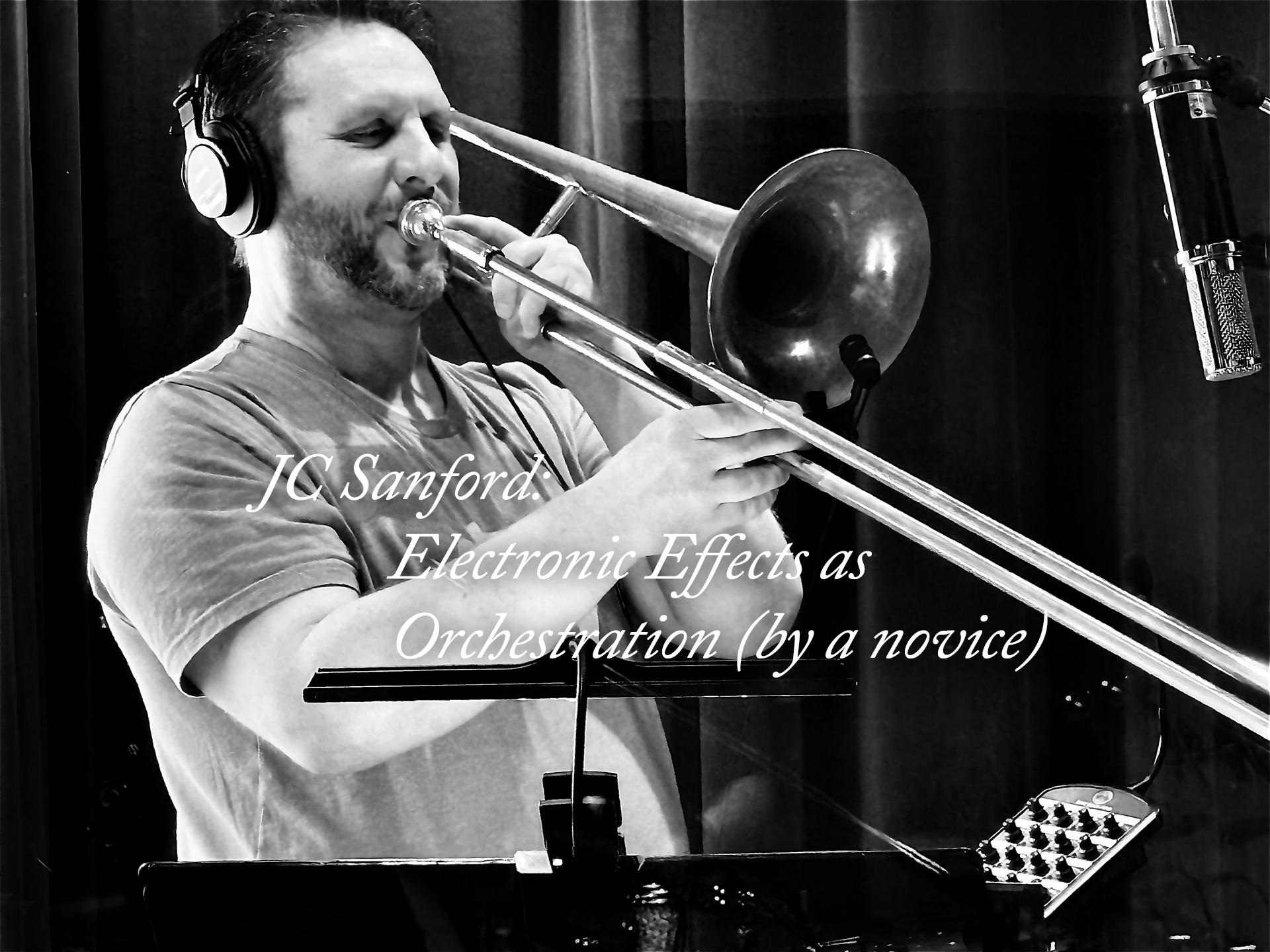
JC Sanford: Electronic Effects as Orchestration (by a novice)

Editor’s note: At various times throughout my tenure as ISJAC blog curator, and scheduled blogging artist fell through late in the game for any number of reasons, so in that case I would often step in to supply a blog for that month. It’s perhaps poetic that for my penultimate curated blog, I am once more in this position. I promise I did not conspire to do this at a time that coincided with the release of my new album, but here you go. During the pandemic, I, like most of you, was trying to investigate ways I might move forward as an artist once we would all be able to play music together again. For me, part of this came out of regularly playing informally with some friends in my little town of Northfield, Minnesota. Both of these guys had very different musical training than me, but they had an understanding of the electronic side of things that I had never investigated. So in our collective improvisations, I started to experiment with a delay/loop pedal. Now I’ve heard countless horn players utilizing electronics over the years, none more notable to me than one of my most important improvisational influences, trombonist Hal Crook. But I had long resisted going down the pedal rabbit hole, partially because of expense, but also I thought I had enough to focus on as a trombonist/composer/bandleader/etc., that I just didn’t see it as practical to add another dimension to what I was doing musically. But this new sonic experience and the feedback I started to receive when using this new technique on live gigs awakened an interest I had long avoided. When I began to explore these electronic possibilities more deeply, I was concerned I was kind of a poser with so many experienced guitarists…
To access this, you be a paid ISJAC member. Become a Paid Member.
Artist Blog

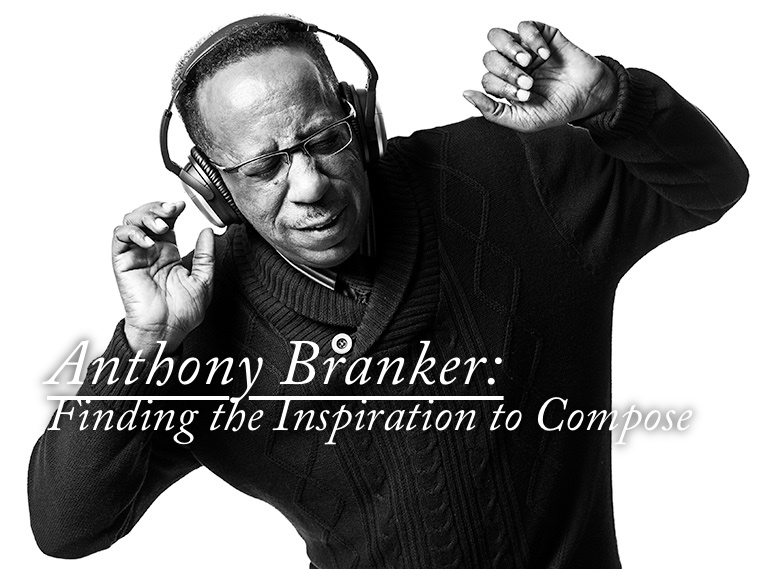
Anthony Branker: Finding the Inspiration to Compose

I am honored to have this opportunity to share some of my thoughts on what guides my practice as a composer and the types of strategies I have used. All my thanks to JC Sanford and Jim McNeely for thinking about me as a potential contributor to this ISJAC artist blog. Since I am probably not someone whose work most of you are familiar with, I really appreciate the chance to introduce you to some of my music within the context of this presentation.

In my own composing and when working with students, I often use a variety of conceptual exercises or problem-solving approaches that can lead to a different kind of envisioning and help move away from those comfortable habits we might fall into. I tend to find inspiration from a wide variety of methods that are both musical and non-musical. Some of these might include:

  • The Sounds and Colors of Modality
  • Melodic Lyricism
  • Going to Rhythmic Places
  • Using Freer Approaches to Music-Making
  • The Bigger Picture: Life Experiences, Spirituality & Social Consciousness

However, the driving force behind all of this is the understanding that I am writing with the listener in mind.

Connecting with the Listener

When writing, I am always trying to find ways to forge a relationship with the listener and engage with them on some level. While it might sound a little strange, I don’t really write specifically for a “jazz” listener in mind. I am actually thinking more about the everyday or general listener – someone that may be coming to the listening experience with a lack of familiarity with or exposure to jazz or music that involves a more active listening approach. With that said, I try to find ways to bring them into the music by connecting with them or meeting them where they are in order to provide them with a feeling of participation.

We all tend to listen to music in different ways and for different reasons, and we listen from many perspectives and levels of engagement. As composer Aaron Copland notes in his book What to Listen for in Music (1939/1967), “Besides the pleasurable sound of music and the expressive feeling that it gives off” (references to his concepts of the sensuous and expressive planes of music listening), it is on the sheerly musical plane “where music exists in terms of the notes themselves and their manipulation.” Here, we consider how such elements as melody, harmony, timbre, rhythm, and form are used in a piece of music. Now, musicians can find themselves a bit preoccupied with this level of listening and often have the inclination to be too analytical when interacting with the music. If we examine the experience of the general listener on this same plane, they are usually quite comfortable connecting with the elements of melody and rhythm because they can identify with them more than the others. If you think about it, we are essentially conditioned from a very young age to interact with music through singing melodies and recognizing melody within a song. Consequently, melody is the means by which most people seem to relate to music.

Rhythm, I would offer, is what listeners often respond to in a very physical or visible way when experiencing music. When we perceive rhythm, we do so with the help of patterns of sound occurring over time that can serve as a source of organization. Rhythm can also be a “kinesthetic thing” that can trigger the listener to interact with what they are hearing through movement. This might be due to the sensation of particular rhythmic groupings or how meter is used or the feeling of “groove” they are connecting with.

Recognizing the power that melody and rhythm can have when it comes to reaching and bringing all manner of listeners into our musical world, my writing aims to explore lyrical melodic content within different types of modal and non-harmonic settings; musical ideas with strong rhythmic identities; and the utilization of groove with its infectious nature. I also use tone rows and pitch sets, but try to put all of these techniques into practice in meaningful, “bigger picture” ways.

Modal Approaches

My introduction to the world of modal harmony changed my thinking and my approach to creating music forever!! Though I had already found these sounds appealing and thought-provoking when I was in high school and college, I really didn’t know how to make sense out of what I was hearing, which was so different from the bebop-derived music I had been checking out during this period. It was when I attended the University of Miami Frost School of Music for the master’s program in jazz pedagogy that I had the chance to study with composer Ron Miller who helped me develop a better understanding of the music from multiple perspectives and who constantly inspired me!!

I find there are so many conceptual positives when using the modal harmonic language. First of all, there is a certain sense of freedom that seems to automatically accompany its use. When it comes to organizing the flow of chord progression movement, modal harmony doesn’t require the use of the types of restrictive chordal root movement that are driven by the dominant-to-tonic relationship found in functional harmony (i.e. V7-I; ii-V7-I; iii-VI7-ii-V7, etc.). With that said, the bass motion can now be more melodic in character and less functional in the traditional sense.

I also view the modal language as one that facilitates a more visual approach to creating music. The spectrum of modal harmonies, which are derived from the major, ascending melodic minor, harmonic minor, harmonic major, and melodic minor #5 parent scales (as well as the use of non-harmonic, symmetrical scale systems) offers a range of colors to draw from and, subsequently, the ability to imagine creating music from a more visual or cinematic perspective.

In addition, this approach has the added benefit of making use of the types of “moods” that can be associated with certain modal chord colors as a way of organizing the compositional flow and intent (i.e. hearing Phrygian as “mysterious,” Ionian as “relaxed, peaceful, soothing,” Lydian-Augmented as “quite aggressive or frantic/panicky”; of course these can all be seen as subjective descriptions as there will frequently be different kinds of mood associations and the context in which these sounds appear will also impact one’s perception). The modal approach also offers a very flexible harmonic language that is adaptable for use with many music genres or styles (classical, Latin, contemporary popular music, funk, Brazilian, R&B) in addition to jazz.

Finally, it promotes individuality of expression, accommodates both lyrical and virtuosic writing sensibilities, encourages experimenting with form and flow, and can undoubtedly add to one’s harmonic/melodic palette as a composer and improviser. A wonderful resource that I find to be most empowering is Ron Miller’s Modal Jazz Composition & Harmony (Volumes 1 & 2) from Advance Music!!

I would like to share two examples of my writing that take place in modal harmonic settings. The first, “Many Roads Beneath the Sky,” is actually a piece where the melody came to me in a nearly completed form almost immediately after I sat down at the piano and began exploring (this is not usually the case with me!). In this instance, it was the melody that would go on to determine the modal harmonic framework.

The second example, “Sundown Town,” was shaped by written directions for creating a modal harmonic scheme to be used to guide the realization of the harmonic progression for this piece. The melody and development of the composition’s formal structure (see Example #3) came later. I also use this approach with my students in an effort to offer guidance on creating progressions for writing projects. Interestingly, what I have found here is that ten students could use the exact same text description and the result will be the realization of ten completely different works (I mean, no two pieces are ever similar!!). The title of this composition refers to the segregated “sundown towns,” in which a municipality or neighborhood in the United States was intentionally all-white and excluded people of color who were met with intimidation, discriminatory laws, and violence. The term is derived from posted signs warning people of color to leave the town by sundown.

Click to see full document

Click to see full document


Rhythm & Groove

In my own writing, as I have shared earlier, it’s all about rhythmic engagement in an effort to connect with the listener and allow them to feel like a participant in this process. To accomplish this, I am always considering such notions as groove, rhythmic interaction, rhythmic identity, using metric variety to play with the listener’s expectations, and that potential kinesthetic impact – making the body want to move!

“Let’s Conversate” was strongly influenced by the infectious spirit of funk music, which was so much a part of my life as a teenager and young musician when coming up. It is a composition that is conversational in nature and highlights the independence of musical voices, each with its own story to tell, which interact with each other in musical dialogue. The piece is based on two tetrachords that, when linked by a whole step, create the seventh mode of the harmonic minor scale, which is known as the “Altered bb7 mode” (this involves both the “Spanish Phrygian” tetrachord = C-Db-Eb-Fb and the “Hungarian Minor” tetrachord = F#-G#-A-C). It was also inspired by the concept of minimalism and the use of specific pitch collections for constructing melodic material, piano voicings, and bass lines (all of which are comprised of notes from the aforementioned scalar pitch set).

The composition incorporates displaced rhythmic stress to provide a sense of uncertainty as to the actual meter or “groove” being used. It is largely organized around 7/4 meter (4/4 + 3/4) for the introduction, exposition, and the tenor saxophone/trombone N.C. (No Chord) solo exchanges. However, a slightly altered bass line is introduced during this solo section that was meant to move the listener away from the original metric subdivision pattern to now emphasize a much different subdivision of 4/4 + 3/4 + 4/4 + 3/4 + 4/4 + 2/4 + 4/4 + 4/4. The tenor saxophone/trombone phrase trading then leads to a collective improvisation in a “Crazy Frenetic Madness” section in 4/4 – an even more tense and dissonant polychordal area that involves three superimposed chord structures (Ab minor/major 7 over Gb minor/major 7 over Eb major), which would not really be considered the traditional way of achieving release from tonal tension. A contrast in meter is introduced for the piano solo (moving to 4/4) as well as a different bass line; this solo also culminates in the “Crazy Frenetic Madness” section.

Click to see full document


Composing Using Tone Rows

I also like to challenge the listener to step outside of their comfort zones, but in doing so, I always try to ground that experience with some sort of interaction with the areas they may be most comfortable with – melody/lyricism and rhythm. A good example of this would be my composition “Placeless” from the upcoming What Place Can Be For Us? release on Origin Records. The melody is based on a series of 12-tone rows with the exception coming at the end of the melodic exposition where a pitch set of six notes is repeated several times as part of a melodic motive (see Example #8). While this may sound super academic and a recipe for a dry musical offering, it is the angular funk vibe and feeling of shifting rhythmic grooves based on phrases that are asymmetric in length that serves the purpose of meeting the listener where they are, catching their attention, and bringing them into this musical experience.


Click to see full document


Pitch Sets

In addition to tone rows, I use pitch sets or smaller groupings of pitches (as was recently mentioned) and then manipulate that material through inversions, retrograde, and shuffling sets. I also play around with rhythm in similar kinds of ways by creating rhythmic sets and using retrograde to reimagine rhythmic patterns. Sometimes in these cases, the harmonic foundation might be modal in flavor with “Dance Like No One is Watching” from the Uppity recording and “Joy” and “Loving Day (June 12)” from the recording Beauty Within, as examples of this. However, I still try to approach all of this with a strong sense of melodic lyricism and rhythmic awareness in mind; even if you might hear some crazy kinds of ideas “up in there.”


The Bigger Picture: Life, Spirituality & Social Consciousness

Putting techniques into practice in meaningful ways

My work as a composer also explores issues of social consciousness and addresses themes of social justice, equality, race, intolerance, hate, prejudice, gender, ethnicity, humanity, politics of representation, spirituality, and “place” in society, all in an effort to provide opportunities for all of us to gain a deeper awareness and understanding of these issues, each other, and ourselves.

In recognition of a significant legal ruling that impacted my family in profound ways, I wrote the composition “Loving Day (June 12),” which is named for the day in 1967 when the Supreme Court of the United States effectively struck down the anti-miscegenation laws that existed in sixteen states. The case before the court, “Loving vs Virginia” involved the interracial married couple of Mildred and Richard Loving who were subsequently arrested and forced to move out of Virginia. The Lovings brought the case to then-Attorney General Robert F. Kennedy and it was later referred to the ACLU (American Civil Liberties Union), which represented them. Several years later, the Supreme Court unanimously voted the law unconstitutional. This composition is dedicated to my grandparents John & Mary Hulnik who were, respectively, of Polish and Trinidadian descent, and who helped raise me from the late 1950s until the end of the 1970s. I also dedicated this piece to my Uncle Mervyn Guy Carmichael & Aunt Rita Carmichael, who were from Trinidad and Germany.

The upcoming What Place Can Be For Us? release is a 10-movement suite that speaks to notions of “Place” and the overarching issues of inclusion, belonging, place as an emotional space of being, finding one’s place in a socially stratified society, as well as circumstances of exploitation and zones of refuge experienced by people of color and other global citizens.

“Sunken Place” is a composition inspired by Jordan Peele’s critically acclaimed film, “Get Out” and his reference to the sunken place. In the words of Peele it is: “the system that silences the voice of women, minorities, and of other people…the sunken place is the President (Trump) who calls athletes sons of bitches for expressing their beliefs on the field…Every day there is proof that we are in the sunken place.” In a statement made on Twitter, Peele explained, “the Sunken Place means we’re marginalized. No matter how hard we scream, the system silences us.”

As we all know, composing is a multifaceted activity with so many ways available to us to awaken our creative thoughts and actions beyond those I have shared. Yet, I do hope some of the approaches presented here manage to resonate and possibly inspire you in some small way. These are strategies that have served as sources of stimulation and have opened up the creative process for me while also helping me to move away from those predictable or comfortable habits I would fall into when composing. Thanks so very much for reading and for listening to the music!!


About the Author:

Composer, conductor, and bandleader Anthony Branker is an Origin Records recording artist who was named in Down Beat magazine’s 63rd & 62nd Annual Critics Poll as a “Rising Star Composer.” Dr. Branker has eight releases in his fast growing and musically rich discography that have featured Ralph Bowen, Fabian Almazan, Linda May Han Oh, Rudy Royston, Pete McCann, David Binney, Conrad Herwig, Jim Ridl, Kenny Davis, Donald Edwards, Mark Gross, Tia Fuller, Steve Wilson, Antonio Hart, Clifford Adams, Andy Hunter, Bryan Carrott, Eli Asher, Jonny King, Freddie Bryant, John Benitez, Belden Bullock, Adam Cruz, Ralph Peterson Jr., Wilby Fletcher, Renato Thoms, Alison Crockett, and Kadri Voorand.

In 2023, Origin Records will reissue Branker’s Spirit Songs project featuring drummer Ralph Peterson, Jr. and release his most recent project What Place Can Be For Us? – a 10-movement suite that speaks to the overarching issues of inclusion, belonging, place as an emotional space of being, as well as circumstances of exploitation and zones of refuge experienced by people of color and other global citizens. It will feature tenor saxophonist Walter Smith III, trumpeter Philip Dizack, alto & soprano saxophonist Remy Le Boeuf, guitarist Pete McCann, pianist Fabian Almazan, bassist Linda May Han Oh, drummer Donald Edwards, and vocalist Alison Crockett.

            Branker was a Third Place Winner in the 2021 International Songwriting Competition (ISC) in the jazz category, has received commissions, served as a visiting composer, and has had his music featured in performance in Poland, Italy, Denmark, Finland, France, Estonia, Russia, Australia, China, Germany, Lithuania, and Japan. During his residency at the Estonian Academy of Music & Theatre in Tallinn, Branker composed The Eesti Jazz Suite, a five-movement work inspired by the culture and the spirit of the people of Estonia. The work was premiered in 2006 at the academy of music as part of the concert tour of the Princeton University Jazz Composers Collective, which was sponsored by the Department of State of the United States, the U.S. Embassy in Estonia, and the Estonian Academy of Music. Dr. Branker’s works have also been performed and/or recorded by the New Wind Jazz Orchestra, Sylvan Winds with Max Pollack Dance Ensemble, Composers Concordance Big Band, Princeton University Orchestra, Rutgers University Jazz Ensemble, and the Rutgers Avant Garde Ensemble.

            Dr. Anthony Branker was on the faculty at Princeton University for 27 years, where he held an endowed chair in jazz studies and was founding director of the program in jazz studies until his retirement in 2016. Currently, he is on the jazz studies faculty at Rutgers University Mason Gross School of the Arts where his teaching responsibilities include graduate and undergraduate courses and ensembles. Branker has also served as a U.S. Fulbright Scholar at the Estonian Academy of Music & Theatre and has been a member of the faculty at the Manhattan School of Music, Hunter College (CUNY), and Ursinus College.