Artist Blog

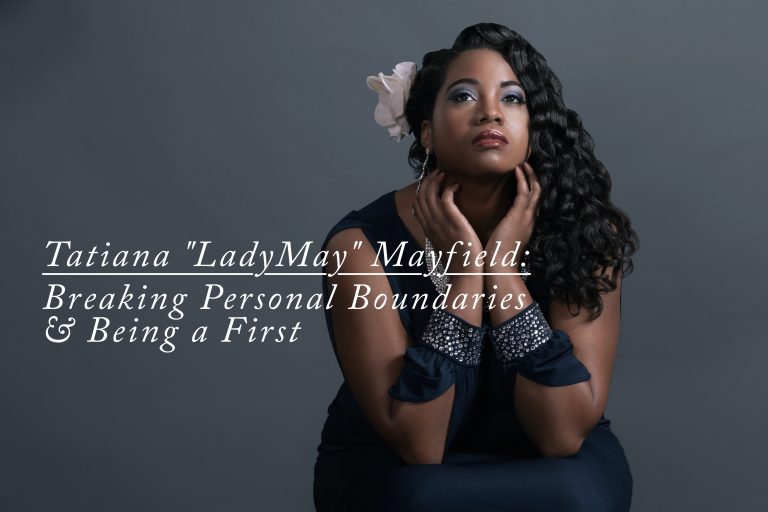
Tatiana “LadyMay” Mayfield: Breaking Personal Boundaries & Being a First

Blog curator’s note:

In late May, I had been contemplating who I might solicit to write the July 1 ISJAC blog. I wanted to hear a voice different from the kinds of folks I had previously featured. Then I happened to catch this post shared by my friend Dominique Eade on Facebook: “I am the first African-American to earn a Master’s degree in Jazz Composition from UTA! #BlackHistory.” I thought, now that sounds like a story I’d like to hear, so I was delighted that Tatiana agreed to write something for us. Little did I know that 2 days later, George Floyd would be murdered by police officers not far from where I live in Minnesota and change all our lives (again) so strongly. So, in the midst of all that and this seemingly endless COVID crisis, I can’t think of a more appropriate voice for us all to hear from right now. My friends, Tatiana LadyMay Mayfield.


Backstory: Why Go Back To School?

It was February of 2018. I had just released my third album The Next Chapter a few days after my birthday and I wasn’t happy, but I should have been. I wanted to release it in February because of the ties to my personal life; my birthday, Black History Month, and my parent’s anniversary are just a few of the most important things about this month to me. However, I felt like everything about the project fell short except for the music after taking 4 years to complete it.

I spent the next few months trying to figure out what my next move would be while I continued to teach at Cedar Valley College in Lancaster, Texas and gig around town. At this point, I had been teaching voice for 8 years after graduating with my bachelor’s degree in jazz studies from the University of North Texas. During the course of that time, I toyed with the idea of going back to school to get my master’s degree several times but fear would always creep into the equation as well as the thought of more financial stress from dreaded student loans. I kept thinking to myself, “You’ve been away from school too long. It will be too hard getting back into the groove. Besides, what would you get your master’s in? Won’t this interfere with performing?” All I knew was that I wanted to open more doors financially for myself so that I could continue making the music that I love and share that passion with others through teaching, recording, and live performances.

After speaking with pianist and educator Stefan Karlsson on a monthly gig we had together in Dallas, I was convinced that I needed to fight my fears and apply for my master’s degree at UTA (University of Texas-Arlington) where he was then teaching piano. He talked to me about program options and I decided on jazz composition because I really wanted to grow musically in this area. I knew it would be the challenge that I needed to propel me forward to explore my creativity in ways that I thought were potentially too difficult for me.


My Experience at UTA

I started studying at UTA in fall of 2018. I was really nervous but proud of myself for taking a leap of faith and trusting that I would eventually land on my feet. I was immediately welcomed in the music department and felt comfortable around my classmates. I felt appreciated and was fortunate enough to know most of the instructors from the local jazz scene which gave me both anxiety and comfort, as I had worked with some in the past. Anxiety that they knew me and expected the very best from me, but comfort in that they were awesome musicians that I knew I could learn a lot from. I studied piano with Stefan Karlsson and Sergio Pamies, jazz history with Brian Muholland, conducting with Tim Ishii, and composition with Dan Cavanagh.

Cavanagh was the department chair and professor over jazz composition at the time. He also taught a course titled “Jazz Style and Analysis” which I took in my first semester. Each week we would discuss the jazz style during an era (using the standard narrative of jazz) and submit 3 transcriptions of choice on our prospective instruments. The course started in the 1920s and ended in the present. We also had to write a short essay and present our written transcriptions to the class while listening to the original recording. Since my primary instruments are voice and trombone, I transcribed several vocal solos until I got to the “post-bop” era where I switched to trombone.  At first, I felt like the task was daunting because of the amount of transcriptions and the fact that I was not proficient at writing music on paper quickly. By the end of the course, I certainly got better at transcribing and it made me feel great!

My lessons with Cavanagh were always very open, honest, and full of encouragement. I had done some traditional composition at UNT (small group arranging and big band arranging), but since it was not my primary focus during my undergrad, I had some reviewing and new concepts I needed to get under my belt. I learned new ways to organize my thoughts about composing before even writing a note; I was allowed to always be myself creatively. I explored writing for strings (something I’ve always wanted to do), used different methods for horn voicings, and challenged myself rhythmically while changing time signatures throughout a piece. The difficulty variation was split between the assignments and me. We talked about racism and sexism and the role it’s played in jazz throughout history as well as in academia. We discussed it even more in my “Jazz History and Historiography” class with Brian Muholland. I was told not only that I was the first vocalist in the program, but the first black woman to strive for this degree. It wasn’t until recently that I discovered that I am the first black American to receive this degree. This is an honor I don’t take lightly and am deeply proud of. I find it interesting that there are still “firsts” of this kind in 2020. I hope that it encourages more black musicians to go forth in getting more degrees in jazz on both the undergraduate and graduate levels.

Being Black and A Woman in Jazz

I was taught as a young black child that I had to work 10 times harder to achieve and be noticed in society than my counterparts in order to lead a successful and somewhat comfortable life. Thus, I’ve always put an amazing amount of pressure on myself to be successful in whatever “success” means to me and/or my family. However, I feel even more pressured than ever because of the positive reputation I’ve built both musically and professionally over the years.

As a black woman, musician, composer, and educator it is stressful in ways many don’t or can’t fully understand. I’m in a very marginalized category because I deal with two sides of a difficult coin: one for being black and one for being a woman. Neither those I can change, only people’s perspective of me can. These inferior feelings have almost always bled into how I’ve felt about myself since I can remember. No one ever really told me I couldn’t be great, but societal pressures and subliminal media made me feel this way. On the musical spectrum, there’s often this dismissal from male counterparts on any musical front and on the racial end there’s this assumption that you are probably good but have a bad attitude (“angry black woman” stereotypes). Being a female vocalist also has its own stereotypes that are difficult to break (don’t know any music theory, can’t count off tunes, diva mentality, etc.).  In addition, the jazz industry still doesn’t fully recognize women and women of color for their great work and contributions as a whole outside of a handful of great singers and a few pianists. Representation matters and when it isn’t or is rarely there, sometimes it’s hard to stay motivated.

I used Patrice Rushen as a source of compositional and personal inspiration throughout the course of time writing music while at UTA. Her albums Before The Dawn (1975) and Patrice (1978) are my favorites because they’re a mix of straight ahead, soul, and funk, styles that fit my mindset and musical interest. She is an amazing composer and songwriter with the piano chops and voice to match. I did a lot of research of her and her career and hope to one day make the type of mark she’s made on me on other women in the jazz community. I also appreciate the compositions and arrangements of trombonist and composer/arranger Melba Liston and the contemporary eclectic style of Esperanza Spalding’s work. Other strong compositional/arranging influence came from Duke Ellington, Quincy Jones, and Herbie Hancock.

Pandemic Effects, Protests and Life Transitions

COVID-19 hit in March, right in the middle of the semester as I was to begin to finish my last few pieces for my recital. When everything shut down, so did I. I was already having some writers block happening shortly before, but the pandemic completely closed me up creatively. It was then I knew I needed to allow myself time to process, focus, and heal so that I could finish the rest of my required work.

Prior to the pandemic, I was teaching and gigging while attending school. So, that meant going back and forth between Cedar Valley and UTA sometimes on the same day. One semester I was even an adjunct instructor at UNT also. It was insane and a little too demanding but I still had to work. I got engaged in October of 2019 and began planning my wedding with my now husband. My master’s recital was set for April. I was going to graduate in May and we would be married in June on Juneteenth.  I had planned to travel with friends to Jamaica for 4 days and go back to China to teach at a jazz summer program for 2 weeks and perform.

While we are here we are in the middle of the worst pandemic since the 1918 Spanish Flu, the tragic and unnecessary murder of George Floyd happens due to a police officer kneeling on his neck for almost 9 minutes. As if we aren’t dealing with enough collectively as a nation, this becomes the new focus. When the news of this reached me, I was immediately outraged and sick to my stomach. I thought about all the other black men and women who had been killed in recent weeks and years from police and/or racist violence: Breonna Taylor, Ahmaud Arbery, Botham Jean, Philando Castile, Alton Sterling, Trayvon Martin, Sandra Bland, and so many others. I thought about when I wrote the protest song “Freedom” on The Next Chapter with my friend musician/producer Jemarcus Bridges and poet Rodderick Parker about some of these very killings. My heart was and still is broken and tired. However, seeing people take to the streets to demand justice for George Floyd and the others who have lost their lives gave me a bit of hope for continued resilience like that seen from the 1950s-60s Civil Rights Movement. Despite the pandemic and social injustice fight currently, I find a little bit of peace seeing that there may be some real change happening and from knowing we are all in this together.

I’ve recently started to put pen to paper again charting new ideas about how to express my feelings forwardly and creatively that not only sheds light on this issue, but also leaves hope.

Listening to “Search For The New Land” by Lee Morgan and “Fables of Faubus” by Charles Mingus are just 2 compositions that came to mind to draw from.

What I Learned Getting Through A Master’s Program

Studying jazz composition at UTA opened my eyes to many new ways to think about constructing harmony and organizing musical ideas. I also learned a lot about myself; I’m much more resilient than I thought and I can now write for different types of instrumentation. I enjoyed singing big band tunes with the jazz orchestra, learning how to research a topic and write about it, and speak with my professors about their careers as educators and gigging musicians. I even dug deeper into my roots as a black American and what that means to the music I hold dear and to society. UTA summer jazz camp was where I began my jazz educational journey when I was a teenager so it’s funny how life comes full circle sometimes. Overall, my time at UTA was memorable and special. A time period I will look back on with gratitude and a bittersweet smile.


About the Author:

Refreshing and beautiful are how many have described the voice and persona of Tatiana “LadyMay” Mayfield, a jazz vocalist, musician, composer, and educator from Fort Worth, Texas. “LadyMay” (as she has been named) has been singing and playing jazz music since the tender age of thirteen. Since then, she has performed in various venues and festivals throughout the U.S. and abroad, which in turn have earned her rave reviews from listeners and musicians in addition to numerous awards.

In 2017, “LadyMay” was awarded 2nd place in the Sarah Vaughan International Jazz Vocals Competition held at NJPAC in New Jersey. In that same year, she received the “Jazz Innovators Award” from Dallas, TX as part of Jazz Appreciation Month for her contributions to jazz education for young people in the Dallas/Ft. Worth area. Mayfield was also chosen as one of the twelve semi-finalists to compete in the prestigious 2010 Thelonious Monk International Jazz Vocals Competition that was held in Washington, D.C before a legendary panel of judges. In the summer of 2019, the city of Fort Worth awarded her with a “Legend In The Making” award at their annual “Dr. Marion J. Brooks Living Legends Awards” for her accomplishments in entertainment and education. In addition to several other awards, she is also a 2006 YoungArts winner for Jazz Voice. She has also appeared on Dallas/Ft. Worth’s news television show WFAA “Good Morning Texas” four times since 2011. Mayfield has opened for several well-known artists such as Kirk Whalum, Will Downing, Randy Brecker, Dave Valentin, Bobbi Humphrey, and The Main Ingredient. LadyMay has also performed in 3 concerts between 2016-2018 with the legendary Cincinnati Pops Orchestra. The first concert was a tribute celebrating African-American women in music entitled “I’m Every Woman”, then again for their Independence Day “Patriotic Pops: Celebrating the 75th Anniversary of the USO”, and as of late in the “Classical Roots: Under One Roof” concert honoring the diverse history of the historic Music Hall where they perform. Mayfield has also performed with the Hilton Head Symphony Orchestra in South Carolina in the spring of 2018.

“LadyMay” has recorded three albums, From All Directions (2009), A Portrait Of LadyMay (2012), and The Next Chapter (2018). The first album From All Directions was recorded while she was still attending the University of North Texas, where she received her degree in Jazz Studies. Jazz journalist Scott Yanow described her voice on her debut album From All Directions (2009) as “attractive” with “excellent elocution” and a “joyful spirit”. On her sophomore album A Portrait Of LadyMay (2012), Harvey Siders, former writer of JazzTimes and Downbeat magazines, describes her intonation as “flawless” and her scatting “as natural as breathing.” In addition to her vocal skills, she plays piano, trombone, composes, and teaches voice and music theory. In May of 2017, she was awarded 3rd place in the “Performance” category of the International Songwriting Competition for her original song “Forgive Me Someday” from her latest album The Next Chapter.

LadyMay’s appeal has also reached listeners abroad in the UK, Switzerland, Germany, France, Nigeria, and Brazil. Her music has been featured on several international radio stations such as “Solar Radio”, “Jazz FM”, “Tropical FM”, and “Premier Gospel Radio” in the UK, “RJM Radio” in France, and “Smooth 98.1” in Nigeria. In November 2012, her song “Real” from A Portrait Of LadyMay reached #1 on the “UK Soul Chart”. In July of 2013, she completed her first tour (LadyMay In The UK) to London where she was widely received on radio appearances, as well as at some of their top performance venues such as Ronnie Scott’s, Pizza Express in Soho, and the Flyover Portobello. UK based record store “Soul Brother Records” labeled “A Portrait Of LadyMay” as one of their “Best New Jazz Releases of 2013”.  As an educator, Mayfield is an adjunct professor of commercial voice at Cedar Valley College in Lancaster, TX and has previously taught jazz voice for the University Of North Texas in Denton, Texas. In 2019, she taught in Zhuhai, China for the Golden Jazz Henquin Jazz Week and performed in the “Crossing Music and New Generation Jazz Festival”. Mayfield has a bachelor’s degree in jazz studies from the University of North Texas (Denton, TX) and a master’s degree in jazz composition from the University of Texas at Arlington.

For more information on Tatiana “LadyMay” Mayfield, visit www.tatianamayfield.com.

Artist Blog

Rufus Reid: Preparation Is Key To Success! My WDR Big Band Experience

There were many lessons learned from the time I was asked to schedule a timeline to perform with the infamous WDR Big Band in Koln, Germany, with my music. For those who do not know, WDR, Westdeutscher Rundfunk is a German public-broadcasting Institution with the main office in Köln, Germany. NDR Big Band is based in the North in Hamburg, Germany. The HR Big Band is in Frankfurt, Germany. Each of these bands are made up of exceptionally talented jazz musicians, many who are from other countries, including the United States, as well as from Germany. These professional European bands have been around a very long time. I am deeply honored to have been invited this past March to perform my music with the WDR. My dear friend, Dennis Mackrel, was my conductor who made this memorable visit a most successful one on many levels.

(Watch Link: https://www.facebook.com/watch/?ref=external&v=576875436374551)

To become a good composer is somewhat similar to becoming a good player. One should have, at least, one significant role model for inspiration. One also has to be persistent, diligent, and consistent with conviction to be taken seriously, so they can be called again and again to play with other good musicians. Composers also want to hear their music played more than once, as well. You can be recommended that first time, but the second time is totally based on that initial performance. When are you ready? Watch, listen, study, and ask questions by seeking out those individuals who inspire you! When it’s time for your music to be performed on the stage, it must sound like it belongs there. How do you know? When people you respect give you an unsolicited thumbs up! Believe me, it will empower and carry you a long way! Begin being truly honest with yourself! Bottom line, the music you compose must resonate with others. The best compliment would be, “I’d love to hear that again!” Ultimately, it’s all on you.

In my many years as a professional improvising bassist, I have had the good fortune to perform and record with some of the greatest players who were and are incredible composers, as well. I have always been intrigued and baffled how they were able to conceive this incredible music. I began a quest to find out what this composition thing was all about.

When I joined the BMI Composers Workshop in 1999, I was thrust into an environment that was completely foreign to me. Intellectually, I understood we would be writing for a big band. I had written a few big band arrangements, but this workshop was about coming up with fresh ideas. Arranging requires its own set of unique skill sets to take a known composition and give it a new look and/or sound. I was asked to write what I wanted to write. I was NOT prepared to write what “I” wanted to write. I had no idea what that was! In that moment I felt completely at a loss to respond in any way. I had never been asked that question before, ever! The music I knew basically was already prescribed for a particular musical setting, i.e. music for film, television, a musical, a wedding, or a myriad of situations. So, the inner search was initiated to find out what actually pleased and satisfied me without being judgmental! HA! Fat chance of that not happening! At the time, the BMI Workshop had three exceptional coaches, Manny Albam, Jim McNeely, and Michael Abene, to help guide all of the individual participants closer to being yourself. In the five years as a participant, I was never told “No, that’s not good!” I was simply asked, “Is that really how you want it to sound?” That sent a huge message for me to return to the drawing board and keep searching! Another was, “That’s pretty good, but try orchestrating this with very different instruments!” We all have our comfort zones and I was asked to stretch and leave mine. I still have to NOT get too comfortable with what I come up with too soon in the process. And that is it! I have grown to love the entire process of composing! The constant search is very mysterious, extremely daunting, and exhilarating when you discover “it!” One of my oldest friends, the late Muhal Richard Abrams, said to never stop listening to all kinds of music. You might be surprised at what you actually like. Eddie Harris taught me not be afraid of any music. So, these past twenty years, I have conscientiously tried to do exactly do as they suggest.

Now, with all that said, one has to learn how to orchestrate so that idea sounds solid, while also “sounds!” It is clearly heard no matter of the density surrounding this idea. Finding the “sweet spots” of all instruments. Manny Albam used to call them the “money notes” because he was always on the clock and it had to sound good all of the time or people were unhappy! Whether you are on the clock, everything written must have a “sound.” The idea sounds. That voicing really sounds! The orchestration truly sounds. Everything is clear with articulations, dynamics, measure numbers, page numbers, chord symbols, and whatever else makes a great sounding chart, etc. etc. etc!

The WDR Big Band experience gave me a real taste of what the BMI workshop prepared me for! That in itself was extremely gratifying. I remember so well being told that you are in a good place when you finish a commission or any project. Now, have the confidence to put the score and parts in a package. Mail the package and do not expect to hear anything, except it was received, the first reading went well, and the music was liked by all! THAT, my fellow readers, is not easy to accomplish, but I am getting closer, I think!

The music I have written and performed with the WDR Big Band will give the listener a glimpse of what has happened in these past years. I was sent guidelines as how to prepare my music to send via PDF. All of the scores and parts had to be prepared by computer software. That made sense since we all use Finale or Sibelius software, but they did not want to see the “jazz font” at all. I had four charts with the jazz font. I know, supposedly, you can designate the change and push a button and that’s it. It isn’t quite that simple. The articulations changed. Then I said to myself, since I’m in this, let me see if I can tweak some parts and the domino effect came in. Oh my, did I mention I had a couple different versions of this chart in the computer and I tweaked and sent the wrong one? Fortunately, I caught most of the proofing issues before sending out nine pieces of music for this project. We rehearsed four days and all of the players were so on it about everything! Specific articulations had to be discussed and finalized before moving on. What one might think is a universal language for “jazz” articulation, is not that simple, particularly to those who do not know you or your music! When you are aware your music is new to everyone, the clearer everything must be at the outset! I had to adjust some measures in a saxophone tutti in one piece and correct some trombone voicings in another. This doesn’t sound like much, but folks, I was mortified! The score and parts matched, which is supposed to be a good thing, but they were wrong! I do not know how any of that could have happened! The computer messed up my parts, I am sure of it! DUH! I am truly happy that out of all the music I sent, this was minor, but it should not have happened at all at this level. If I had truly taken the time to proof and/or have someone else proof, the music would have been sufficient, as it should be.

One of the issues at hand for me at this juncture in my life, is, I am attempting to compose other music outside and away from the jazz mentality or sensibilities. This has required me to become more articulate with literally everything on the music page. When you write for your band or players who are familiar with you, the music should still be clear enough to have a smooth initial rendering. Theoretically, I am well aware of the importance of proofing, but somehow it still eludes me. That’s when it hurts when you get busted for it!

The moral to this story, is no matter how savvy you are with the computer software, one should have another set of eyes and ears to help proof your music. I wish to be asked to return to perform and write for the WDR Big Band again in the future. Hence, preparation is the key to success. “Gots to be more careful!”


About the Author:

Photo by John Abbott

For the last 50 years, Rufus Reid has been a consistent, formidable, and influential presence in the jazz world as a bassist and educator. His performances and recordings with Eddie Harris, Nancy Wilson, Dexter Gordon, Andrew Hill, The Thad Jones-Mel Lewis Orchestra and Quartet, Kenny Barron, Stan Getz, J. J. Johnson, Lee Konitz, Jack DeJohnette, to name but a few, has cemented his stature as one of the great living deans of the jazz bass. His receipt of the 2006 Raymond Sackler Commission resulted in his five-movement suite for large jazz ensemble, Quiet Pride-The Elizabeth Catlett Project. In November 2015, this album received two Grammy nominations, for Best Large Jazz Ensemble and Best Instrumental Composition. Rufus Reid is a 2008 Guggenheim Fellow in the field of composition, which resulted in the three-movement symphonic work, Mass Transit. In April 2016 he was named Harvard University’s Jazz Master in Residence, participating in public conversations and also performing in concert with his original compositions. In April 2017, Lake Tyrrell In Innisfree, Rufus’ third symphonic work was debuted in Raleigh, NC by the Raleigh Civic Symphony. May 2017, Rufus Reid was awarded the America Composers Forum Commission to composed, Remembrance, for Pittsburgh New Music Ensemble to be premiered in July 6-7, 2018. In December 2017, Newvelle Records, an all vinyl recording company, will release the Rufus Reid Trio, “Terrestial Dance,” featuring the Sirius Quartet. February, 2020, Newvelle Records release his second vinyl duo recording, “Always In The Moment,” with stellar pianist, Sullivan Fortner. A distinguished educator as well, for 20 years Rufus was Director of the Jazz Studies Program at William Paterson University and was instrumental in building the program’s international reputation as one of the leading jazz schools in the world. He has recorded more than 400 albums and a dozen albums as a leader and authored a seminal text and DVD for bass methodology, The Evolving Bassist. Rufus’ continues to evolve as a composer and “The Evolving Bassist.”