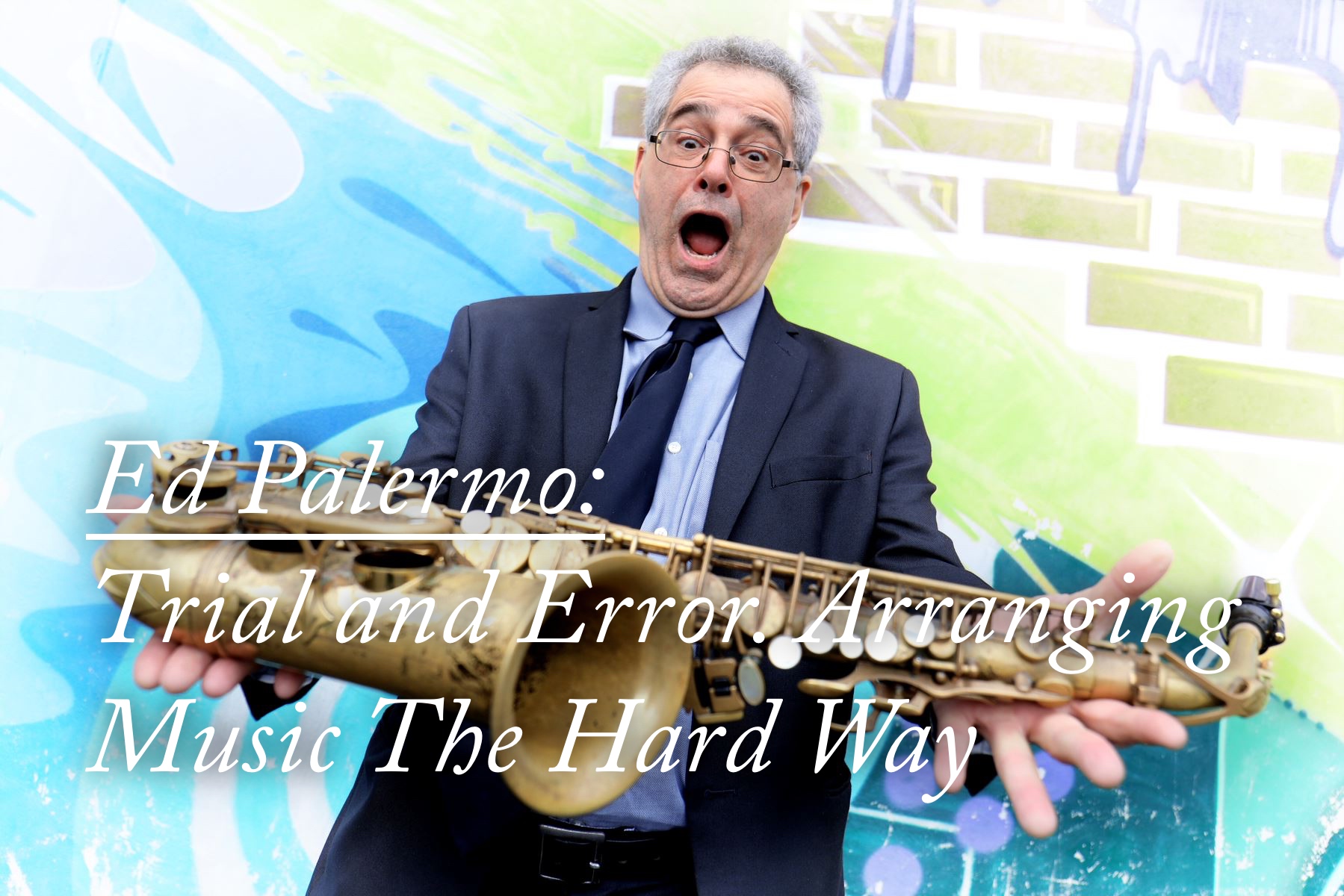
Ed Palermo: Trial and Error. Arranging Music The Hard Way
First off, I am honored and tickled pink to be asked by JC Sanford to write this article. I don’t get asked often about my arranging process so at first the request from JC was a tad daunting. Then I read Michael Cain’s insightful and intelligent article for ISAJC and became even more daunted. No one has ever accused me of being an intellectual but hey, let’s give it a go.
A little background will help. I grew up listening to music non-stop. The first piece of music I recall that had a powerful and lasting effect on me is the theme from the TV show, Perry Mason. I must have been 4 or 5 years old. Whenever that came on, I remember being at once intrigued and frightened. I think the combination of 12/8 and minor major sevenths took me to a place I couldn’t describe. To this day I am moved whenever I hear that piece.
Some years later, I saw the Beatles on Ed Sullivan and was hooked. A few years after that, Frank Zappa and Jimi Hendrix totally sealed the deal. I wasn’t into jazz yet but Zappa’s interpretations of jazz was seeping into my consciousness. When I was a senior in high school, I first heard “My Favorite Things” by John Coltrane. I related to it because it reminded me of Zappa’s “King Kong”. Both songs are in triple meter and employ a dorian mode. Made to order for a young knucklehead like me.
The dorian part of that is important. At the time, the other minor scales turned me off. The harmonic minor scale reminded me of snake charmers. Natural minor just seemed wrong what with that flat 6 and all. Whenever I heard some well-meaning rock player try to play modal and they hit on that lowered six, I’d think, “AMATEUR! It’s dorian or nothing!”
My oldest brother Nick (by four years) always tried to get me into jazz. He even bought me the “Giant Steps” LP for Christmas one year. I was 16 years old at that time. At that point, I had the thought that what separated the music I love from the music I didn’t all had to do with the 2-5-1 chord progression. And “Giant Steps” is nothing BUT 2-5-1’s. As much as that song is considered the gold standard of jazz, to me it was just an intellectualized “Bye Bye Blackbird”.
My feeling about “Giant Steps” has changed since then but it illustrates why I was reluctant to add straight ahead jazz to my listening habits.
Frank Zappa’s autobiography has a chapter titled, “Hateful Practices” and one of those hateful practices is the 2-5-1 chord progression. That’s how I felt in my high school days but Zappa held that abhorrence until he died. Whenever I heard jazz, particularly vocal jazz, it reminded me of the old sitcom “Make Room For For Daddy”, especially at the end of each episode where he would sing a song in his living room with an invisible full orchestra.
I went to college at De Paul University Music School because I wanted to be a jazz sax player, but even then, my main influence was a rock dude named Edgar Winter. Edgar was and still is one of the great unsung talents. His alto playing on his first album, “Entrance” would eventually lead me to Phil Woods and especially Cannonball Adderley.
After college, I moved to New York with the intention of making a living as a jazz tenor sax player. During my college years, I fell under the spell of Dave Liebman, Steve Grossman and Mike Brecker. But I was also fascinated by arrangers.
One of my main influences in that regard was Les Hooper who I played with in Chicago. I was fascinated how much fun his charts were to play. To this day, Les remains a huge influence and I consider him to be one of the greatest musicians I’ve ever met.
I was playing in a big band led by Dave Lalama. Dave and his brother Ralph are amazing musicians and I was lucky to hang out with them. I used to ask Dave all these questions about arranging and he was happy to offer his expertise with me.
I put together a nine piece band to get my feet wet. At the time I loved Dave Liebman’s band, Lookout Farm and had the idea of doing music in that vein but with 5 horns. Very modern but not avant garde.
I wrote a handful of charts for that band. I’d record the rehearsal with my Walkman, then spend the rest of the week changing the scores based on what I didn’t like. There was a LOT not to like.
I read the Don Sebesky arranging book but it was WAY over my head. Instead of studying arranging and orchestration with somebody like any normal person would, I decided to go the
trial and error route. A LOT more work that way but at least I avoided the chance of getting my feelings hurt by a knowledgeable teacher.
That’s enough background for now. Let’s talk arranging.
One of the ways I make a living is by arranging and transcribing big band charts for singers. 99% of that work comes from my friend and hero Christian McBride. For some reason, he seems to think I have some talent. But don’t be too impressed. Christian is pretty much the only guy who hires me. But at the age of 69, that’s fine by me. I’m at the age where I don’t define myself by who hires me. Christian’s work gives me all I need to feed my ego.
The transcription work is VERY cool. I learn a ton whenever I do that. Writing an original arrangement is more satisfying for the soul but you learn so much by figuring out what the greats did before us.
One of the many things I learned is how much better those arrangers were than me and my peers. I’m not dissing my fellow writers. I am in awe of all of them and feel extremely humbled by their craft and talent. But I feel that the ability we now have to automatically hear what we write (with whatever software we use) cheapens the process somehow. Hey, I’m looking at the man in the mirror here. I’m no different that anybody else. It’s a God-send to be able to immediately hear what you just wrote but it certainly doesn’t make any of us any smarter.
The Ed Palermo Big Band has changed radically through the years. Where I used to write lengthy, meticulous charts where every measure had to show my brilliance (puke here), lately I’ve found that I no longer possess the attention span to not only write like that but even to LISTEN to it.
When I write for my band now, all the charts are three minutes or under. For real. I make up for it by writing a lot more tunes. We play all of our shows in suite form. I no longer do the tried and true format of intro, melody, solos, shout chorus, melody, and FINALLY coda.
In fact, most of my charts don’t even have endings because they always segue into another song.
Another thing I no longer do is write backgrounds behind soloists. I used to LOVE doing that. Bob Belden once told me he was impressed with my trombone backgrounds. But the fact of the matter is this: whenever I take a solo and backgrounds come in under me, I can’t stand it. Talk about a hateful practice! Sure, you could argue that the backgrounds help lift the intensity of the music, but I find it just as annoying as when someone in a conversation is saying something interesting, and someone else interrupts them with THEIR thoughts. I wouldn’t blame any soloist if they stopped their solo and yelled, “Hey, I’m talking here!”. Preferably with a Brooklyn accent.
Another thing I never do is write trumpet solis. I just don’t like the sound. And I’m not crazy about high notes on trumpet. I’d be happy if I never heard the instrument go higher than a C above the staff. I don’t even like when Dizzy’s big band had trumpet solis. High and frantic. Makes me nervous. At some point, when the notes are so high and go so fast, I can’t distinguish what the notes are. Who needs that??
But my opinion is my opinion. Nothing more and nothing less. I don’t even like the sound of string quartets, so what do I know? But music (and probably all the arts) are a selfish endeavor where you get to choose what you love and don’t love. What your heart truly embraces and what you feel is a despicable hateful practice.
Thank you for reading.
Audio: “Next Year” comp. David Leone, arr. Ed Palermo
About the Author:
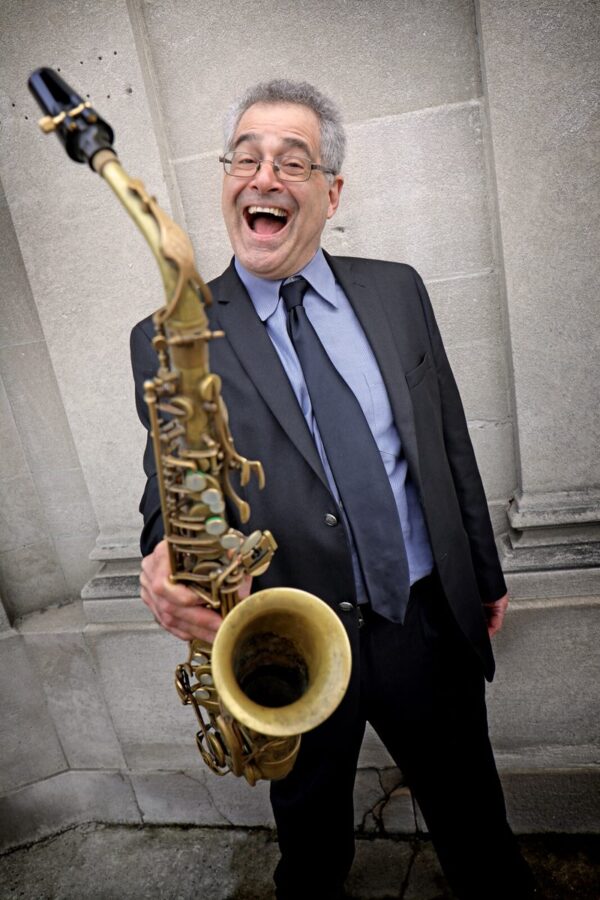 Ed Palermo is a New York-based arranger and alto saxophonist currently living in West Orange, NJ. The Ed Palermo Big Band has been together since 1980 and has been playing and honing the music of Frank Zappa (among other composers) for over 30 years, mainly in monthly performances at the Iridium nightclub in New York City and bimonthly concerts at The Falcon in Marlboro, NY.
Ed was recently listed as one of the top 40 “intriguing musicians to watch out for” by the online magazine, The Daily Beast and a recent album, “The Great Un- American Songbook”, was listed as one of the best albums of 2017 in Downbeat Magazine. His current release, “The Adventures of Zodd Zundgren-the Music of Frank Zappa and Todd Rundgren” is garnering rave reviews.
Ed Palermo arranged music for one of James Brown’s final concerts at the Hollywood Bowl in Los Angeles.
With the Ed Palermo Big Band, the key element is unpredictability. The audience never knows what to expect except pure unfiltered insanity and brilliance.